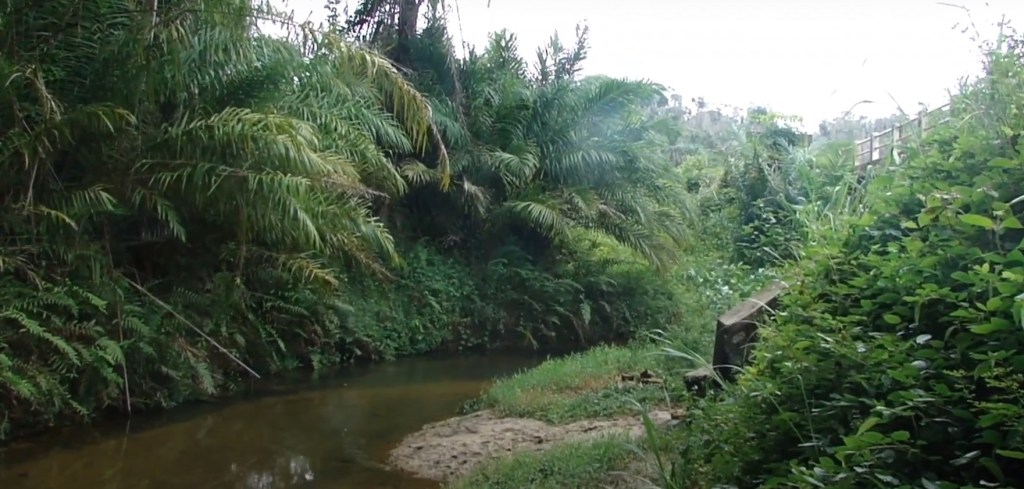
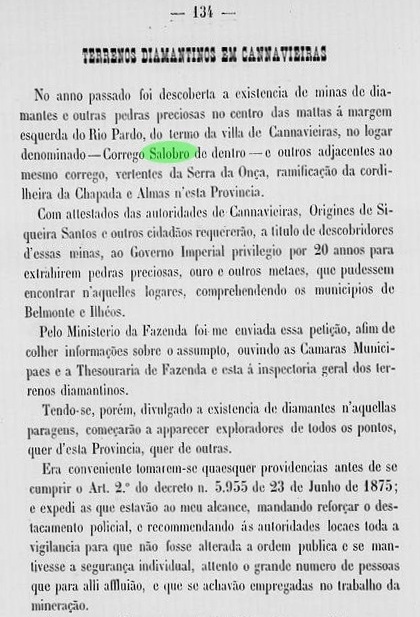
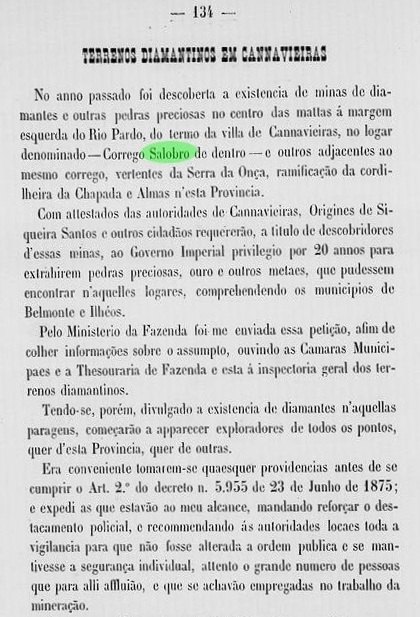
Salobro means brackish or muddy water. So was called a small brook in the municipality of Cannavieiras in southern Bahia, over 400 km away from the province capital Salvador, which remained completely unnoticed until the end of 1881. At that time miners discovered diamonds along the stream bed, and the following mining rush caused a disordered settlement that soon worried regional authorities:
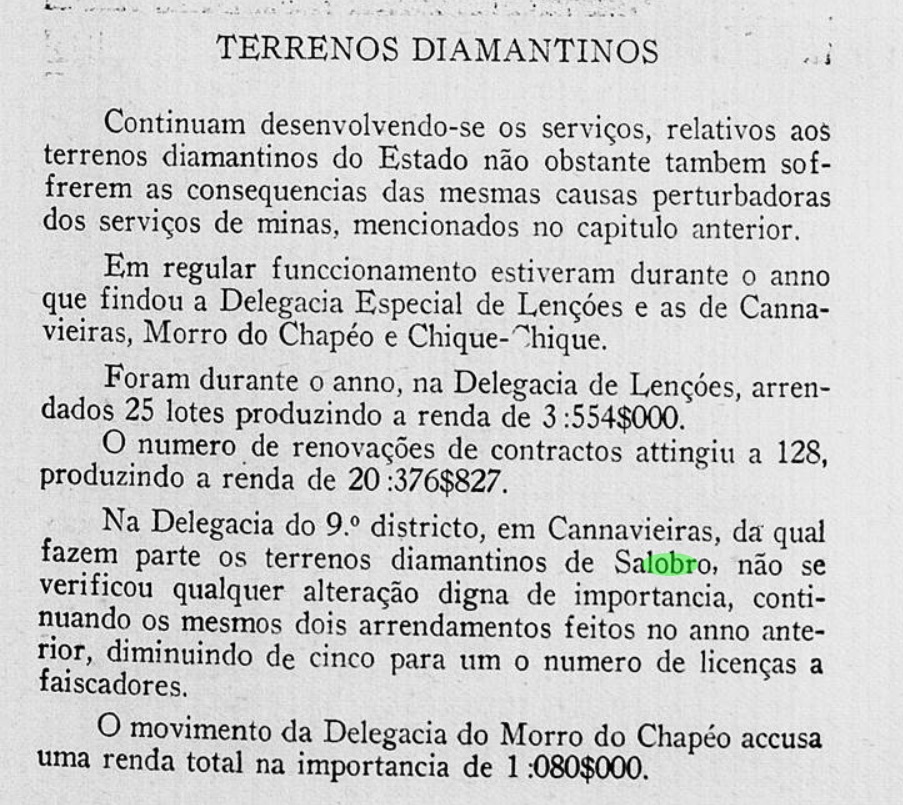
Through the mining boom Salobro was made a district of Cannavieiras in June 1886, but the diamond exploitation would come soon to an end, for the stone potential went exhausted within four decades. The last notice is dated 1922, when there was only one miner left who was officially registered on place:
The toponym Salobro (also written Saloubro) since then disappeared almost so fast as it had appeared. Apparently it is now the Betânia (or Nova Betânia) village, which since May 1985 belongs to the new municipality of Santa Luzia. Betânia is the only locality along the Salobro brook which is visible on maps today, and where small diamonds can still be found.
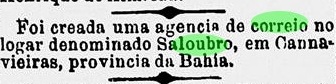
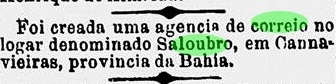
The local post office was created in July 1884, according to a press note from Rio de Janeiro:
The Imperial Mail Register (Tabella das Agencias do Correio do Imperio) of 1885 lists the agency erroneously as the Villa of Salubre (= Healthy Village):

The last postal press register is dated 1903, when the mail from Salvador to Salobro was still shipped twice in a month by the Companhia Bahiana steamers:

Two early post cancels are known. SBA-0640a (Coll. José A. Junges) has a double circle with the inscription SALOUBRO above and a star ornament below. The only known copy has the date March 2, 87 in the centre. SBA-0640b (Coll. José A. Junges) could be already republican, for the only exemplar is dated 1896: a double circle with the inscription SALOBRO above, with date in the centre.
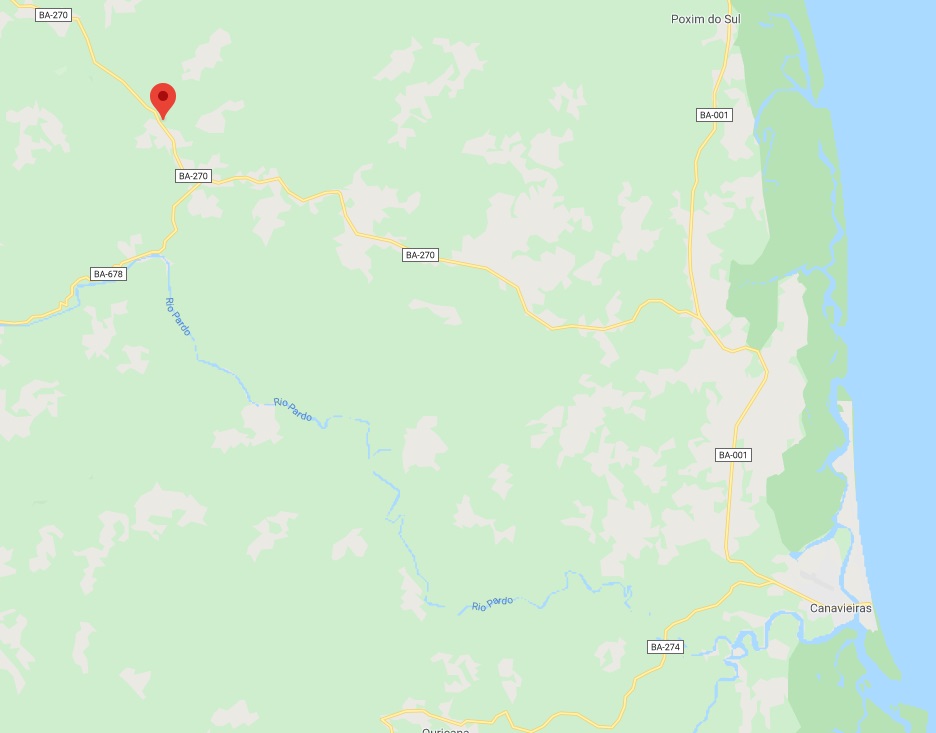
Salobro bedeutet Brack- oder schlammiges Wasser. So wurde ein Bach im Município von Cannavieiras im Süden Bahias genannt, der über 400 km von der Provinzhauptstadt Salvador entfernt und bis Ende 1881 völlig unbemerkt geblieben war. Dann haben Goldsucher Diamanten im Flussbett entdeckt, und die darauf folgende Zeit brachte eine rasche und unkontrollierte Besiedlung mit sich, die der regionalen Regierung Sorgen machte:
Durch den Diamanten-Abbau wurde Salobro bereits im Juni 1886 zum Distrikt Cannavieiras, aber das Edelstein-Potential wurde binnen 40 Jahren ausgeschöpft. In 1922 war nur ein einziger Diamantensucher übrig geblieben, der offiziell registriert war:

Der Ortsname Salobro (oder auch Saloubro) verschwand ebenfalls fast so schnell, wie er erschienen war. Scheinbar heißt er nun Betânia (oder Nova Betânia), ein Vorort des 1985 geründeten Município von Santa Luzia. Betânia ist heute der einzige Ort entlang des Salobro, den man auf Karten finden kann, und wo gelegentlich kleine Diamanten noch entdeckt werden.
Das örtliche Postamt entstand im Juli 1884, wie die Presse aus Rio de Janeiro berichtet:
Das Verzeichnis der kaiserlichen Postämter (Tabella das Agencias do Correio do Imperio) aus 1885 listet die Postagentur fälschlicherweise als Villa de Salubre (= Gesundes Dorf):

Die letzte postalische Presseeintragung ist 1903 datiert, als die Post von Salvador nach Salobro noch zweimal im Monat mit den Dampfern der Companhia Bahiana verschickt wurde:

Zwei frühe Postabstempelungen sind überliefert. SBA-0640a (Samml. José A. Junges) hat einen Doppelkreis mit der Inschrift SALOUBRO oben und einem sternförmigen Ornament unten. Das einziges Exemplar hat das Datum 2. März 87 in der Mitte. SBA-0640b (Samml. José A. Junges) könnte bereits republikanisch sein, da das einziges Exemplar 1896 datiert wurde: ein Doppelkreis mit der Inschrift SALOBRO oben, dazu Datum in der Mitte.

 Carimbologia