Text update of June 28, 2020
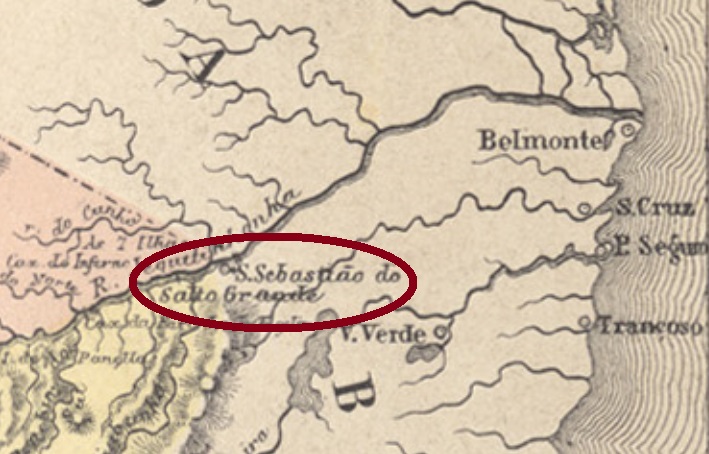
The district of São Sebastião do Salto Grande was founded in May 1870 at the south bank of the Jequitinhonha River in the municipality of Minas Novas do Arassuahy, over 800 km northeast of the province capital Ouro Preto. In October 1871 it passed to the municipality of São Miguel de Jequitinhonha, in January 1938, to the municipality of Vigia, and in December 1943 (under the new name of Salto da Divisa) to the municipality of Almenara. Since December 1948 it is the town and municipality of Salto da Divisa, which means Waterfall at the Border. The Jequitinhonha is a natural border between the actual states of Minas Gerais and Bahia.
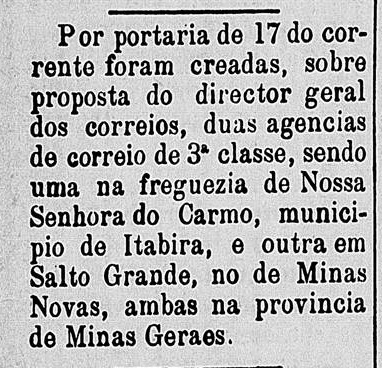
According to Paula Sobrinho (História Postal de Minas Gerais, Belo Horizonte, 1997), the post office was created in August 1881, which can be confirmed by the press:
Two early cancels are known: SMG-2690a (Coll. José A. Junges) has a double circle with the inscription SALTO GRANDE above and a diamond ornament below, which consists of four small diamonds. The sole exemplar is dated 1889. SMG-2690b (Coll. Márcio Protzner) has also a double circle with SALTO GRANDE above, but now one can read (MINAS) below. One exemplar found, dated 1897 in the centre.
Textaktualisierung vom 28. Juni 2020
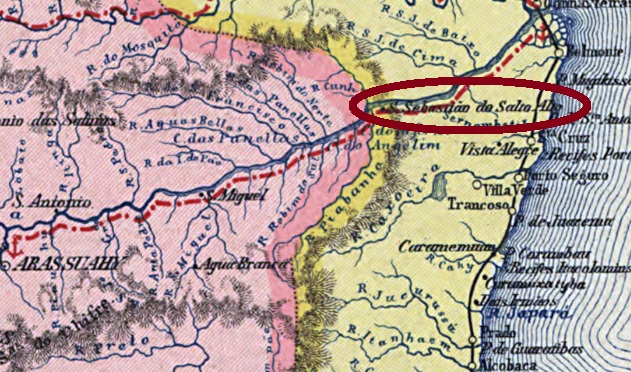
Der Distrikt von São Sebastião do Salto Grande wurde im Mai 1870 am Südufer des Flusses Jequitinhonha im Município von Minas Novas do Arassuahy und lag über 800 km nordöstlich der Provinzhauptstadt Ouro Preto entfernt. Im Oktober 1871 ging er zum Município von São Miguel de Jequitinhonha, im Januar 1938 zu Vigia, und im Dezember 1943 (unter dem neuen Ortsnamen Salto da Divisa) zum Município von Almenara. Seit Dezember 1948 heißt er Stadt und Município von Salto da Divisa (= Wasserfall at der Grenze). Der Jequitinhonha ist die Naturgrenze zwischen den heutigen Bundesstaaten Minas Gerais und Bahia.
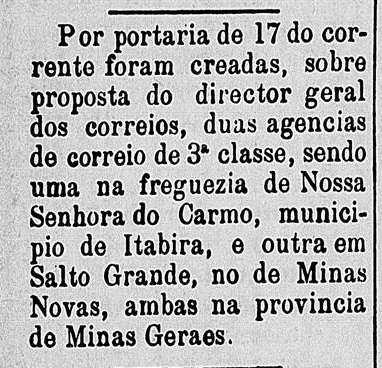
Laut Paula Sobrinho (História Postal de Minas Gerais, Belo Horizonte, 1997) wurde das Postamt im August 1881 gegründet, was durch die Presse bestätigt wird:
Zwei frühe Abstempelungen sind überliefert: SMG-2690a (Samml. José A. Junges) hat einen Doppelkreis mit der Inschrift SALTO GRANDE oben und einem Ornament in Rautenform unten, das aus vier kleinen Rauten besteht. Das einzige Exemplar trägt ein Datum aus dem Jahr 1889. SMG-2690b (Samml. Márcio Protzner) hat ebenfalls einen Doppelkreis mit SALTO GRANDE oben, aber nun liest man (MINAS) unten. Das bisher einzige Exemplar trägt Datum d.J. 1897 in der Mitte.

 Carimbologia