Print version update, on October 19, 2021
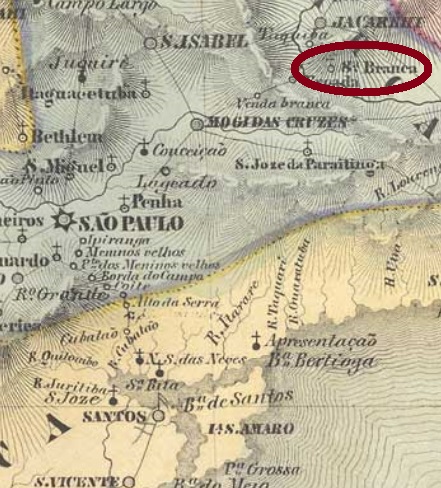
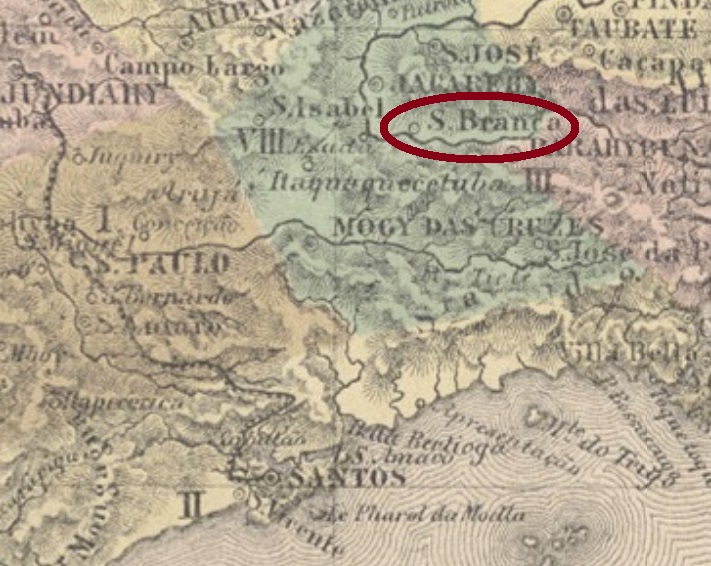
Santa Branca was since February 1841 a district of the municipality of Jacarehy, situated on the south bank of the Paraíba do Sul River, less than 100 km east of the province capital São Paulo. In March 1856 it ascended to a villa with own municipality.
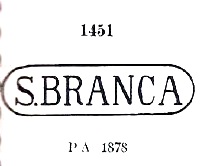
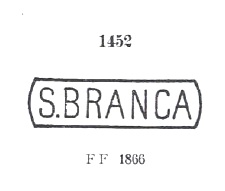
According to Nova Monteiro (Administrações e Agencias Postaes do Brasil Imperio, in Brasil Filatelico/RJ, 1934-5; Reprint SPP 1994-1999) the post office was created in August 1854. There is clearly a problem with the images of the earliest cancels from this village: Paulo Ayres (Catálogo de Carimbos Brasil- Império, S. Paulo, 1937, 1942) lists two of them under # 1451 and 1452. The first one was allegedly found from the 1878 emissions on (D. Pedro issue with white beard), the second from the 1866 emissions on (D. Pedro with black beard):
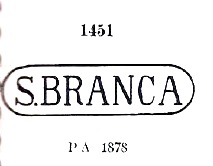
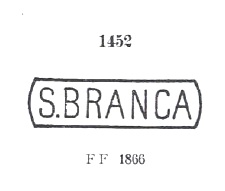
Indeed, the earliest examples found for this cancel were used already in the “numeral” issues (from 1850 on), and their images differ considerably from both Ayres’ examples. Here the best image found for SSP-1275a, which was found on stamps dated between 1854 and at least 1878 (image from Antonio Torres auctions):
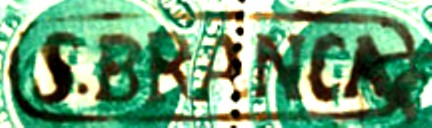
The letter S and the following dot are quite different from both Paulo Ayres versions, else than further variations in letters and frame. Since we haven’t seen any example confirming either # 1451 or 1452 by P. Ayres, we can’t consider these images yet.
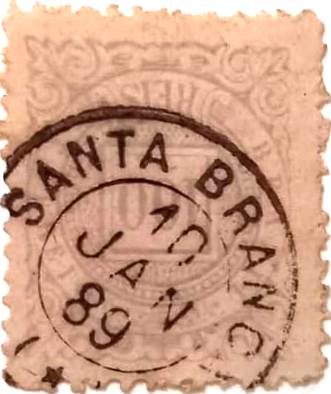
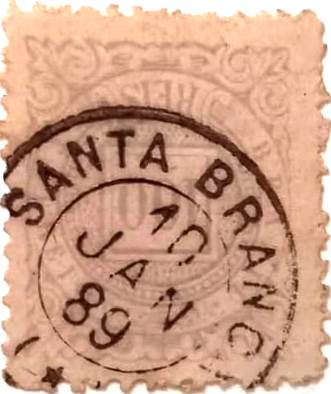
A second imperial cancel from Santa Branca, SSP-1275b (coll. José A. Junges), was found on pieces dated between 1882 and 1891. There is here a double circle with the inscription SANTA BRANCA above and the date in the centre. From the Fuad Ferreira Fo. collection comes a third cancel from there: SSP-1275c is a French type, which is reproduced here since it does not appear in Carimbologia S1:
Aktualisierung der Printausgabe am 19. Oktober 2021
Santa Branca war seit Februar 1841 ein Distrikt des Município von Jacarehy, der am Südufer des Flusses Paraíba do Sul, unter 100km östlich der Provinzhauptstadt São Paulo entfernt lag. Im März 1856 wurde daraus eine Villa im eigenen Município.
Laut Nova Monteiro (Administrações e Agencias Postaes do Brasil Imperio, in Brasil Filatelico/RJ, 1934-5; Reprint SPP 1994-1999) entstand das örtliche Postamt im August 1854. Es gibt allerdings ein Problem mit den ersten Stempeln dieser Ortschaft: Paulo Ayres (Catálogo de Carimbos Brasil-Império, S. Paulo, 1937, 1942) listet zwei davon unter den Nummern 1451 und 1452. Der erste wurde angeblich ab den Dom Pedro Ausgaben von 1878 (mit weißem Bart) gefunden, während Nr. 1452 ab den D. Pedro-Ausgaben v. 1866 (mit schwarzem Bart) einzutreffen ist:
Tatsächlich wurden die frühen Beispiele dieses Stempels bereits ab den Numeral-Ausgaben (den so genannten Katzenaugen) gebraucht, und ihre Abbildungen weisen erhebliche Unterschiede gegenüber Ayres’ Beispielen auf. Hier die bisher deutlichste Abbildung von SSP-1275a , anzutreffen zwischen 1854 und mindestens 1878 (Abb. Alberto Torres Auktionen).
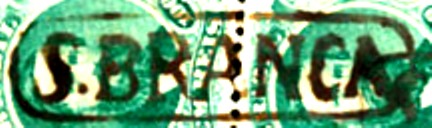
Die Buchstabe S und der darauf folgende Punkt sind deutlich anders, als von Ayres angegeben, abgesehen von weiteren Abweichungen in Buchstaben und Rahmen. So lange keine passenden Beispiele von Ayres Nr. 1451 oder 1452 auftauchen, bleiben beide Stempel fürs Erste außen vor.
Ein zweiter Santa Branca-Stempel aus der Kaiserzeit, SSP-1275b (Samml. José A. Junges) wurde auf Marken mit Daten zwischen 1882 und 1891 gefunden. Hier haben wir deinen Doppelkreis mit der Inschrift SANTA BRANCA oben und dem Datum in der Mitte. Aus der Sammlung Fuad Ferreira Fo. stammt ein dritter Stempel von dort: SSP-1275c ist ein französischer Typ, der hier abgebildet ist, da er nicht in Carimbologia S1 erschienen ist:

 Carimbologia