Text update of July 27, 2020
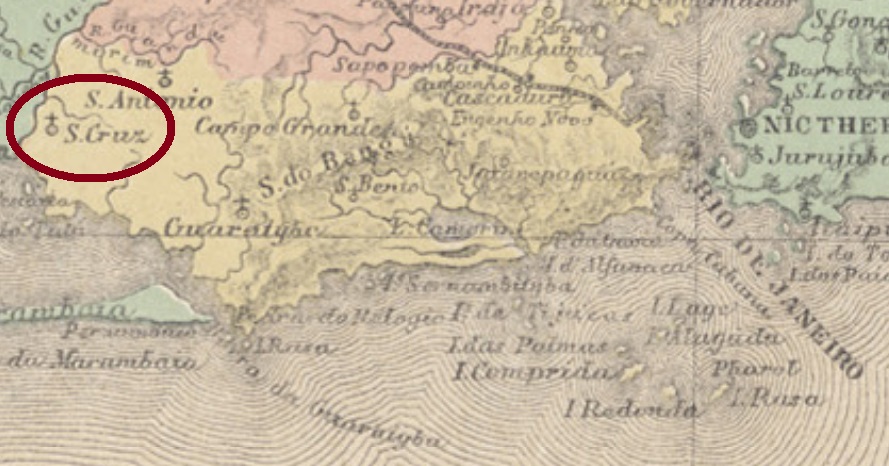
A curato in Portuguese is a settlement provided with an own priest (cura) for its church. The Curato Imperial de Santa Cruz was created in 1833 and has its origins in the royal palace installed for D. João VI after the arrival of the Portuguese court in Rio de Janeiro in 1808. Since 1889 is Santa Cruz a suburb situated over 60 kw west of the capital.
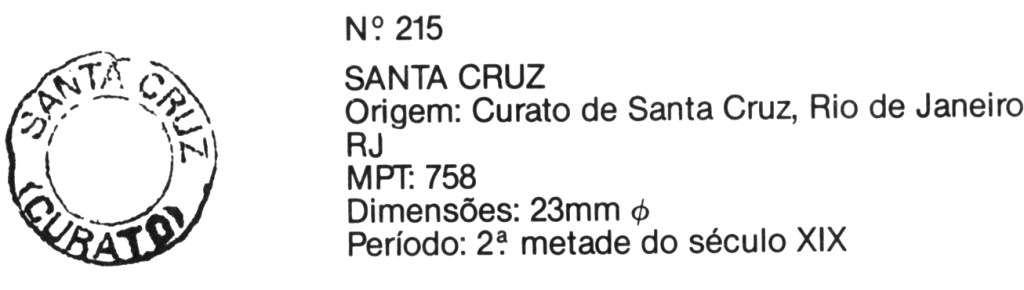
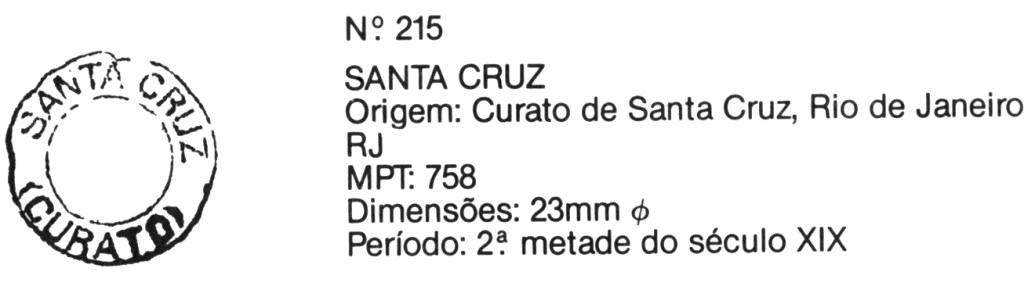
According to Nova Monteiro (Administrações e Agencias Postaes do Brasil Imperio, in Brasil Filatelico/RJ, 1934-5; Reprint SPP 1994-1999), the post office was created in November 1842. Considering that the imperial cancel SMN-0010c (Coll. José A. Junges) was applied without date on a stamp issued in 1866, there must be earlier examples to discover. This one has a double circle, of which the external one is often damaged between the words SANTA and CRUZ above, else than (CURATO) below, with dates until 1899 in the centre:
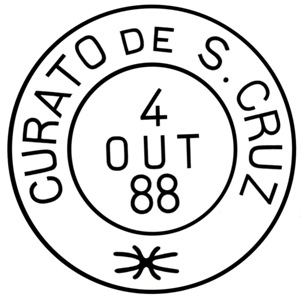
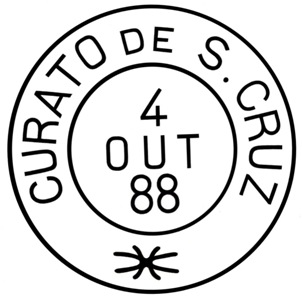
One of the possible predecessors can be SMN-0010b (Coll. Fuad Ferreira Filho): A double circle with the inscription CURATO DE S. CRUZ above and a not quite legible ornament below. Fortunately, a reconstruction of the sole known copy of 1888 was made possible by Claudio Coelho:
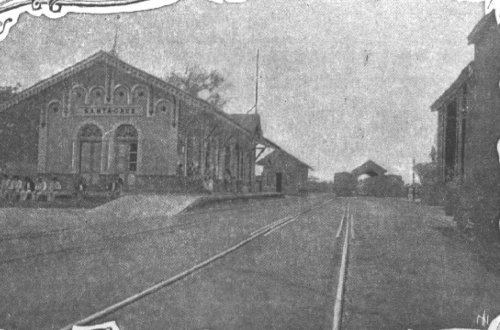
The curato train station was inaugurated on December 2, 1878 by the Estrada de Ferro D. Pedro II railway, as a final line destination. In 1911, the line went until Itaguahy, and in 1914, until Mangaratiba. After the end of the Empire, the rail line passed to the Estrada de Ferro Central do Brasil, and in 1975, to the Rede Ferroviária Federal SA. Since 1997 the line belongs to Supervia (estacoesferroviarias.com.br).
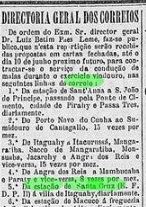
Probably the curato post office was transferred to the train station within the period 1878-1883, for from this year on there was a courier line between the station and Itaguahy:
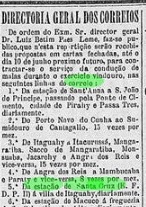
As long as no train station postal cancels appear, we can assume that the curato cancels were used in the station after the relocation.
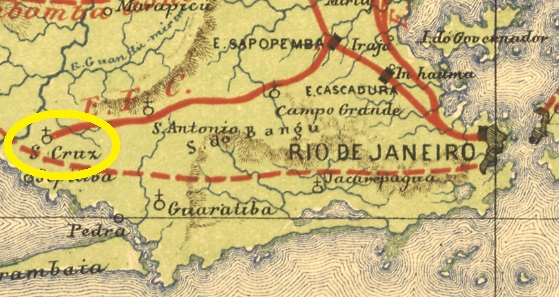
Textaktualisierung vom 27. Juli 2020
Ein Curato auf portugiesisch ist eine Siedlung, die über einen eigenen Pfarrer (Cura) für die Ortskirche verfügt. Der Curato Imperial de Santa Cruz wurde 1833 gegründet, hat aber seinen Ursprung im königlichen Palast für D. João VI, der hastig nach der Ankunft des portugiesischen Hofs 1808 aus einer großen Fazenda hergerichtet wurde. Seit 1889 ist Santa Cruz ein über 60 km entfernter Stadtteil im Westen von Rio de Janeiro.
Laut Nova Monteiro (Administrações e Agencias Postaes do Brasil Imperio, in Brasil Filatelico/RJ, 1934-5; Reprint SPP 1994-1999), wurde das örtliche Postamt im November 1842 eingeweiht. Da der Stempel aus dem Kaiserreich SMN-0010c (Samml. José A. Junges) ohne Datum auf einer Marke zu sehen ist, die erst 1866 ausgegeben wurde, warten bestimmt noch frühere Stempel auf ihre Entdeckung. Dieser hat einen Doppelkreis, wovon der äußere oft einen Bruch zwischen den Worten SANTA und CRUZ oben aufweist. Unten liest man (CURATO), und die Daten (bis 1899) sind in der Mitte:
Ein möglicher Vorgänger wäre SMN-0010b (Samml. Fuad Ferreira Filho): ein Doppelkreis mit der Inschrift CURATO DE S. CRUZ oben und einer nicht ganz lesbaren Verzierung unten. Eine Rekonstruktion des bisher einzigen Exemplars dieses Stempels (aus 1888) wurde freundlicherweise durch Claudio Coelho ermöglicht:
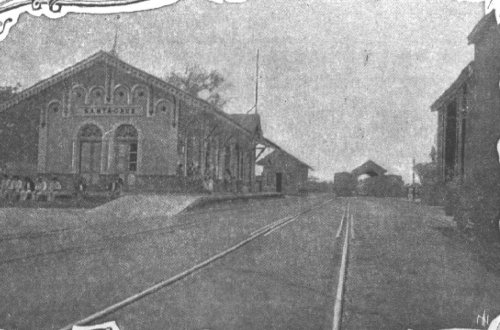
Der Curato-Bahnhof wurde am 2 Dezember 1878 durch die Estrada de Ferro D. Pedro II als Endstation engeweiht. Die Linie wurde noch zweimal verlängert: 1911 nach Itahguahy und 1914 nach Mangaratiba. Nach dem Ende des Kaiserreichs ging die Bahnlinie zur Estrada de Ferro Central do Brasil, und 1975, zur Rede Ferroviária Federal SA. Seit 1997 gehört die Bahnstrecke der Supervia (estacoesferroviarias.com.br).
Wahrscheinlich zog das Curato-Postamt zum Bahnhof irgendwann zwischen 1878 und 1883 um, den im letztgenannten Jahr wurde ein Post-Staffetendienst zwischen dem Curato-Bahnhof und Itaguahy eingeführt:
So lange keine neuen Bahnhofsstempel auftauchen, können wir annehmen, dass die alten Curato-Stempel auch nach dem Umzug zum Bahnhof gebraucht wurden.

 Carimbologia