Other names: Sant’Anna de Japuíba, Santana, Japuíba
See also Sant’Anna da Santíssima Trindade (SRJ-0860)
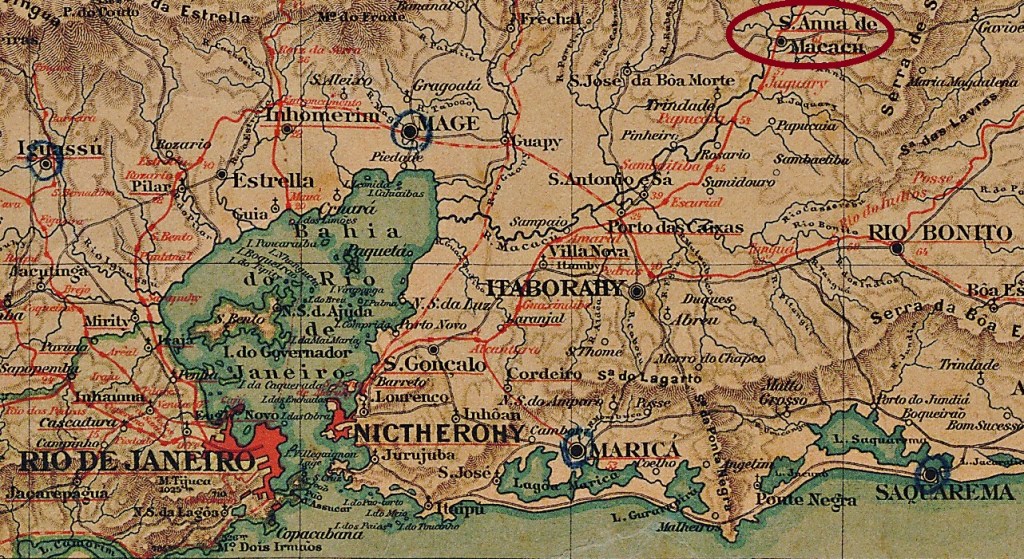
The Arraial of Sant’Anna da Santissima Trindade (= of the Holiest Trinity) was founded in November 1868 on the east bank of the Macacu River, round 100 km northeast of the imperial capital Rio de Janeiro, and belonged to the now extinguished Villa of Santo Antonio de Sá. In September 1877 it ascended to a Villa under the name of Santa’Anna de Macacu, which changed the toponym to Sant’Anna de Japuíba in December 1898. It received even the town status in December 1929, but apparently has not improved significantly since then, for it was degraded to the district of Santana in the municipality of Cachoeiras in December 1938. Five years later it was renamed Japuíba, and Cachoeiras became Cachoeiras de Macacu.
According to Paulo Novaes (agenciaspostais.com.br), the local post office was created ca. 1861 and operated until March 1899. Since the first cancel does not mention the Macacu River, it will be presented while discussing Sant’Anna da Santíssima Trindade (SRJ-0860).
Four later 19-century post cancels were found, all of them have double circles. SRJ-1530a (Coll. José A. Junges) shows simply S. A. DE MACACÚ, and the dates inside were found between 1877 and 1884. Sometimes the year indication is missing. SRJ-1530b (Coll. José A. Junges) presents STA. ANNA DE MACACÚ above and a diamond ornament below, whoich consists of four small diamonds. Dates from 1885 to 1887 inside. SRJ-1530c (Coll. Dieter Kerkhoff) was found with dates within the period 1888-1889 and has the legend S. ANNA DE MACACÚ above and a double XX below forming a cross at a central black point. Consequently, it differs considerably from the image provided by Paulo Ayres on page 125 of his Catálogo de Carimbos Brasil-Império, (S. Paulo, 1937, 1942):
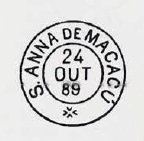
The last cancel, SRJ-1530d (Coll. Karlheinz Wittig), can be already republican, for it shows dates from 1890 to 1891: the inscription above is now SA. ANNA DE MACACÚ, and the ornament below is cross-like.
Andere Namen: Sant’Anna de Japuíba, Santana, Japuíba
Siehe auch Sant’Anna da Santíssima Trindade (SRJ-0860)
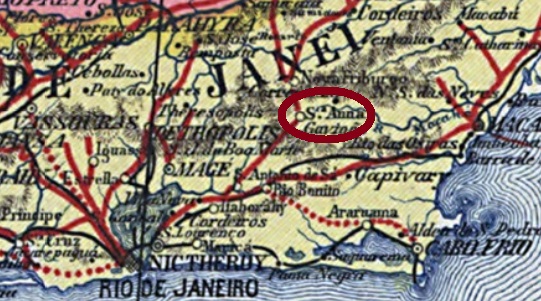
Der Arraial (Dorf) von Sant’Anna da Santissima Trindade (= der Heiligsten Dreifaltigkeit) wurde im November 1868 am Ostufer des Flusses Macacu gegründet, lag rund 100 km nordöstlich der kaiserlichen Hauptstadt Rio de Janeiro entfernt und gehörte der inzwischen ausgelöschten Villa von Santo Antonio de Sá. Im September 1877 stieg er zur Villa auf, mit dem Namen Santa’Anna de Macacu, der allerdings im Dezember 1898 zu Sant’Anna de Japuíba wechselte. Er wurde im Dezember 1929 sogar eine Stadt, die allerdings nicht besonders gut gedeihte: schon im Dezember 1938 wurde sie zum Distrikt von Santana im Município von Cachoeiras degradiert. Fünf Jahre später kehrte der Ortsname Japuíba zurück, während aus Cachoeiras Cachoeiras de Macacu wurde.
Laut Paulo Novaes (agenciaspostais.com.br) entstand das örtliche Postamt ca. 1861 und blieb bis März 1899 in Betrieb. Da aber der erste Stempel den Macacu-Fluss gar nicht erwähnt, wird er bei Sant’Anna da Santíssima Trindade (SRJ-0860) vorgestellt.
Vier spätere Poststempel wurden auffindbar, die alle Doppelkreise haben. SRJ-1530a (Samml. José A. Junges) zeigt einfach S. A. DE MACACÚ, und die Daten in der Mitte wurden für den Zeitraum 1877-1884 gefunden. Manchmal fehlt die Jahresangabe. SRJ-1530b (Samml. José A. Junges) hat STA. ANNA DE MACACÚ oben und einen rautenförmigen Ornament unten, das aus vier kleinen Rauten besteht. Daten im Inneren zwischen 1885 und 1887. SRJ-1530c (Samml. Dieter Kerkhoff) wurde bisher mit Daten von 1888-1889 gesehen und hat die Legende S. ANNA DE MACACÚ oben und zwei XX unten, die sich kreuzweise schneiden an einem schwarzen Punkt in der Mitte. Dieser Stempel weicht also deutlich vom Bild ab, das Paulo Ayres auf S. 125 seines Catálogo de Carimbos Brasil-Império, (S. Paulo, 1937, 1942) veröffentlicht hat:
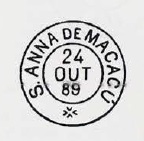
Der letzte Stempel, SRJ-1530d (Samml. Karlheinz Wittig), kann bereits republikanisch sein, denn seine Daten wurden bisher für 1890 und 1891 gefunden: die Inschrift oben lautet nun SA. ANNA DE MACACÚ, das Ornament unten ist in Kreuzform.

 Carimbologia