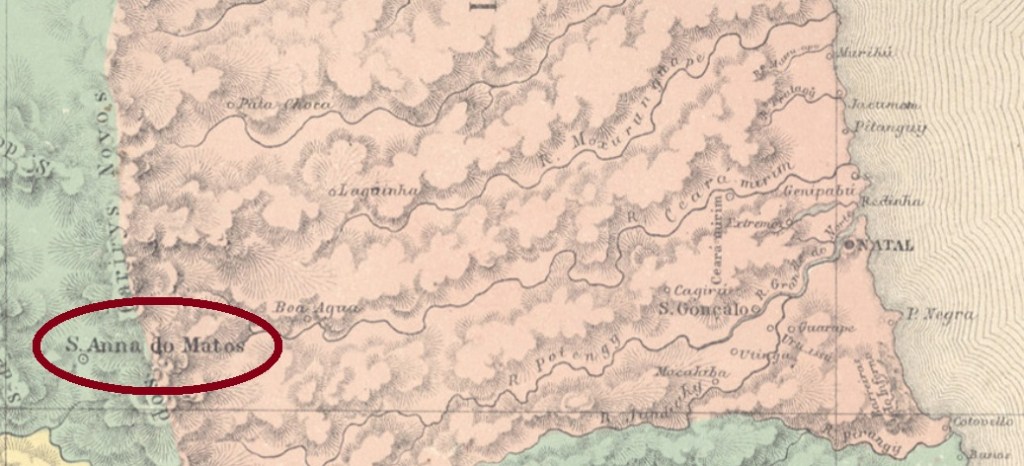
This toponym rises a question about its correct writing: is it DO, DE or DOS Mattos? All three variants occur abundantly, sometimes even mixed together in the same publication. We decided to write DO Mattos, for it is both the first official name and the actual version, as long as the postal cancels – whenever they may appear – don’t have another spelling.
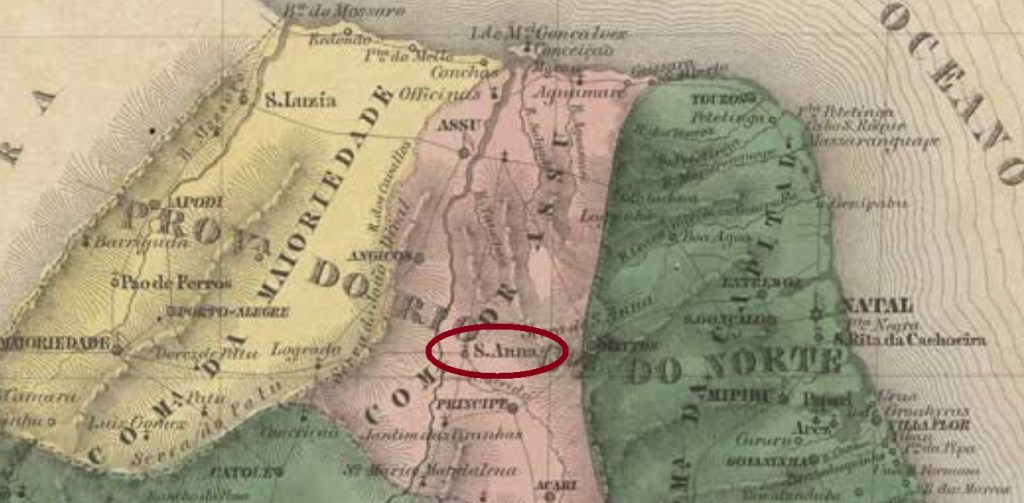
According to the Brazilian Institute for Geography and Statistics (IBGE), the locality has originated from the farm Bom Bocadinho (=Delicious Little Piece), whose owner Manoel José de Mattos had decided to build a chapel in honor to the Holy Anna, and was situated in the municipality of Assú, over 200 km west of the provincial capital Natal. Still in colonial times, in August 1821, it was made a district, which ascended to a Villa in October 1836. Between 1853 and 1855 it was degraded again to a district, before recovering the villa status. Since October 1927 it is the town and municipality of Santana do Matos.
There are two dates for the creation of the local post office, which means that the agency was closed at least once. Nova Monteiro (Administrações e Agencias Postaes do Brasil Imperio, in Brasil Filatelico/RJ, 1934-5; Reprint SPP 1994-1999) asserts it took place in September 1846, whereas the Imperial Mail Register (Tabella das Agencias do Correio do Imperio) of 1885 lists the office from 1874 on. No postmark from the empire has appeared until now.
Über den Ortsnamen stellt sich gleich die Frage: ist es DO, DE oder DOS Mattos? Alle drei Varianten kommen oft vor, manchmal sogar gemeinsam in derselben Veröffentlichung. Wir entschieden uns für DO Mattos, da diese Schreibweise sowohl die erste offizielle als auch die aktuelle ist, so lange die Poststempel der Kaiserzeit – wenn sie mal zu sehen sein werden – keine andere Alternative erzwingen.
Laut dem Brasilianischen Institut für Geografie und Statistik (IBGE) hat diese Ortschaft ihren Ursprung im Großgrundbesitz Bom Bocadinho (=Leckeres Stückchen), dessen Eigentümer Manoel José de Mattos eine Kapelle für die Heilige Anna bauen ließ, und lag in der Gemarkung Assú, über 200 km westlich der Provinzhauptstadt Natal entfernt. Noch in der Kolonie-Zeit, im August 1821, wurde daraus ein Distrikt, der im Oktober 1836 zur Villa aufstieg. Zwischen 1853 und 1855 wurde der Ort wieder zum Distrikt herabgesetzt, bevor der Villa-Status zurück kehrte. Seit Oktober 1927 ist es die Stadt und Município von Santana do Matos.
Es gibt zwei Entstehungsdaten für das örtliche Postamt, ein sicherer Hinweis dafür, dass es mindestens einmal geschlossen wurde. Nova Monteiro (Administrações e Agencias Postaes do Brasil Imperio, in Brasil Filatelico/RJ, 1934-5; Reprint SPP 1994-1999) behauptet, es fand im September 1846 statt, während das Verzeichnis der kaiserlichen Postämter (Tabella das Agencias do Correio do Imperio) von 1885 die Agentur ab 1874 auflistet. Kein Poststempel der Kaiserzeit ist bisher aufgetaucht.

 Carimbologia