Other names: Santo André (1923), Catuni (1943)
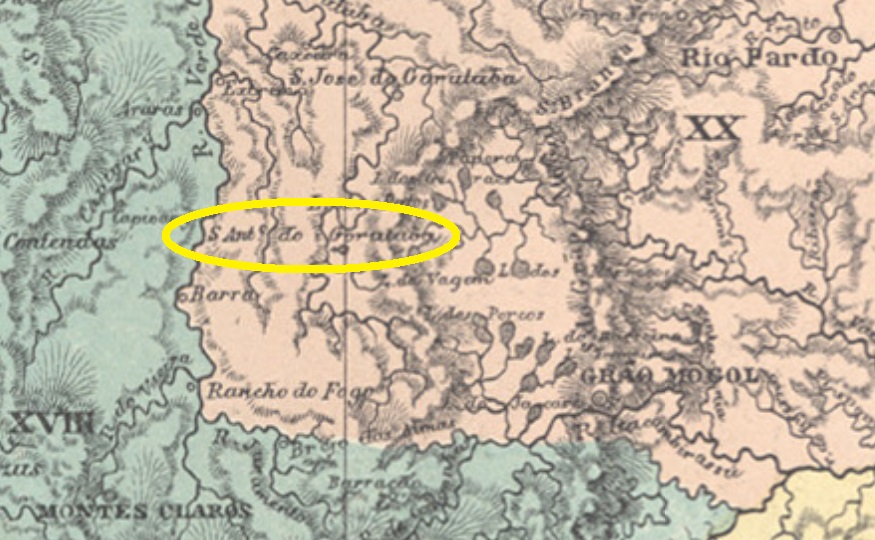
Santo Antonio do Gorutuba was since December 1874 a freguesia in the municipality of Grão-Mogol, situated on the west bank of the Gorutuba (plenty of stones, in tupi guarani) River, over 600 km north of the province capital Ouro Preto. In September 1923 the toponym changed to Santo André, and in December 1943, to Catuni, which allegedly means good water in the indian language. Catuni is since February 1964 a district of the municipality of Francisco Sá.
According to Paula Sobrinho (História Postal de Minas Gerais, Belo Horizonte, 1997), the local post office was created in April 1885. Only one cancel from the Empire was seen, whose left side is unfortunately missing. SMG-2030a (Coll. José A. Junges) has a double circle with the inscriptions (S.A. DO) GORUTUBA above and (MINAS) below. The date at the centre of the sole exmaple shows the year 1888.
Andere Namen: Santo André (1923), Catuni (1943)
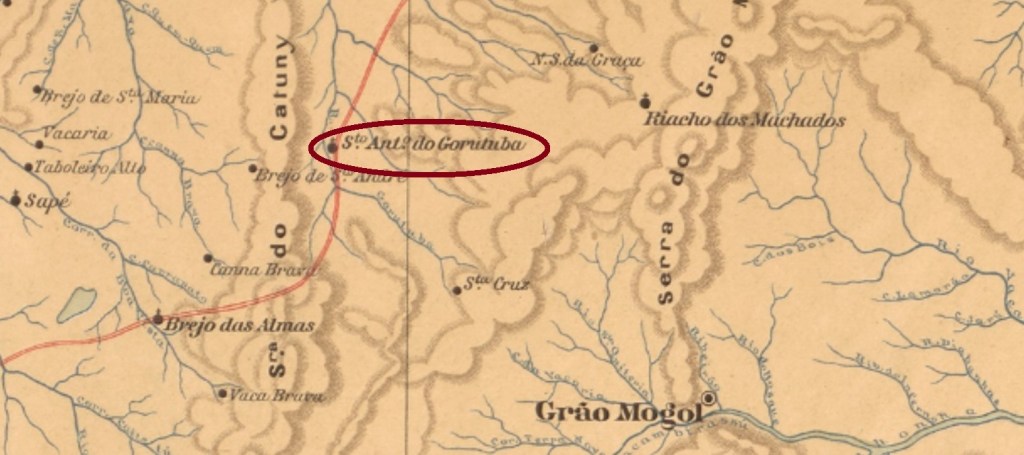
Santo Antonio do Gorutuba war ab Dezember 1874 eine Freguesia im Município von Grão-Mogol, die am Westufer des Flusses Gorutuba (viele Steine, auf Tupi-guarani) lag, über 600 km nördlich der Provinzhauptstadt Ouro Preto entfernt. Im September 1923 änderte sich der Ortsname zu Santo André, und im Dezember 1943 zu Catuni, d.h. angeblich Gutes Gewässer in der Indianersprache. Catuni ist seit Februar 1964 ein Distrikt im Município von Francisco Sá.
Wie Paula Sobrinho (História Postal de Minas Gerais, Belo Horizonte, 1997) berichtet, gibt es dort ein Postamt seit April 1885. Nur ein Stempel des Kaiserreichs wurde gefunden, dessen linke Seite leider nicht zu sehen ist. SMG-2030a (Samml. José A. Junges) hat einen Doppelkreis mit den Inschriften (S.A. DO) GORUTUBA oben und (MINAS) unten. Das Datum in der Mitte des einzigen Exemplars zeigt das Jahr 1888.

 Carimbologia