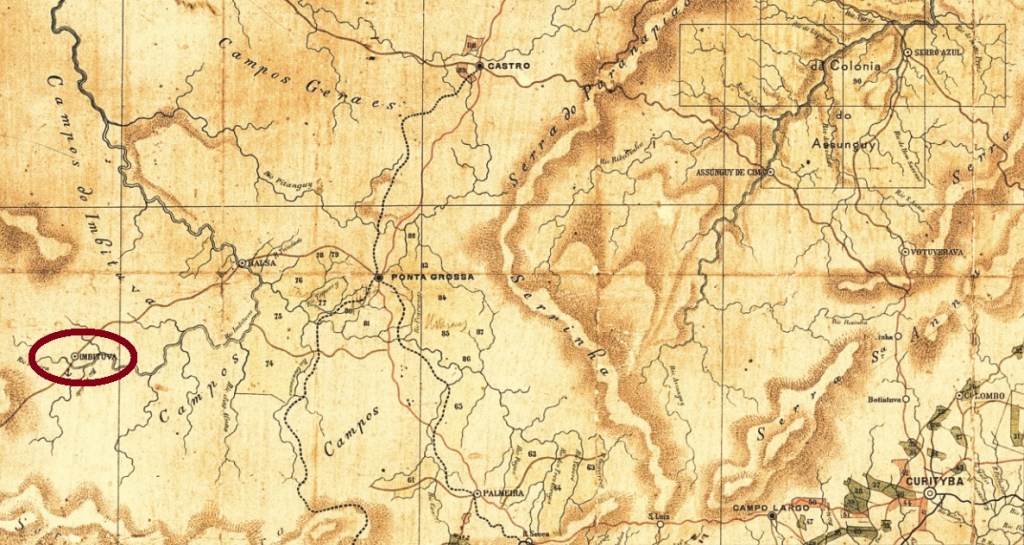
Other names: Campo do Cupim, Imbituva (1929)
See also Cupim (R. Koster: Carimbologia XV)
Santo Antonio de Imbituva was since March 1881 a villa in the Paraná province, situated 170 km west of the capital Curitiba. According to the Brazilian Institute of Geography and Statistics (IBGE), the freguesia had been founded in February 1876 under the name of Cupim (portuguese for termite) in the municipality of Ponta Grossa, after the settlement Campo do Cupim (=termite field), which was quite an important stop on the cattle trail from South Brazil to Sorocaba. In April 1910 the local was declared a town, which simplified the name to Imbituva in April 1929.
TheImperial Mail Register (Tabella das Agencias do Correio do Imperio) of 1885 lists this post office still under the toponym Cupim, as created in 1874. This means there was a postal agency there before the freguesia was founded. No cancel under Santo Antonio de Imbituva was seen until now. For cancels featuring Cupim see Koester (Carimbologia XV).
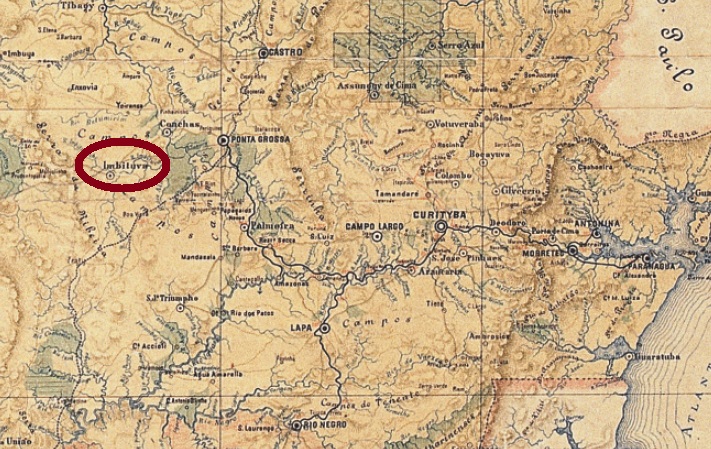
Andere Namen: Campo do Cupim, Imbituva (1929)
Siehe auch Cupim (R. Koster: Carimbologia XV)
Santo Antonio de Imbituva war ab März 1881 eine Villa in der Provinz Paraná, die 170 km westlich der Hauptstadt Curitiba lag. Laut dem brasilianischen Institut für Geografie and Statistik (IBGE) wurde die Freguesia im Februar 1876 unter dem Ortsnamen Cupim (portugiesisch für Termite) im Município von Ponta Grossa gegründet, nach der Siedlung Campo do Cupim (=Termitenfeld), einer wichtigen Haltestelle auf dem Viehtransportweg vom Süden Brasiliens nach Sorocaba. Im April 1910 stieg der Ort zur Stadt auf, die seit April 1929 den vereinfachten Namen Imbituva trägt.
Das Verzeichnis der kaiserlichen Postämter (Tabella das Agencias do Correio do Imperio) von 1885 listet dieses Amt immer noch unter dem Ortsnamen Cupim auf, mit Gründungsdatum 1874. Also gab es dort ein Postamt noch bevor die Freguesia errichtet wurde. Kein Stempel mit der Legende Santo Antonio de Imbituva wurde bisher gesichtet. Für Abstempelungen mit Cupim siehe Koester (Carimbologia XV).

 Carimbologia