Another name: Granada (1943)
See also Matipóo (RK: Carimbologia XXVII)
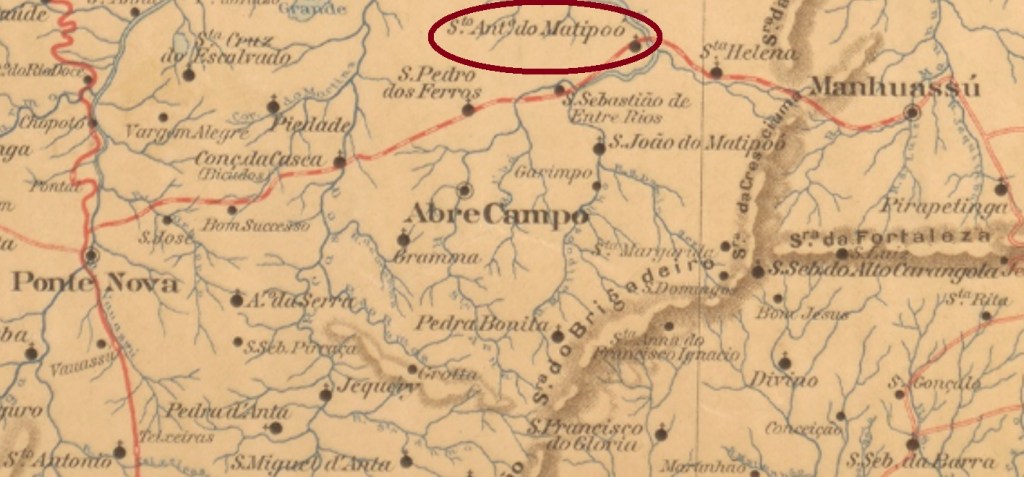
The name Matipoó derives from the tupi-guarani and supposedly means bursting maize. The small river Matipó (barely 150 km long) is an affluent to the Rio Doce, which in January 1880 gave the name to the parish of Santo Antonio on its the south bank, situated over 150 km east of the provincial capital Ouro Preto. It has belonged from then on to the municipality of Abre Campo (“Open the Field”) and since December 1943 the district is called Granada.
According to Paula Sobrinho (História Postal de Minas Gerais, Belo Horizonte, 1997), the local post office was created in July 1882. One imperial cancel was found: SMG-2970a (Coll. José A. Junges) has a double circle with the inscriptions S. ANT. DO MATIPOÓ above and (MINAS) below. Dates at the centre from 1889 until 1894.
Anderer Name: Granada (1943)
Siehe also Matipóo (RK: Carimbologia XXVII)
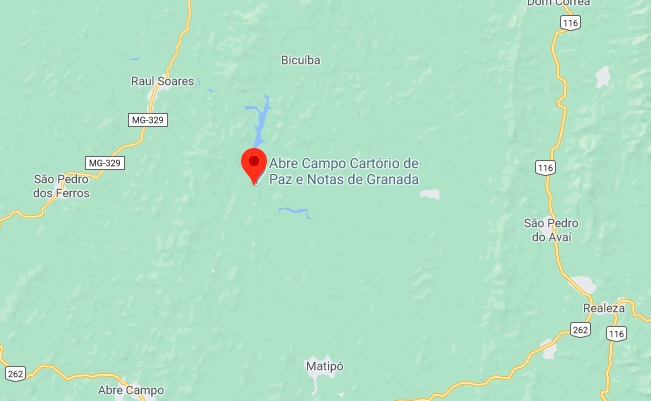
Der Name Matipoó hat einen Tupi-guarani-Ursprung und bedeutet angeblich platzender Mais. Vielleicht krachte der kleiner Fluss Matipó (knapp 150 km lang) Matipó wie platzende Maiskörner, bevor er in den Rio Doce mündete. Nach dem Matipó wurde die Pfarrei in Ehren von Santo Antonio im Januar 1880 gegründet. Diese lag am Südufer, über 150 km östlich der Provinzhauptstadt Ouro Preto entfernt. Die Pfarrei gehörte dem Município von Abre Campo (“Öffne das Feld”), und seit Dezember 1943 trägt der Distrikt den Namen Granada.
Laut Paula Sobrinho (História Postal de Minas Gerais, Belo Horizonte, 1997) gibt es dort ein Postamt seit Juli 1882. Ein Stempel der Kaiserzeit ist bekannt: SMG-2970a (Samml. José A. Junges) hat einen Doppelkreis mit den Inschriften S. ANT. DO MATIPOÓ oben und (MINAS) unten. Daten in der Mitte von 1889 bis 1894.

 Carimbologia