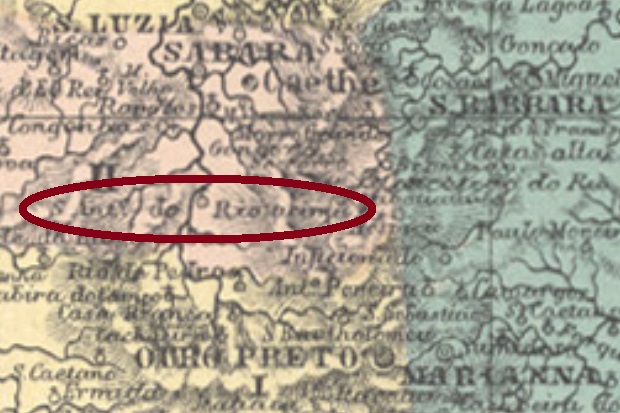
Another name: Rio Acima (1923)
Santo Antonio do Rio Acima (= of the Upper Course) was since April 1839 a district in the municipality of Sabará, situated ca. 70 km northwest of the provincial capital Ouro Preto. Oddly enough, the river hier is not the Santo Antonio – as in Santo Antonio do Rio Abaixo (SMG-3045) – but the legendary Rio das Velhas, an affluent to the São Francisco which flows through most prominent regions in imperial Minas Gerais. The locality went in February 1891 to Nova Lima and got the name simplified as Rio Acima in September 1923. It became emancipated in December 1948 as the municipality of Rio Acima.
According to Paula Sobrinho (História Postal de Minas Gerais, Belo Horizonte, 1997), the local post office was created in February 1880, but closed in November 1932. One early cancel has been found, whose dates, however, are already republican until now: SMG-3050a (Coll. Márcio Protzner) has a double circle with the inscription S. ANTONIO DO RIO ACIMA above and a diamond ornament below, formed by four small diamonds. Dates at the centre, between 1895 and 1898.
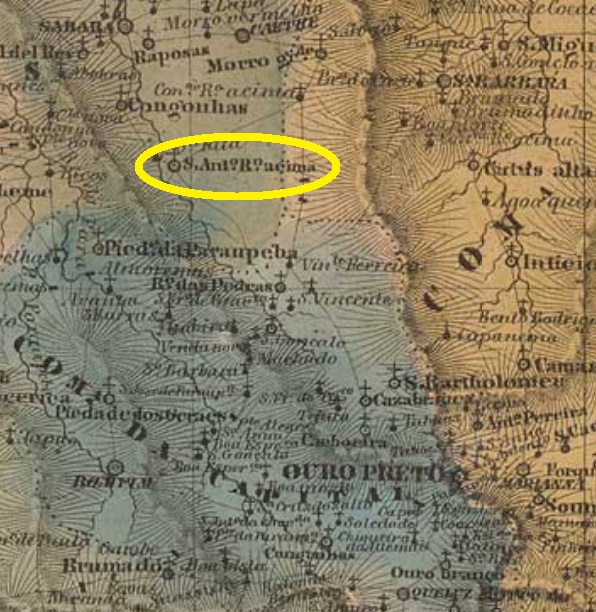
Anderer name: Rio Acima (1923)
Santo Antonio do Rio Acima (= am Oberlauf) war ab April 1839 ein Distrikt im Município von Sabará, der ca. 70 km nordwestlich der Provinzhauptstadt Ouro Preto entfernt lag. Merkwürdigerweise ist der Fluss hier nicht der Santo Antonio – wie bei Santo Antonio do Rio Abaixo (SMG-3045) – sondern der legendäre Rio das Velhas, ein Zufluss des São Francisco, der durch wichtigste Regionen im kaiserlichen Minas Gerais fließt. Die Ortschaft ging im Februar 1891 zu Nova Lima über und bekam den vereinfachten Namen Rio Acima im September 1923. Im December 1948 kam dann die politische Emanzipation, als der Município von Rio Acima gegründet wurde.
Laut Paula Sobrinho (História Postal de Minas Gerais, Belo Horizonte, 1997) entstand das örtliche Postamt im Februar 1880, schloss aber im November 1932 wieder. Ein früher Stempel war zu finden, dessen bisherigen Daten dennoch aus der Republik entstammen: SMG-3050a (Samml. Márcio Protzner) hat einen Doppelkreis mit der Inschrift S. ANTONIO DO RIO ACIMA oben und einem rautenförmigen Ornament unten, das aus vier kleinen Rauten besteht. Die Daten in der Mitte gehen von 1895 bis 1898.

 Carimbologia