Another name: Sambaetiba (1910)
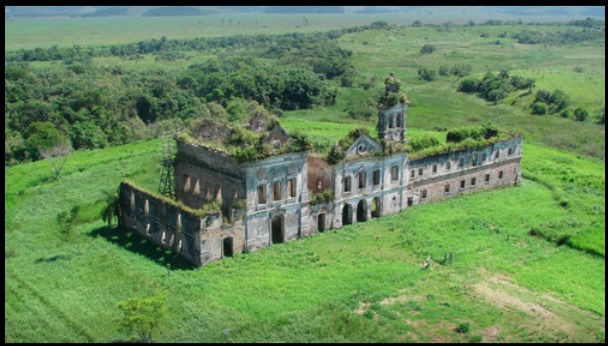
This location won’t be found on any actual map, because the villa does not exist anymore since 1875. The former freguesia of Santo Antonio do Caceribu was created as early as February 1647 near Itaborahy, ca. 60 km northeast of the later colony capital Rio de Janeiro. At that time, Brazil’s capital was still Salvador da Bahia. In August 1697 it was elevated to the villa of Santo Antonio de Sá, a tribute to the Portuguese Sá family, which founded and governed Rio de Janeiro during at least half a century. The villa was officially extinguished in 1875, at the end of a decline period caused by an increase of tropical deseases related to the massive and fast deforestation in the region. Possibly one of Brazil’s earliest ecologic desasters. There are still a few traces of this villa nowadays, the most important are the ruins of the São Boaventura cloister near the Macacu delta in Itaboraí (see above).
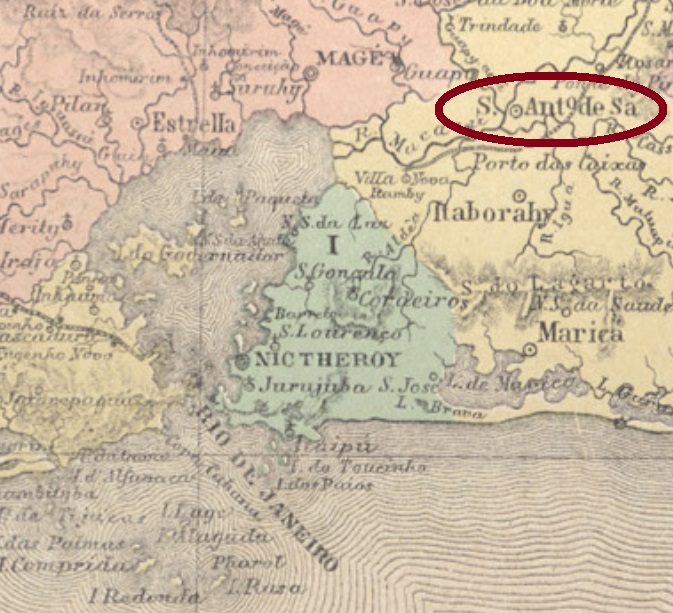
After loosing the villa status, Santo Antonio de Sá became a district of Itaborahy in May 1892, which was renamed to the actual Sambaetiba in October 1910.
According to Nova Monteiro (Administrações e Agencias Postaes do Brasil Imperio, in Brasil Filatelico/RJ, 1934-5; Reprint SPP 1994-1999), the local post office was created in January 1820. Paulo Novaes (agenciaspostais.com.br) tells us it closed in September 1897. No postal cancel of the Empire was seen until now.
Anderer Name: Sambaetiba (1910)
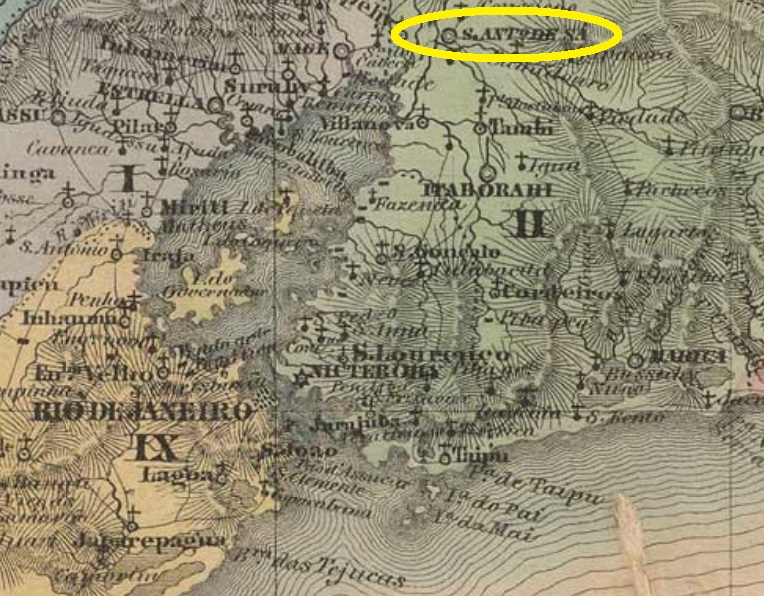
Diese Ortschaft steht auf keiner Karte heutzutage: die Villa existiert seit 1875 nicht mehr. Die ehemalige Freguesia von Santo Antonio do Caceribu entstand bereits in Februar 1647 nahe Itaborahy, ca. 60 km nordöstlich der späteren kolonialen Hauptstadt Rio de Janeiro. (Damals war noch Salvador da Bahia die Hauptstadt.) Im August 1697 stieg sie zur Villa von Santo Antonio de Sá, als eine Hommage an die portugiesische Familie Sá, die Rio de Janeiro sowohl gegründet als auch über einem halben Jahrhundert lang regiert hat. Das Ende der Villa 1875 war der Schlusspunkt einer langen Dekadenz, die durch tropische Krankheiten verursacht wurde, die wiederum von der massiven und raschen Waldabholzung in der Region begünstigt waren. Diese war womöglich eine der ersten ökologischen Katastrophen Brasiliens. Unter den letzten Spuren der verschwundenen Ortschaft ist die Klosterruine São Boaventura die wichtigste, die sich nah am Macacu-Delta befindet (siehe ganz oben). Nach dem Ende als Villa wurde Santo Antonio de Sá im Mai 1892 ein Distrikt im Município von Itaborahy, der seit Oktober 1910 Sambaetiba heißt.
Laut Nova Monteiro (Administrações e Agencias Postaes do Brasil Imperio, in Brasil Filatelico/RJ, 1934-5; Reprint SPP 1994-1999) entstand das örtliche Postamt im Januar 1820. Paulo Novaes (agenciaspostais.com.br) berichtet über eine Postschließung im September 1897. Kein Stempel der Kaiserzeit war bisher zu sehen.

 Carimbologia