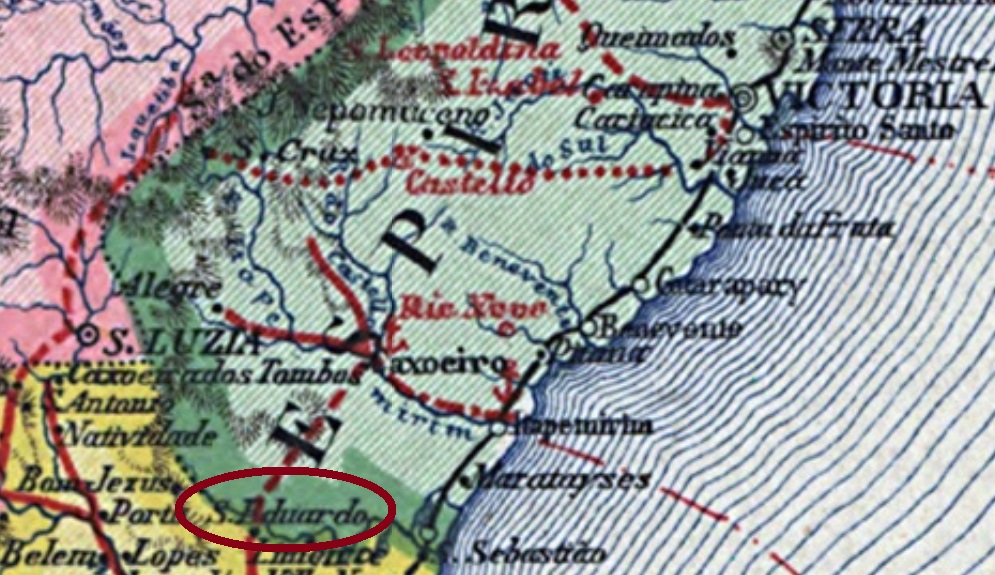
Other names: Ponte de Santo Eduardo, Itabapoana, Ponte de Itabapoana (1930)
The district of Santo Eduardo has belonged to the former municipality of São Pedro de Alcantara and was situated on the north bank of the Itabapoana River, which separated the Rio de Janeiro and Espirito Santo provinces, round 200 km southwest of the capital Victoria. In August 1896 it ascended to a villa named Ponte de Santo Eduardo (= St. Edward Bridge), but returned to the district status in January 1930, now under the still actual name Ponte do Itabapoana. The municipality was then called São Pedro de Itabapoanna, but has changed twice since that time: in November 1930 to João Pessoa, and in December 1943 to the present Mimoso do Sul.
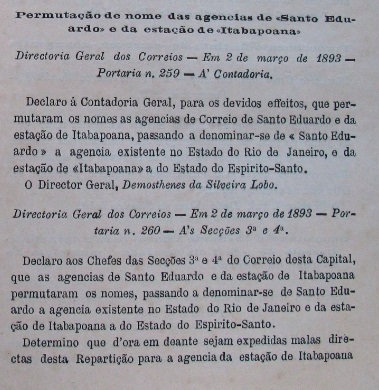
Since on the Rio de Janeiro side of the Itabapoanna River a train station with exactly the same name was built in June 1879, which received an own post office in March 1893, a very pretty confusion originated between both localities, their stations, post offices and cancels. Details (in portuguese) here: http://agenciaspostais.com.br/?page_id=20075
The confusion increased at that time, when both post offices switched their names. So from then on the Santo Eduardo office in Espirito Santo was named Itabapoana station, whereas the Itabapoana station in Rio was called Santo Eduardo, as ordered by the Rio postal administration:
Considering that Paulo Novaes tells us that the Santo Eduardo post office in Espirito Santo was created already in September 1879 (see http://agenciaspostais.com.br/?page_id=7511), we can conclude that all postal cancels from that time until February 1893 must be related to this agency. So two different cancels are present here. SES-0175a (Coll. Fuad Ferreira Fo.) has a double circle with the inscription SANTO EDUARDO above and a diamond ornament below, whose four sides are open. It occurs in black, blue and lilac and shows dates from 1880 until 1888 at the centre. SES-0175b (image from the internet) might be already republican, for the dates at the centre go from 1891 to 1893. It is a double circle in black or blue with inscriptions S. EDUARDO above and (ESP. SANTO) below.
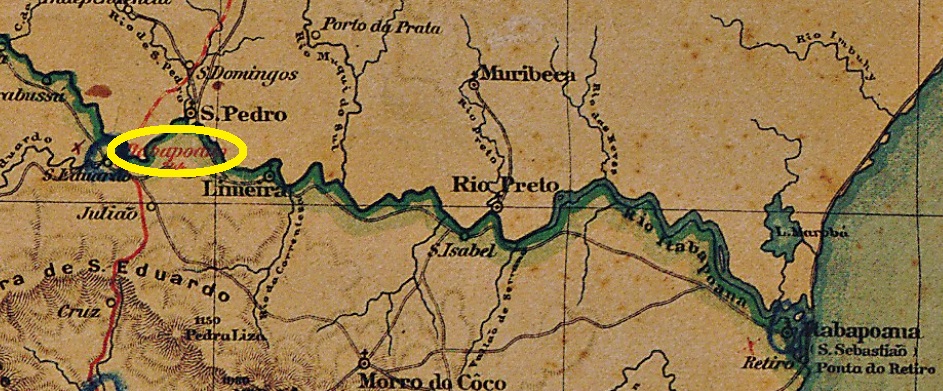
Andere Namen: Ponte de Santo Eduardo, Itabapoana, Ponte de Itabapoana (1930)
Der Distrikt von Santo Eduardo gehörte dem ehemaligen Município von São Pedro de Alcantara und lag am Nordufer des Flusses Itabapoana, der die Provinzen Rio de Janeiro und Espirito Santo voneinander trennte, rund 200 km südwestlich der Hauptstadt Victoria. Im August 1896 stieg der Ort zu einer Villa namens Ponte de Santo Eduardo (= St. Eduards Brücke) auf, um im Januar 1930 wieder zu Distrikt degradiert zu werden, nun unter dem heutigen Namen Ponte do Itabapoana. Der Município hieß nun São Pedro de Itabapoanna, aber wechselte den Namen seitdem zweimal: im November 1930 zu João Pessoa, und im Dezember 1943 zum noch aktuellen Mimoso do Sul.
Eine sehr schöne Verwechslung entstand im Juni 1879, als auf der Rio de Janeiro-Seite des Itabapoanna ein Bahnhof gebaut wurde, der exakt den gleichen Namen bekam und ab März 1893 auch ein Postamt beherbergte. Details (in Portugiesisch) hier: http://agenciaspostais.com.br/?page_id=20075
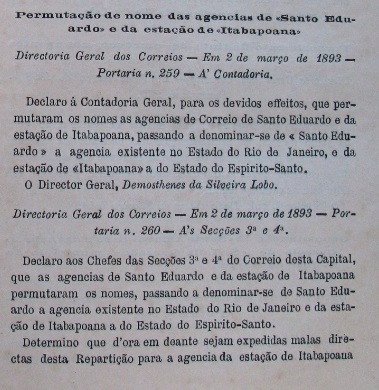
Zu dieser Zeit wurde die Konfusion perfekt, da beide Postämter ihren Namen umtauschten. So hieß das Postamt Santo Eduardo in Espirito Santo fortan Bahnhof Itabapoana, während aus dem Bahnhof Itabapoana in Rio der Bahnhof Santo Eduardo wurde, wie von der Postverwaltung in Rio befohlen:
Zum Glück berichtet uns Paulo Novaes auch darüber, dass das Postamt Santo Eduardo in Espirito Santo bereits im September 1879 entstanden ist (siehe http://agenciaspostais.com.br/?page_id=7511). Daraus folgt, dass alle Poststempel ab diesem Datum bis Februar 1893 aus diesem Postamt stammen müssen. Und davon gibt es zwei Stück. SES-0175a (Samml. Fuad Ferreira Fo.) hat einen Doppelkreis mit der Inschrift SANTO EDUARDO oben und einem Rautenornament unten, dessen vier Seiten offen sind. Er kommt in schwarz, blau und lila vor und zeigt in seiner Mitte Daten von 1880 bis 1888. SES-0175b (Abb. aus dem Internet) könnte bereits republikanisch sein, da die Daten im Inneren von 1891 bis 1893 gehen. Es ist ein Doppelkreis in schwarz oder auch blau mit Inschriften S. EDUARDO oben and (ESP. SANTO) unten.

 Carimbologia