Text update of August 29, 2024
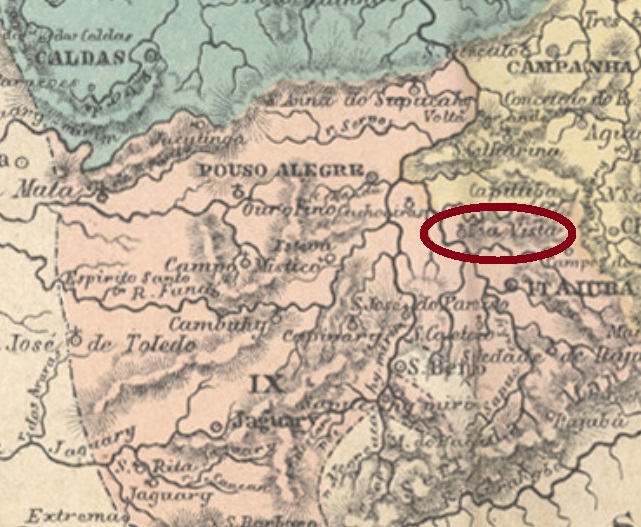
Other names: Santa Rita, Santa Rita da Boa Vista, Santa Rita do Vintém
As like Santo Antonio da Boa Vista (SAL-0245), I have simply forgotten to put this locality in the Carimbologia S1 book. So let’s introduce it with all available data and images.
This was the former freguesia of Santa Rita of the municipality of São Sebastião do Capituba, which switched to Pouso Alegre and, in November 1880 already with the actual name, to São Gonçalo do Sapucahy. As the name suggests, it was located on the east bank of the Sapucahy (now written Sapucaí) River, round 450 km southwest of the province capital Ouro Preto. In September 1888 it emancipated as a villa and was declared a town in May 1892. The population in 1880 was 4.145 inhabitants, for 2020 43.753 souls were estimated (IBGE).
Both Nova Monteiro (Administrações e Agencias Postaes do Brasil Imperio, in Brasil Filatelico/RJ, 1934-5; Reprint SPP 1994-1999) and Paula Sobrinho (História Postal de Minas Gerais, Belo Horizonte, 1997) agree in asserting that the local post office was created in September 1866. Four early cancels were found, the third one might be already republican:
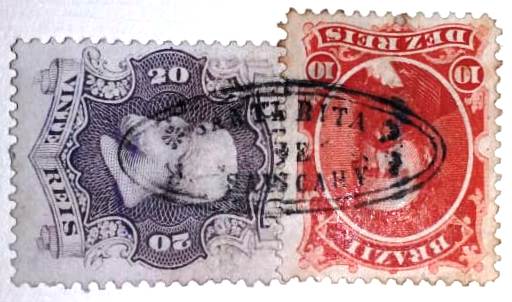


The fourth cancel SMG-2920d was recently discovered by Felipe Piccinini on an envelope from 1880, which also featured a very interesting mute cancel:


With special thanks to Fuad Ferreira Fo, who made this complement possible.
Textaktualisierung am 29. August 2024
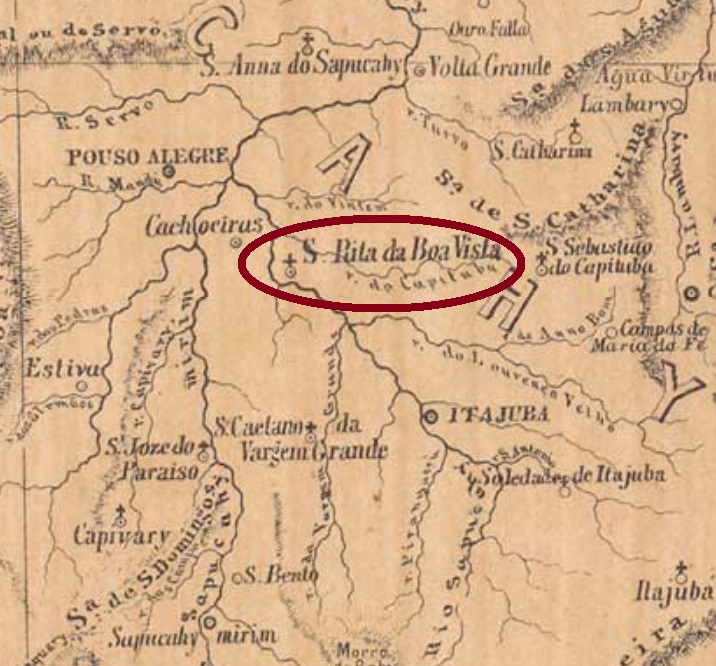
Andere Namen: Santa Rita, Santa Rita da Boa Vista, Santa Rita do Vintém
Wie bei Santo Antonio da Boa Vista (SAL-0245) habe ich einfach vergessen, diese Ortschaft ins Buch Carimbologia S1 einzutragen. Also wird sie hier in vollem Umfang vorgestellt, auch mit allen Stempelbildern.
Der Ort war früher die Freguesia von Santa Rita im Município von São Sebastião do Capituba, der später nach Pouso Alegre und – im November 1880 bereits unter dem aktuellen Namen – zu São Gonçalo do Sapucahy. Wie man erahnen kann, liegt die Ortschaft am Ostufer des Flusses Sapucahy (heute Sapucaí geschrieben), rund 450 km südwestlich der Provinzhauptstadt Ouro Preto entfernt. Im September 1888 wurde sie zur Villa, und im Mai 1892 zur Stadt ernannt. Aus 4.145 Einwohnern 1880 wurden im Jahre 2020 geschätzte 43.753 Seelen (IBGE).
Sowohl Nova Monteiro (Administrações e Agencias Postaes do Brasil Imperio, in Brasil Filatelico/RJ, 1934-5; Reprint SPP 1994-1999) als auch Paula Sobrinho (História Postal de Minas Gerais, Belo Horizonte, 1997) sind sich darüber einig, dass das örtliche Postamt im September 1866 entstand. Vier frühe Stempel wurden für den 19. Jahrhundert gefunden, wobei der dritte davon wohl republikanisch ist:


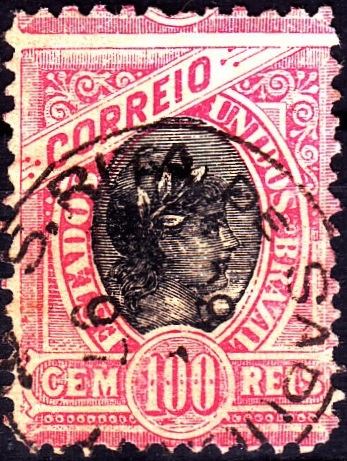
Der vierte Poststempel SMG-2920d wurde kürzlich von Felipe Piccinini auf einem Briefumschlag aus dem Jahr 1880 entdeckt, der auch einen sehr interessanten stummen Stempel enthielt:


Mit besonderem Dank an Fuad Ferreira Fo., der diesen Nachtrag veranlasst hat.

 Carimbologia