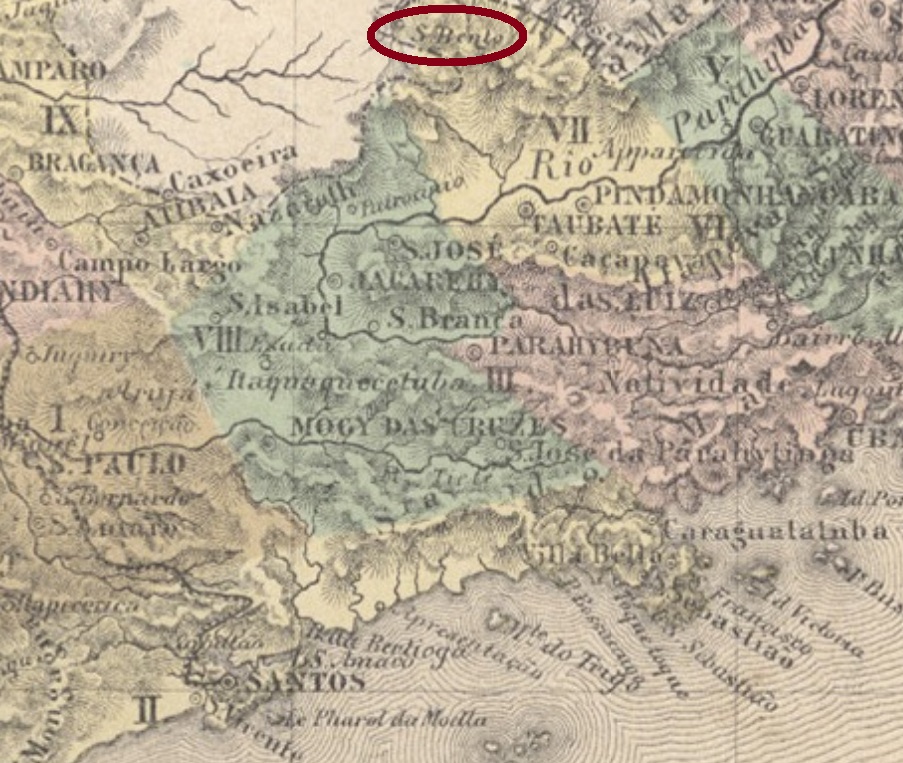
Other names: São Bento de Sapucahy, S. Bento do Sapucaí
This locality was a former freguesia of Pindamonhangaba, situated on the east bank of the Sapucaí-Mirim River, near the Minas Gerais border, some 200 km northeast of the province capital São Paulo. Sapucaí-Mirim means small shouting river in the tupi-guarani language. The place was made a villa in May 1858 and is a town since March 1876.
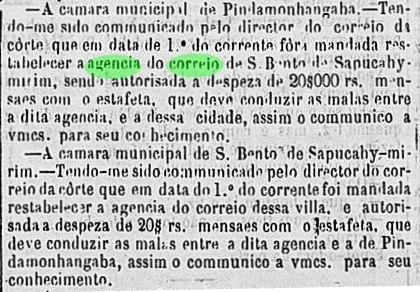
Two dates for the local post office have been found. Nova Monteiro (Administrações e Agencias Postaes do Brasil Imperio, in Brasil Filatelico/RJ, 1934-5; Reprint SPP 1994-1999) and the Postal Report for 1859 write December 1857, a date confirmed by Aureo G. Santos in Agências de Correio Criadas e Suprimidas 1851, 1855, 1856 e 1857 (Brasil Filatélico 181, Rio de Janeiro):

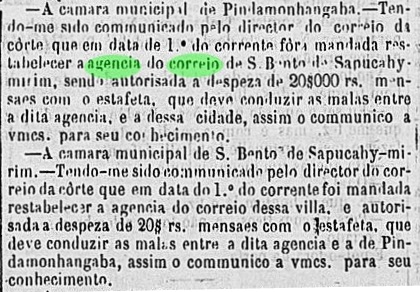
Apparently, this office was closed shortly after, for a reopening in June 1864 was announced in the regional press:
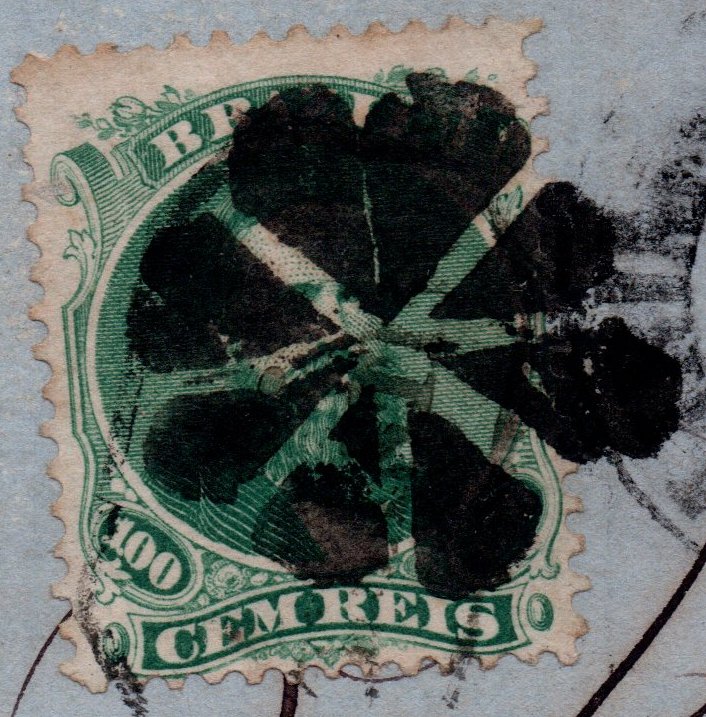
We can present three imperial local cancels, else than a mute one. The oldest one is SSP-1670a (Coll. José A. Junges), a single circle with inscription S.BTO DE SAPUC. MIRIM above and a five-leg star below. The centre is free for writing the date by hand, but both known examples (used at least until 1866) have no date inside. SSP-1670b (Coll. José A. Junges) presents now a double circle with inscription S. B. DE SAPUCAHYMERIM and dates at the centre between 1877 and 1880. SSP-1670c (image from the internet) is a French-type double circle with inscription S. B. DE SAPUCAHY above and the star between parentheses below. Dates available 1885-1890.
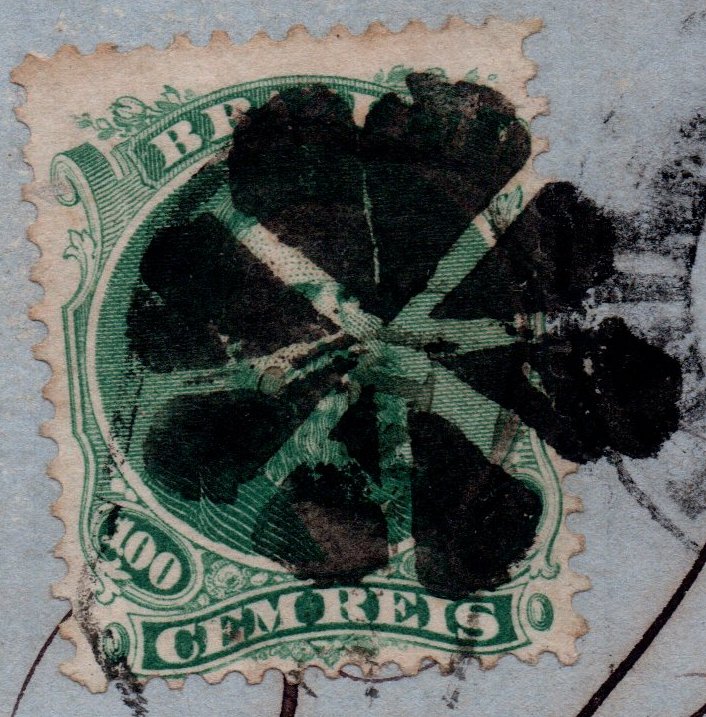
The mute cancellation was found on an envelope to Rio, posted with a 100 réis D. Pedro issue of 1866 and accompanying SSP-1670b:
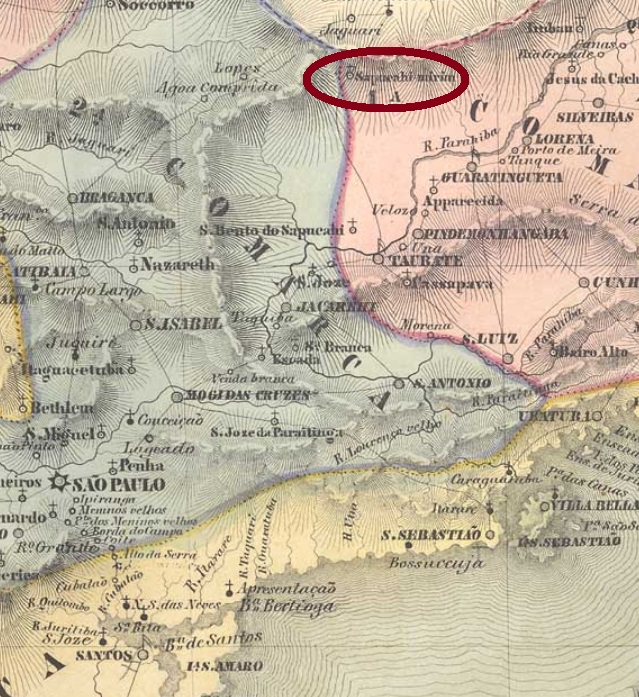
Andere Namen: São Bento de Sapucahy, S. Bento do Sapucaí
Diese Ortschaft war eine ehemalige Freguesia von Pindamonhangaba, die am Ostufer des Flusses Sapucaí-Mirim nah an der Grenze zu Minas Gerais lag, etwa 200 km nordöstlich der Provinzhauptstadt São Paulo entfernt. Sapucaí-Mirim bedeutet kleiner schreiender Fluss in der Tupi-guarani Indianersprache. Der Ort stieg zur Villa im Mai 1858 und zur Stadt im März 1876 auf.
Zwei Daten furs örtliche Postamt waren zu finden. Nova Monteiro (Administrações e Agencias Postaes do Brasil Imperio, in Brasil Filatelico/RJ, 1934-5; Reprint SPP 1994-1999) und der Postbericht für 1859 schreiben den Dezember 1857. Dieses Datum wurde durch Aureo G. Santos in Agências de Correio Criadas e Suprimidas 1851, 1855, 1856 e 1857 (Brasil Filatélico 181, Rio de Janeiro) bestätigt:

Scheinbar aber wurde die Agentur kurz danach geschlossen, da eine Wiedereröffnung im Juni 1864 in der Regionalpresse bekannt gegeben wurde:
Wir können drei Ortsstempeln vorstellen, dazu eine „stumme“ Entwertung. Der älteste Stempel ist SSP-1670a (Samml. José A. Junges): ein Kreis mit Inschrift S.BTO DE SAPUC. MIRIM oben und einem fünfzackigen Stern unten. Die Mitte ist für ein handgeschriebenes Datum frei, aber beide Exemplare (benutzt mindestens bis 1866) tragen kein Datum. SSP-1670b (Samml. José A. Junges) zeigt nun einen Doppelkries mit Inschrift S. B. DE SAPUCAHYMERIM und Daten in der Mitte zwischen 1877 und 1880. SSP-1670c (Abb. aus dem Internet) ist ein Französischer-Typus: Doppelkreis mit Inschrift S. B. DE SAPUCAHY oben und ein kleiner Stern in Klammern unten. Vorhandene Daten 1885-1890.
Die stumme Abstempelung war auf einem Umschlag nach Rio zu finden, frankiert mit einer 100 Réis D. Pedro-Ausgabe von 1866 und begleitet vom SSP-1670b:

 Carimbologia