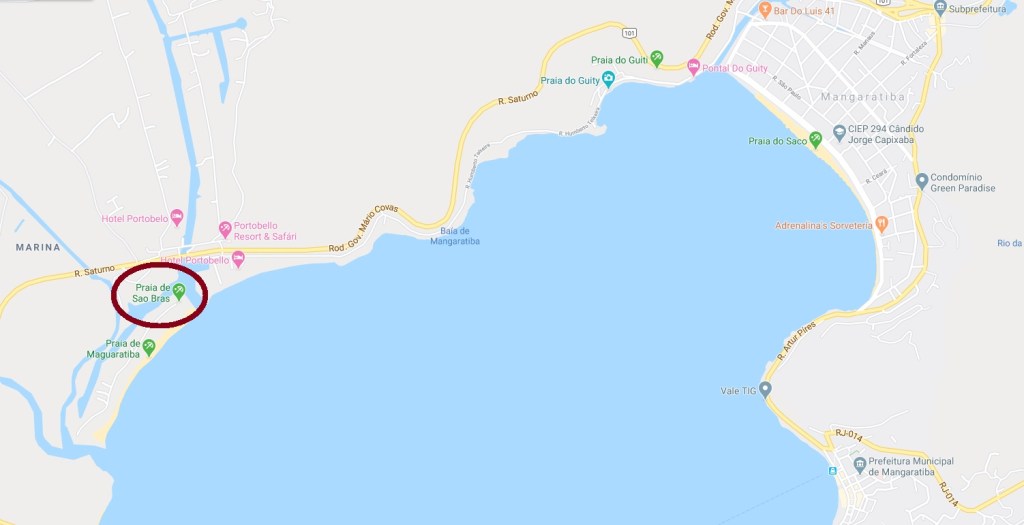
Text update of January 15, 2021
Another name: São Braz de Mangaratiba
This is another enigmatic post office in imperial Brazil: we ignore why it has been built so near the more important agency of Sacco de Mangaratiba (see SRJ-2345) in a rural zone. It was in west Mangaratiba Bay, over 100 km west of the imperial capital, and has never become ever a district, since Mangaratiba was made a villa in November 1831. Now it is the charming tourist site of São Brás, or Mangaratiba Beach.
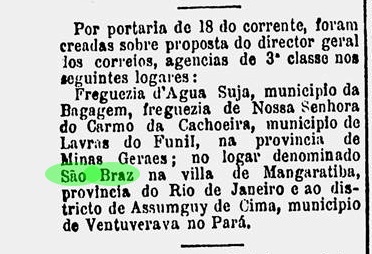
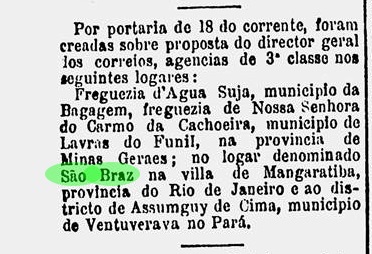
According to Paulo Novaes (agenciaspostais.com.br), the local post office was created in February 1882, which can be confirmed by the regional press:
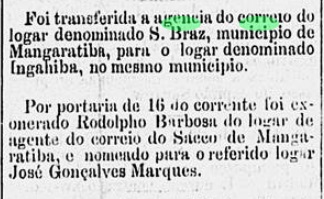
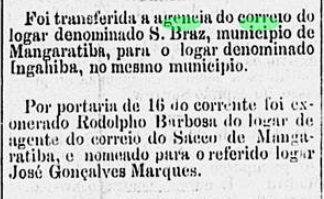
Four years later, however, the post office was transferred to Ingahiba, a few kilometres toward countryside:
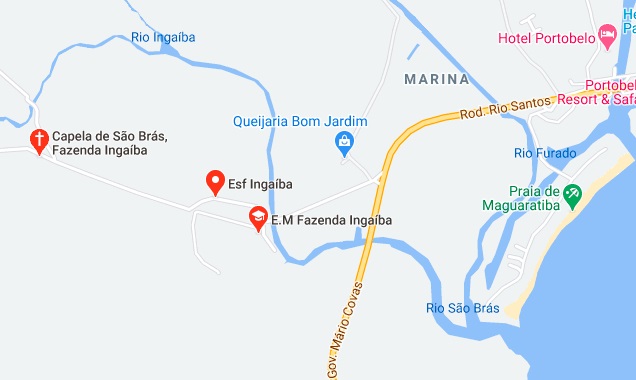
This change can be related to the smallpox epidemic that reached the whole Mangaratiba Bay region from 1873 on. Historians report that at that time a significant part (i.e. the wealthier one) of the population moved to rural zones, specially to Ingahiba, to avoid infection. We also ignore if the post office returned to São Braz. Ingahiba today is a small village with a beautiful chapel, an elementary school and rests of a fazenda (see map below). Paulo Novaes (op. cit.) writes this agency closed in September 1914.
In Carimbologia S1 we presented a cancel (SRJ-1577a, coll. José A. Junges) that supposedly comes from this locality. It was used between 1883 and 1890. Meanwhile, another example of it has appeared (coll. Fuad Ferreira Fo.), which rises doubt about that attribution. It is dated 1887 and accompanied by a Recife cancel from Pernambuco. This may indicate another origin for this S. Braz cancel, from the Alagoas province (see SAL-0200):

The next cancel for this locality is probably republican. SRJ-1577b (Coll. Fuad Ferreira Fo.) has a double circle with the inscription S. BRAZ DE MANGARATIBA on top. The bottom was not visible, the centre shows dates from 1893 to 1896.
Textaktualisierung vom 15. Januar 2021
Anderer Name: São Braz de Mangaratiba
Dieses ist wieder ein rätselhaftes Postamt aus dem kaiserlichen Brasilien: wer weiß, warum es so nah am wichtigeren Postamt von Sacco de Mangaratiba (siehe SRJ-2345) am Strand errichtet wurde? Es lag im Westen der Bucht von Mangaratiba, über 100 km westlich der kaiserlichen Hauptstadt Rio de Janeiro, und schaffte es nicht mal zum Distriktstatus, nachdem aus Mangaratiba im November 1831 eine Villa wurde. Nun ist es ein reizendes Touristenziel, als Strand von São Brás, oder Mangaratiba.
Laut Paulo Novaes (agenciaspostais.com.br) gab es dort ein Postamt ab Februar 1882, wie auch die Regionalpresse bestätigen kann:
Schon vier Jahre später wurde das Postamt ein Paar Kilometer in Richtung Landesinnere verlegt, in die kleine Ortschaft Ingahiba:
Diesen Umzug wird man wohl in Verbindung mit der Pockenepidemie zu bringen, die ab 1873 das Mangaratiba-Buchtgebiet erreichte. Historiker berichten, dass ein wichtiger Teil der Bevölkerung (d.h. die Reicheren) ins Landesinnere umgezogen ist – insbesondere nach Ingahiba, um einer Infektion zu entkommen. Wir wissen auch nicht, wann und ob überhaupt das Postamt nach São Braz zurückkehrte. Ingahiba heute ist ein Dörfchen mit einer hübschen Kapelle, einer Volksschule und den Überresten einer Fazenda (siehe Karte oben). Paulo Novaes (op. cit.) schreibt, die Agentur schloss endgültig im September 1914.
In Carimbologia S1 wurde ein Stempel präsentiert (SRJ-1577a, Samml. José A. Junges), der vermutlich aus dieser Ortschaft entstammte, gebraucht zwischen 1883 und 1890. Inzwischen ist ein weiteres Exemplar davon aufgetaucht (Samml. Fuad Ferreira Fo.), das Zweifel in dieser Zuordnung bringt. Es ist 1887 datiert und wird von einem Recife-Stempel aus Pernambuco begleitet, wodurch eine Zuordnung des Stempels zu S. Braz in der Provinz Alagoas naheliegen würde (siehe SAL-0200):

Der folgende Stempel dieser Ortschaft ist wohl schon aus der Republik. SRJ-1577b (Samml. Fuad Ferreira Fo.) hat einen Doppelkreis mit der Inschrift S. BRAZ DE MANGARATIBA oben. Der untere Teil ist leider nicht zu sehen, in der Mitte stehen Daten von 1893 und 1896.

 Carimbologia