Printed text update of January 22, 2021
Another name: São Carlos (1908)
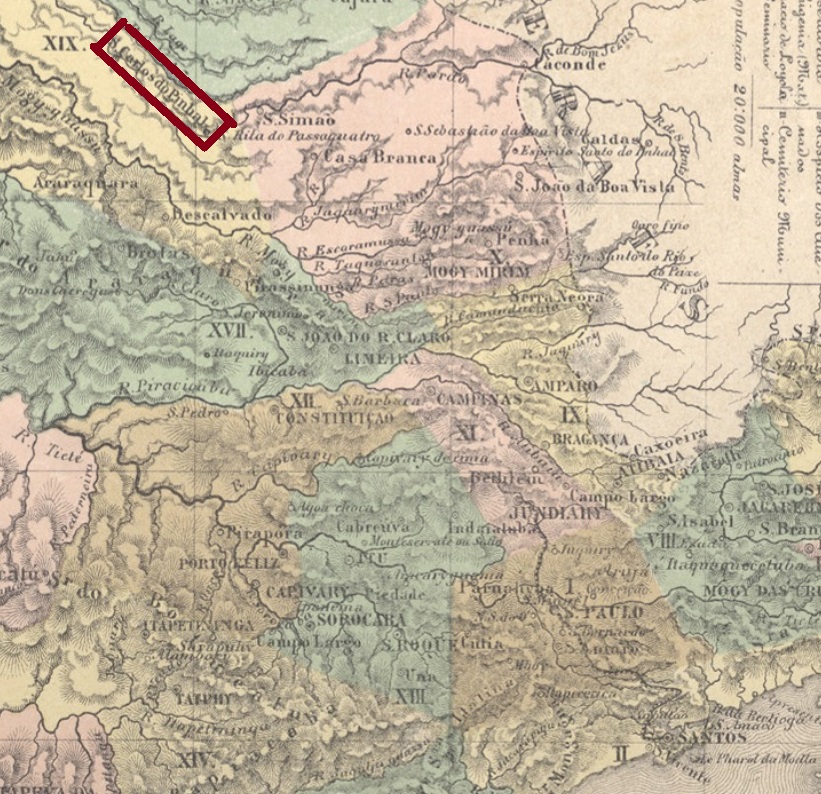
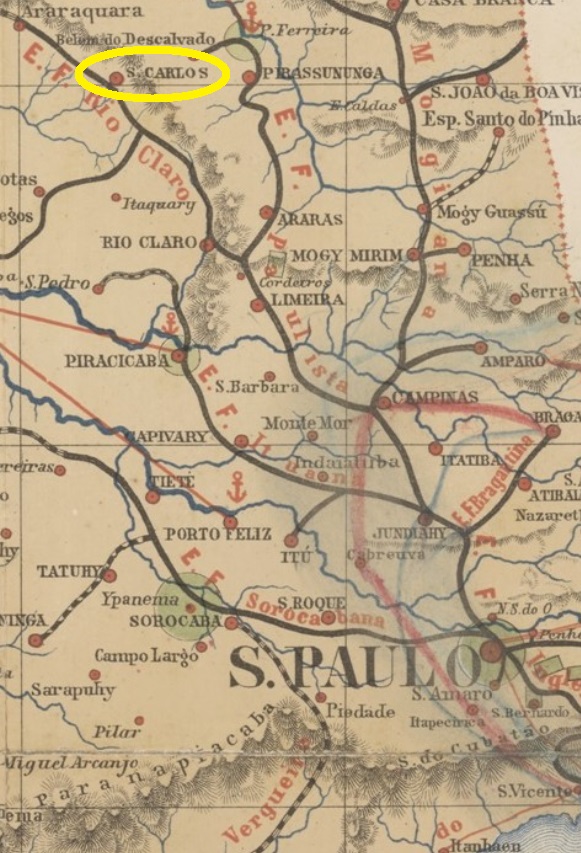
The actual town of São Carlos in the São Paulo state has developed very fast along the second half of the 19th century. The former district of Araraquara, established in April 1858, was situated almost 250 km northwest of the province capital. It became a villa less than seven years later, and a town in April 1880. Since December 1908 the municipality has the actual name.
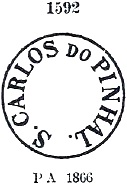
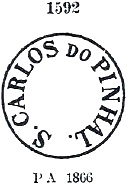
According to Nova Monteiro (Administrações e Agencias Postaes do Brasil Imperio, in Brasil Filatelico/RJ, 1934-5; Reprint SPP 1994-1999), the local post office was created in June 1858. Nine imperial post cancellations were found so far. The earliest one is apparently SSP-1675a, which occurs in black, violet, and sepia, as presented by Paulo Ayres (Catálogo de Carimbos Brasil-Império, S. Paulo, 1937, 1942) under #1592:
There follows SSP-1675b (Coll. José A. Junges): a double circle with the inscription S.C. DO PINHAL on top and dates at the centre between 1877 and at least 1881. SSP-1675c (Coll. José A. Junges) is a rare French-type, whose only found example is dated 1886: a double circle with inscription S. CARLOS DO PINHAL on top and the star in parentheses below. SSP-1675d (Coll. José A. Junges) has within circles the same inscription as before, now with a four-leg star ornament below. Dates at the centre 1876ff-1894. SSP-1675e (image from the internet) occurs in black and blue and has the same inscription between circles on top as before, but here the letters are shorter and rounder, and the ornament below resembles an eight-leg star. Dates at the centre: 1884-1894.
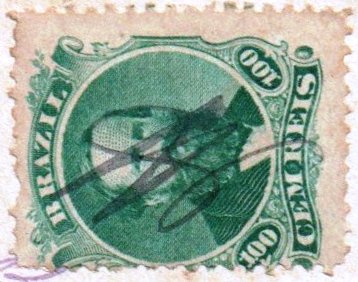
SSP-1675f (Coll. Klerman W. Lopes) is a railway ambulant cancel, with inscription S. CARLOS between circles on top and (C.A.) below, dated at the centre 1886-1892. Finally, there are two manuscript cancellations and a mute one:

Buchtest-Aktualisierung von 22. Januar 2021
Anderer Name: São Carlos (1908)
Die heutige Stadt São Carlos im Busdesstaat São Paulo hat sich rasch während der zweiten Hälfte des 19. Jahrhunderts entwickelt. Der im April 1858 gegründete Distrikt von Araraquara lag fast 250 km nordwestlich der Provinzhauptstadt entfernt. Er wurde eine Villa in weniger als sieben Jahre, und eine Stadt im April 1880. Seit Dezember 1908 trägt der Município seinen aktuellen Namen.
Laut Nova Monteiro (Administrações e Agencias Postaes do Brasil Imperio, in Brasil Filatelico/RJ, 1934-5; Reprint SPP 1994-1999) gibt es dort ein Postamt seit Juni 1858. Neun postalische Entwertungen der Kaiserzeit wurden bisher gefunden. Anscheinend ist SSP-1675a die früheste davon. Es gibt sie in schwarz, violett und sepia, und sie wurde bereits durch Paulo Ayres (Catálogo de Carimbos Brasil-Império, S. Paulo, 1937, 1942) unter Nr. 1592 abgebildet:
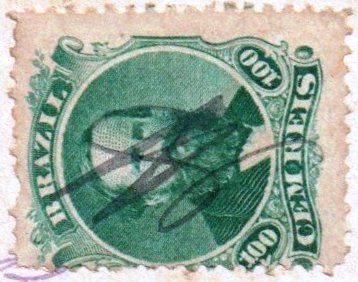
Es folgte SSP-1675b (Samml. José A. Junges): ein Doppelkreis mit der Inschrift S.C. DO PINHAL oben und Daten in der Mitte zwischen 1877 und 1881ff. SSP-1675c (Samml. José A. Junges) ist ein seltener Französischer-Typus, das einzige gefundene Exemplar trägt ein Datum aus 1886: ein Doppelkreis mit Inschrift S. CARLOS DO PINHAL oben und den Stern in Klammern unten. SSP-1675d (Samml. José A. Junges) hat die gleiche Inschrift oben zwischen den Kreisen wie vorher, hier aber mit einem vierzackigen Stern als Ornament unten. Daten in der Mitte von 1876ff-1894. SSP-1675e (Abb. aus dem Internet) kommt in schwarz und blau vor und hat derselben Inschrift oben zwischen den Kreisen, wobei hier die Buschstaben kürzer und etwas runder sind. Das Ornament unten ähnelt einem achtzackigen Stern. Daten in der Mitte: 1884-1894.
SSP-1675f (Samml. Klerman W. Lopes) ist eine Eisenbahn-Abstempelung für die ambulante Post, mit Inschrift S. CARLOS oben zwischen den Kreisen und (C.A.) unten, in der Mitte 1886-1892 datiert. Schließlich gibt es noch zwei handgeschriebene Entwertungen und einen stummen Stempel zu zeigen:


 Carimbologia