Printed version update from February 4, 2021
Another name : São Fidelis de Sigmaringa
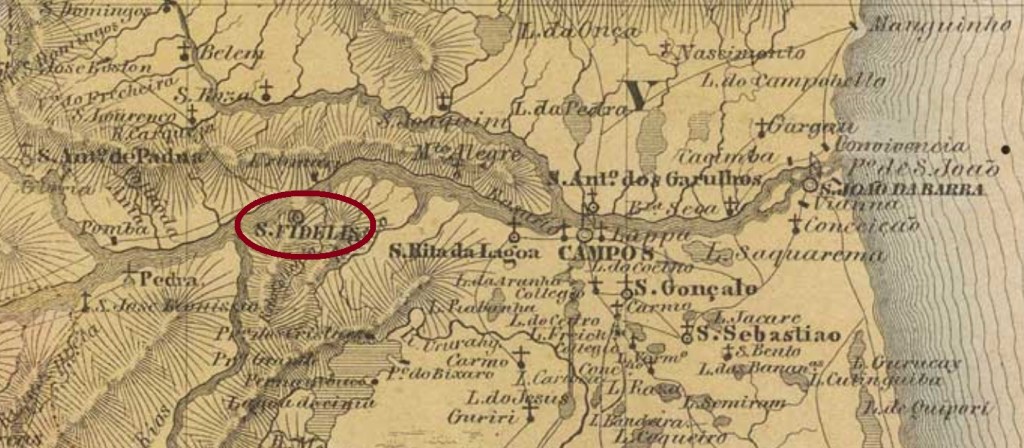
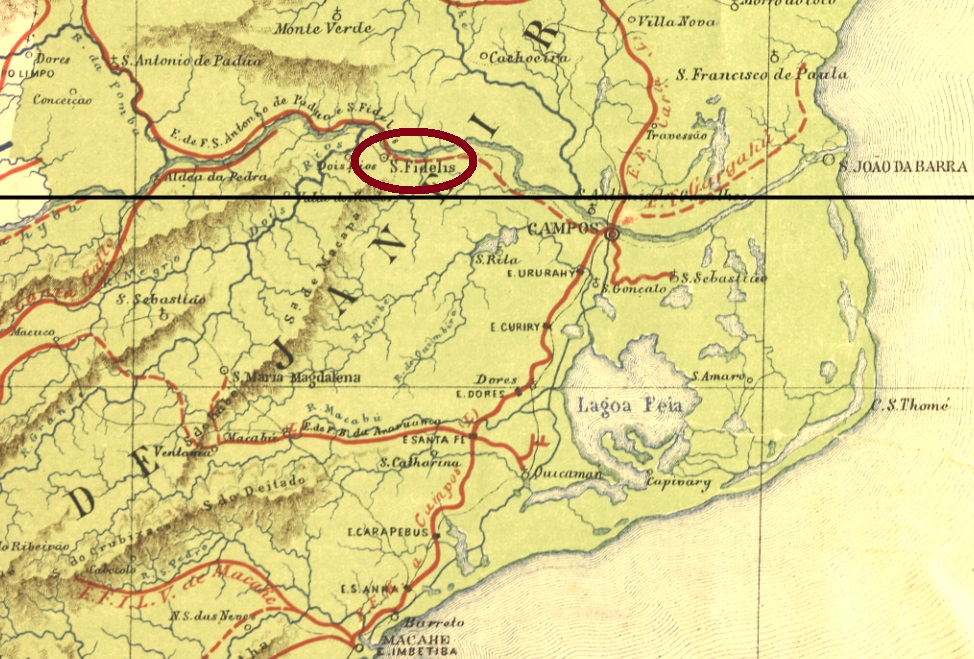
Saint Fidelis of Sigmaringen (1578-1622), philosopher, jurist, religious priest and martyr, also had his admirers in colonial Brazil. The parish of Sao Fidelis de Sigmaringa was founded in 1812 on the south bank of the Parahyba do Sul river near Campos, 300 km northeast of Rio de Janeiro. In April 1840 it was elevated to a freguesia and exactly 10 years later to a villa. Since December 1870, it has been a town.
As Nova Monteiro in Administrações e Agencias Postaes do Brasil Imperio (Brasil Filatelico/RJ, 1934-5; Reprint SPP 1994-1999) reports, there is a post office there since November 1833. So you can find many imperial cancels here, starting with SRJ-0925a, which was used from the beginning until at least 1868 and was already presented by Paulo Ayres (Catalogo de Carimbos Brasil-Império, S. Paulo, 1937, 1942) under No. 1456:

There followed SRJ-0925b (Coll. José A. Junges): a simple double circle with inscription S. FIDELIS above and the date at the centre, period of use ca. 1878-1886. SRJ-0925c (Coll. Dieter Kerkhoff) is similar to his predecessor, but has an additional diamond-shaped ornament at the bottom of the circles, which consists of four small diamonds. Copies were found for the period 1884-1889. At SRJ-0925d (image from the internet) the lower ornament consists of three ellipses in series, the middle one standing, the others lying. 1889 to 1892. Finally, SRJ-0925e (Coll. Karlheinz Wittig) may already be Republican, since its dates at the centre go from 1894 until 1899: here too we have a double circle with S. FIDELIS above, the ornament below is now an X.
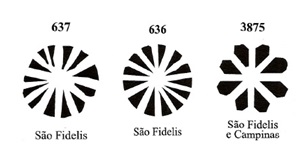
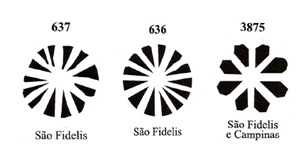
Four mute cancels could be assigned to this place, three of which were identified by A. Dingler and K. Lopes (Mute Cancellations of the Brazil Empire / Carimbos Mudos do Brasil Império, Brazil Philatelic Association, Rio de Janeiro, 2000):
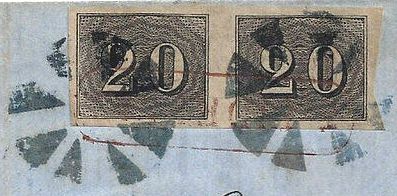
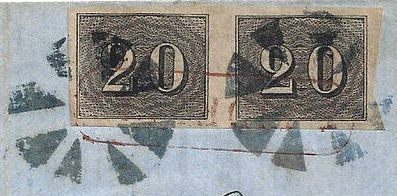
The fourth mute cancel was found on an envelope from 1868 (image from the internet):
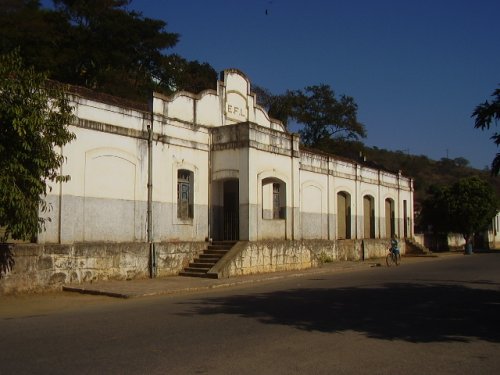
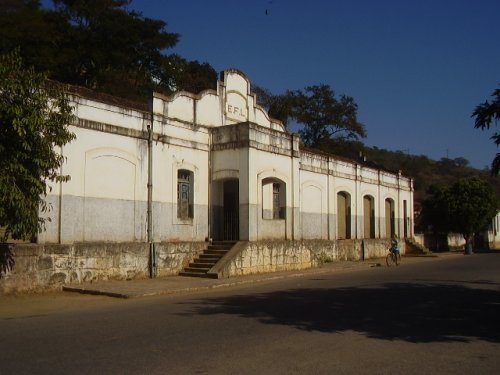
In January 1880, a railway station of the E.F. Santo Antonio de Padua Railway Company was inaugurated in Sao Fidelis. In 1884, the line ownership went to E.F. Macahe a Campos, in 1887 to E. F. Leopoldina, and from 1975 to the end of the company’s operation in 1996, to the Rede Ferroviária Federal S.A. Now the building seems unused (estacoesferroviarias.com.br):
As Paulo Novaes (agenciaspostais.com.br) reports, there was also a train station post office from 1880 on, which had a short service life. Two station cancels were found: SRJ-0926a (Coll. José A. Junges) is the oldest of them, the only copy, in turquoise, was used in 1883: a double circle with inscriptions EST. CENTRAL above and E.F.S.F. below, with date at the centre. It was followed by SRJ-0926b (agenciaspostais.com.br). Here the inscriptions are more detailed: EST CENTRAL above and E.F. DE S. FIDELIS below. Used 1884-1890.
Buchtext-Aktualisierung vom 4. Februar 2021
Anderer Name : São Fidelis de Sigmaringa
Auch der Heilige Fidelis von Sigmaringen (1578-1622), Philosoph, Jurist, Ordenspriester und Märtyrer, hatte seine Verehrer im kolonialen Brasilien. So wurde 1812 die Pfarrei São Fidelis de Sigmaringa am Südufer des Flusses Parahyba do Sul bei Campos, 300 km nordöstlich von Rio de Janeiro errichtet. Im April 1840 wurde sie zur Freguesia und exakt 10 Jahre später zur Villa erhoben. Seit Dezember 1870 ist São Fidelis eine Stadt.
Wie Nova Monteiro in Administrações e Agencias Postaes do Brasil Imperio (Brasil Filatelico/RJ, 1934-5; Reprint SPP 1994-1999) berichtet, gibt es dort ein Postamt seit November 1833. Also kann man hier viele imperiale Stempel vorfinden, beginnend mit SRJ-0925a, der vom Betriebsbeginn bis mindestens 1868 verwendet und bereits durch Paulo Ayres (Catálogo de Carimbos Brasil-Império, S. Paulo, 1937, 1942) unter Nr. 1456 vorgestellt wurde:

Es folgte SRJ-0925b (Samml. José A. Junges): ein schlichter Doppelkreis mit Inschrift S. FIDELIS oben und dem Datum in der Mitte, Verwendungsperiode ca. 1878-1886. SRJ-0925c (Samml. Dieter Kerkhoff) ist ähnlich wie sein Vorgänger, hat aber ein zusätzliches Ornament in Rautenform unten zwischen den Kreisen, das aus vier kleinen Rauten besteht. Exemplare für den Zeitraum 1884-1889 gefunden. Bei SRJ-0925d (Abb. aus dem Internet) besteht das untere Ornament aus drei Ellipsen in Reihe, die Mittlere davon stehend, die anderen liegend. Von 1889 bis 1892. Schließlich könnte SRJ-0925e (Samml. Karlheinz Wittig) bereits republikanisch sein, da seine bisherigen Daten in der Mitte zwischen 1894 und 1899 liegen: auch hier haben wir einen Doppelkreis mit S. FIDELIS oben, das Ornament unten ist nun ein X.
Vier stumme Stempel konnten diesem Ort zugeordnet werden, drei davon haben A. Dingler und K. Lopes (Mute Cancellations of the Brazil Empire / Carimbos Mudos do Brasil Império, Brazil Philatelic Association, Rio de Janeiro, 2000) identifiziert:
Der vierte Stempel wurde auf einem Umschlag aus 1868 vorgefunden (Abb. aus dem Internet):
Im Januar 1880 wurde in São Fidelis ein Bahnhof der E.F. Santo Antonio de Padua Eisenbahngesellschaft eingeweiht. 1884 ging der Linienbesitz zur E.F. Macahe a Campos, 1887 zur E. F. Leopoldina, und von 1975 bis Betriebsende 1996, zur Rede Ferroviária Federal S.A. Nun steht das Gebäude anscheinend ohne Benutzung da (estacoesferroviarias.com.br):
Wie Paulo Novaes (agenciaspostais.com.br) berichtet, gab es auch ab 1880 ein Bahnhofspostamt, das allerdings von kurzer Betriebsdauer war. Zwei Bahnhofsstempel sind da: SRJ-0926a (Samml. José A. Junges) ist davon der Älteste, das einzige Exemplar wurde 1883 in türkis verwendet: ein Doppelkreis mit Inschriften EST. CENTRAL oben und E.F.S.F. unten, dazu Datum in der Mitte. Ihm folgte SRJ-0926b (agenciaspostais.com.br). Hier sind die Inschriften etwas ausführlicher: EST CENTRAL oben und E.F. DE S. FIDELIS unten. Benutzt 1884-1890.

 Carimbologia