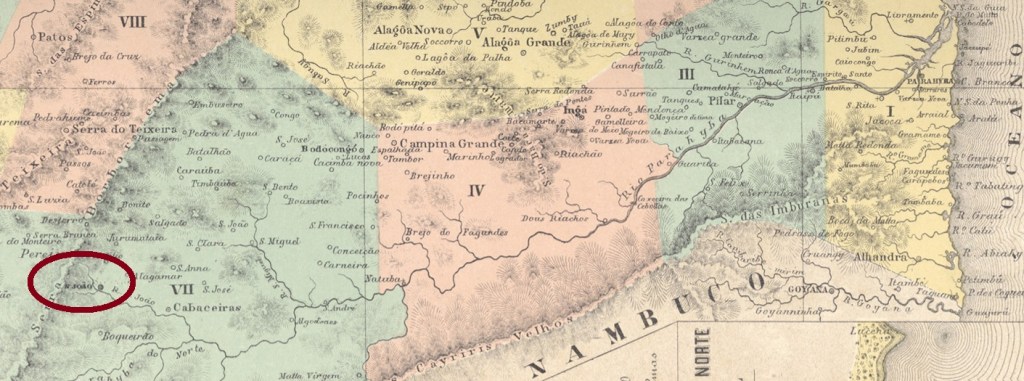
Other names: Nossa Senhora dos Milagres, Sao João do Cariri
The long list of imperial post offices in the Carimbologia S2 volume, which will be published in 2021, starts with the town of Sao João in the province of Paraíba (then Parahyba do Norte). This village was called Freguesia de Nossa Senhora dos Milagres (= Our Lady of Wonders) since 1750 and was located more than 200 km west of the provincial capital Parahyba do Norte (today João Pessoa). In May 1803, it rose to a villa called São João do Cariri. In November 1921 it became a town. Cariri was an Indian tribe in northeastern Brazil, which later named almost the entire hinterland of the region.
According to Nova Monteiro (Administrações e Agencias Postaes do Brasil Imperio, in Brasil Filatelico/RJ, 1934-5; Reprint SPP 1994-1999) there is a post office there since May 1829. Only one cancel of the imperial period could be identified, certainly not the oldest, since its dates remain between 1887 and 1889. SPB-0205b (Coll. José A. Junges) has a simple double circle with the inscription S. JOAO above and the date at the centre.
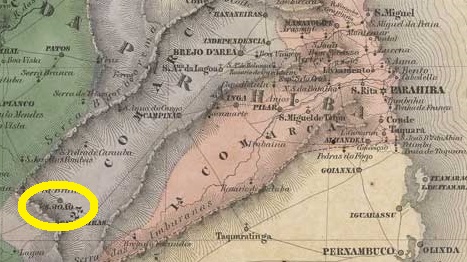
Andere Namen: Nossa Senhora dos Milagres, São João do Cariri
Mit São João in der Provinz Paraíba (damals Parahyba do Norte geschrieben) startet die lange Liste der kaiserlichen Postämter im Band Carimbologia S2, der in 2021 erscheinen wird. Diese Ortschaft hieß seit 1750 Freguesia de Nossa Senhora dos Milagres (= Unsere Liebe Frau der Wunder) und lag über 200 km westlich der Provinzhauptstadt Parahyba do Norte (heute João Pessoa). Im Mai 1803 stieg sie zu einer Villa namens São João do Cariri. Im November 1921 wurde daraus eine Stadt. Cariri war ein Indianerstamm im Nordosten Brasiliens, der später fast das gesamte Hinterland der Region genannt hat.
Laut Nova Monteiro (Administrações e Agencias Postaes do Brasil Imperio, in Brasil Filatelico/RJ, 1934-5; Reprint SPP 1994-1999) gibt es dort ein Postamt seit Mai 1829. Nur ein Stempel der Kaiserzeit konnte identifiziert werden, bestimmt nicht der älteste, da seine Daten zwischen 1887 und 1889 liegen. SPB-0205b (Samml. José A. Junges) hat einen einfachen Doppelkreis mit der Inschrift S. JOAO oben und dem Datum in der Mitte.

 Carimbologia