
Another name: S. João Marcos
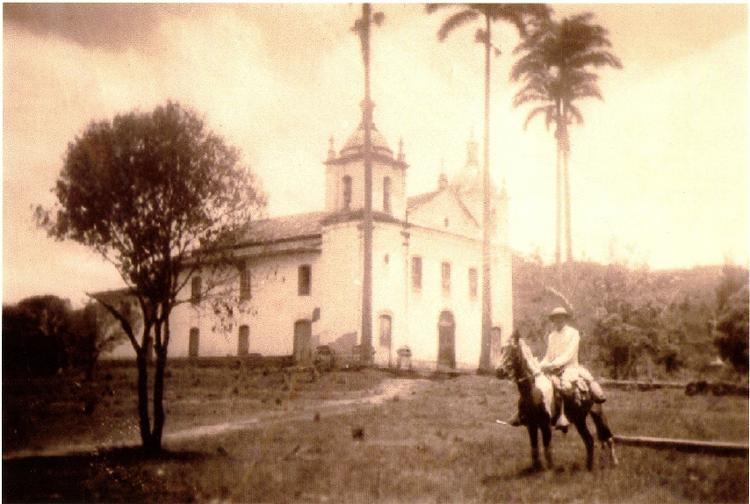
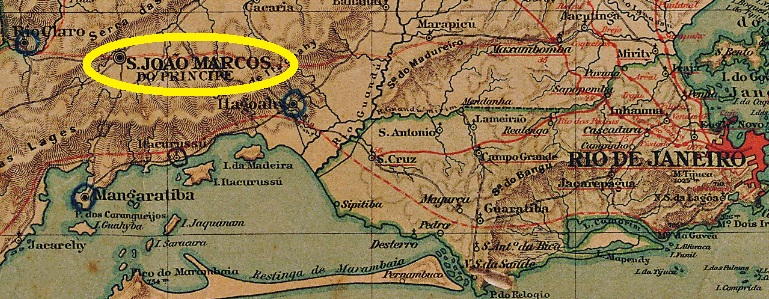
The history of this village begins in 1739 with the foundation of a chapel, and in 1755 it became the freguesia of S. João Marcos, situated about 130 km west of the colonial capital Rio de Janeiro. In February 1811, the village was elevated to the villa of S. João do Principe, a tribute to the future king D. João VI. With the coup of the Republic, the old name S. João Marcos returned in 1890, now as a town. However, the economic decline caused by the end of coffee cultivation and slavery was unstoppable, and in December 1938 S. João Marcos finally became a district of Rio Claro.
But things went worse. Rio’s rapid growth required new energy sources, and the Canadian company Light was commissioned in the early 20th century to build a hydroelectric power plant by building a reservoir on the Rio der Lages. Some districts of S. João Marcos were flooded, but that was not enough. In 1940, the Brazilian dictator Getúlio Vargas released a decree that put the entire town area under water, even though it had been placed under monument protection three years earlier.
Due to the construction of the reservoir (Represa do Ribeirão das Lajes), the whole town was demolished, and all inhabitants were expelled. Houses, cinemas, theatre, everything came down, even the church was blown up. Today, S. João Marcos is a small hamlet of Rio Claro, which is located about 20 km southwest of the old town. The energy company had built an archaeological museum in the area to preserve the local history.
Back to the imperial S. João do Principe, Nova Monteiro, in Administrações e Agencias Postaes do Brasil Imperio (Brasil Filatelico/RJ, 1934-5; Reprint SPP 1994-1999) writes June 1829 as the date of creation for the local post office. Four cancels have been handed down, starting with SRJ-0945a, which has already been presented in the RHM- Catalogo Enciclopédico de Selos & História Postal do Brasil (S. Paulo, 1999):

It was followed by SRJ-0945b (Coll. José A. Junges): a double circle with the inscription S. J. DO PRINCIPE above and one (I) below, with dates at the centre from 1878 to 1880. Then came SRP-0945c, with a characteristical misprint PRINCEPE and which was already shown by Cicero A. Almeida in Carimbos Postais – século XIX, (Rio de Janeiro, 1989) under No. 742:

The last cancel of S. João do Principe is SRJ-0945d (image from the Internet): In the double circle above, S. JOÃO DO PRINCIPE has been now corrected, the tilde hovers between A and O, below there is a chain-like ornament and the dates inside are from 1889 and 1890.
Anderer Name: S. João Marcos
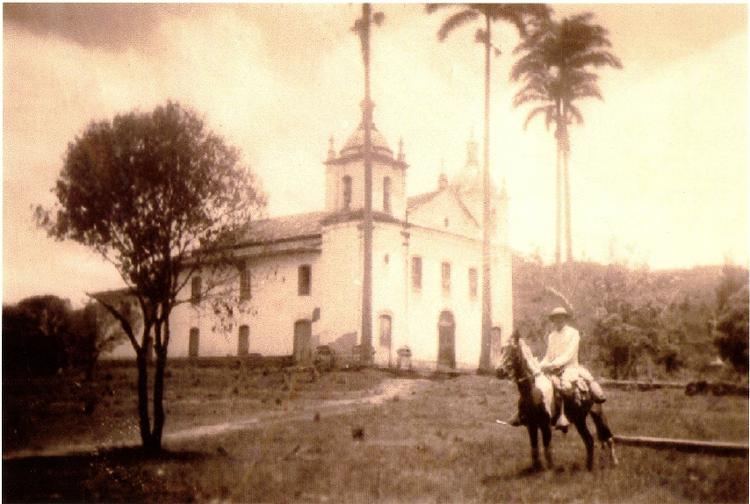
Die Geschichte dieser Ortschaft fängt 1739 mit der Gründung einer Kapelle an, und 1755 wurde daraus die Freguesia von S. João Marcos, ca. 130 km westlich der kolonialen Hauptstadt Rio de Janeiro gelegen. Im Februar 1811 wurde der Ort zur Villa von S. João do Príncipe erhoben, zu Ehren des künftigen Königs D. João VI. Mit dem Putsch der Republik kehrte der alte Bezeichnung S. João Marcos 1890 zurück, nun als Stadt. Der durch das Ende des Kaffeeanbaus und der Sklaverei verursachte wirtschaftliche Abstieg war aber nicht mehr aufzuhalten, und im Dezember 1938 wurde S. João Marcos schließlich ein Distrikt von Rio Claro.
Es kam aber noch schlimmer. Das schnelle Wachstum Rios verlangte neue Energiequellen, und die kanadische Firma Light wurde Anfang des 20. Jahrhunderts beauftragt, ein Wasserkraftwerk durch den Bau eines Stausees am Rio das Lages zu errichten. Einige Distrikte von S. João Marcos wurden dabei überflutet, das war aber nicht genug. Der brasilianische Diktator Getúlio Vargas verfügte daher 1940 per Dekret die gesamte Stadt unter Wasser zu stellen, obwohl sie drei Jahre zuvor unter Denkmalschutz gesetzt worden war.
Durch den Bau des Stausees (Represa do Ribeirão das Lajes) wurde die ganze Stadt abgerissen und ihre Einwohner wurden vertrieben. Häuser, Kinos, Theater, alles kam nieder, sogar die Kirche wurde gesprengt. Heute heißt S. João Marcos ein kleiner Ortsteil von Rio Claro, der ca. 20 km südwestlich der alten Stadt liegt. Der Energieversorger ließ ein archäologisches Museum in der Gegend errichten, um die Geschichte der Stadt aufrecht zu erhalten.
Zurück zum kaiserlichen S. João do Principe. Nova Monteiro (Administrações e Agencias Postaes do Brasil Imperio, in Brasil Filatelico/RJ, 1934-5; Reprint SPP 1994-1999) schreibt den Juni 1829 als Entstehungsdatum fürs örtliche Postamt. Vier Stempel sind überliefert, beginnend mit SRJ-0945a, der bereits im RHM- Catálogo Enciclopédico de Selos & História Postal do Brasil (S. Paulo, 1999) vorgestellt wurde :

Ihm folgte SRJ-0945b (Samml. José A. Junges) : ein Doppelkreis mit der Inschrift S. J. DO PRINCIPE oben und einer (I) unten, mit Daten in der Mitte von 1878 bis 1880. Danach kam SRP-0945c, der durch den Schreibfehler PRINCEPE besticht und bereits von Cicero A. Almeida in Carimbos Postais – século XIX, (Rio de Janeiro, 1989) unter Nr. 742 gezeigt wurde:

Der letzte Stempel von S. João do Principe ist SRJ-0945d (Abb. aus dem Internet): Im Doppelkreis oben ist S. JOÃO DO PRINCIPE wieder berichtigt zu lesen, die Tilde schwebt zwischen A und O, unten ist ein Ornament in Kettenform und die Daten im Zentrum sind aus 1889 und 1890.

 Carimbologia