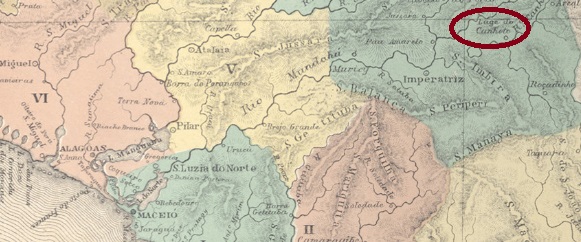
Another name: Lage do Canhoto
This village was formerly a freguesia called Lage do Canhoto, which was located at Vila Nova da Imperatriz on the west bank of the Canhoto River (= left-handed), about 100 km north of the provincial capital Maceió. In July 1876, it rose to a villa, but six years later it was demoted back to a district, now under the name S. José da Lage. The villa status returned in June 1886, and today the municipality of S. José da Laje is written with j.
Two different years were found for the creation of the local post office. Aldo Cardoso (Contribuição para a História dos Correios de Alagoas, Maceió, 1969) writes the quite early year 1835, which may be a misprint. And the Imperial Mail Register (Tabella das Agencias do Correio do Imperio) from 1885 lists the agency from 1872 on, which would be rather plausible. A postmark of the 19th century is available, probably not the oldest. SAL-0205b (Coll. Karlheinz Wittig) has a double circle with the inscriptions S. JOSÉ DA LAGE above and (ALAGOAS) below. The dates at the Centre originate from the period 1891-1894.
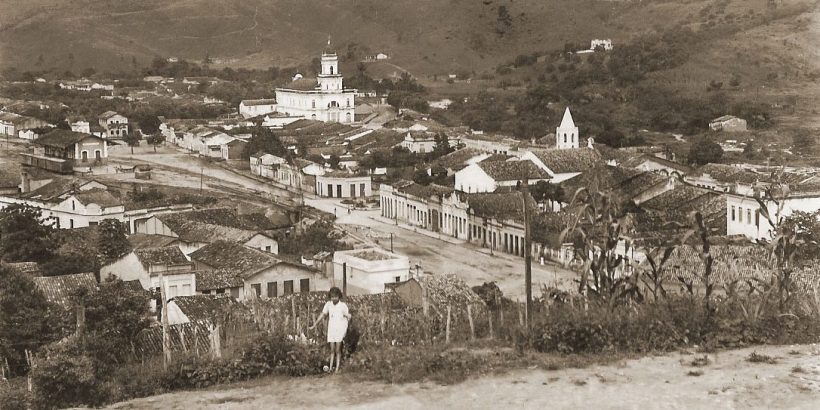
Anderer Name: Lage do Canhoto
Diese Ortschaft war früher eine Freguesia namens Lage do Canhoto, die bei Vila Nova da Imperatriz am Westufer des Flusses Canhoto (= Linkshänder) lag, gut 100 km nördlich der Provinzhauptstadt Maceió entfernt. Im Juli 1876 stieg sie zur Villa auf, aber bereits 6 Jahre später wurde sie zum Distrikt rückgestuft, unter dem Namen S. José da Lage. Der Villa-Status kehrte im Juni 1886 zurück, und heute schreibt sich der Município Laje, mit j.
Zwei Jahresangaben wurden für die Entstehung des örtlichen Postamtes gefunden. Aldo Cardoso (Contribuição para a História dos Correios de Alagoas, Maceió, 1969) schreibt bereits das Jahr 1835, was ein Druckfehler sein mag. Und das Verzeichnis der kaiserlichen Postämter (Tabella das Agencias do Correio do Imperio) von 1885 listet die Agentur ab 1872 auf, was eher plausibel wäre. Ein Poststempel des 19. Jahrhunderts liegt vor, wohl nicht der älteste. SAL-0205b (Samml. Karlheinz Wittig) hat einen Doppelkreis mit den Inschriften S. JOSÉ DA LAGE oben und (ALAGOAS) unten. Die Daten im Zentrum wurden für den Zeitraum 1891-1894 ermittelt.

 Carimbologia