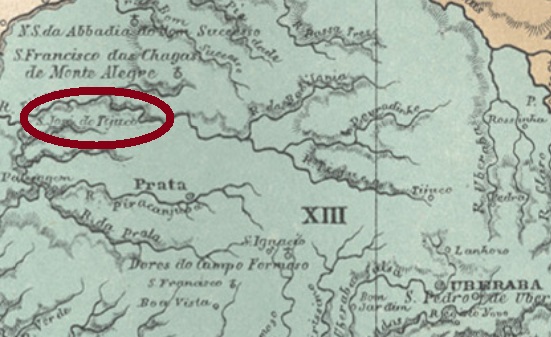
Other names: Villa Platina, Ituiutaba
The word Tejuco (also Tijuco or Tijuca) is very common in Brazilian place names and means mud. From April 1839, São José do Tejuco was a freguesia near Prata, located on the South bank of the Tijuco River, about 750 km west of the provincial capital Ouro Preto. In September 1901, it became politically independent as the municipality of Villa Platina, which has been called Ituiutaba since September 1915. This name has Native American origin and means village on the river meadow.
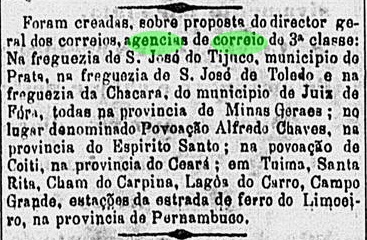
As Paula Sobrinho writes in Historia Postal de Minas Gerais (Belo Horizonte, 1997), the local post office was established in October 1882. This can be confirmed by the press from Rio:
The imperial postmark is SMG-2485a (Coll. José A. Junges): a double circle with the inscription S. JOSÉ DO TEJUCO above and an ornament in diamond form at the bottom, the four sides of which are open. The dates inside date back to the period 1887-1903.
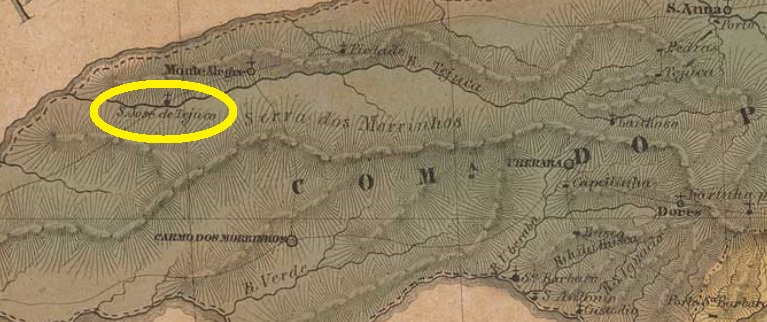
Andere Namen: Villa Platina, Ituiutaba
Das Wort Tejuco (auch Tijuco oder auch Tijuca) kommt sehr häufig in brasilianischen Ortsnamen vor und bedeutet Schwemmland oder Schlamm. São José do Tejuco war ab April 1839 eine Freguesia bei Prata, die am Südufer des Tijuco-Flusses lag, gut 750 km westlich der Provinzhauptstadt Ouro Preto entfernt. Im September 1901 erhielt sie ihre politische Eigenständigkeit als der Município von Villa Platina, der seit September 1915 Ituiutaba heißt. Dieser Name hat indianischen Ursprung und bedeutet Dorf an der Flussaue.
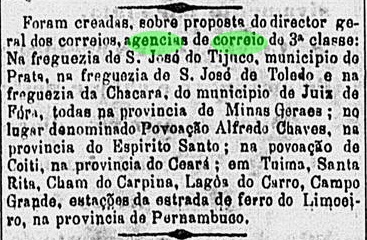
Wie Paula Sobrinho in Historia Postal de Minas Gerais (Belo Horizonte, 1997) schreibt, wurde das örtliche Postamt im Oktober 1882 ins Leben gerufen. Das kann die Presse aus Rio bestätigen:
Der kaiserliche Poststempel ist SMG-2485a (Samml. José A. Junges): ein Doppelkreis mit der Inschrift S. JOSÉ DO TEJUCO oben und einem Ornament in Raute unten, dessen vier Seiten offen sind. Die Daten in der Mitte entstammen dem Zeitraum 1887-1903.

 Carimbologia