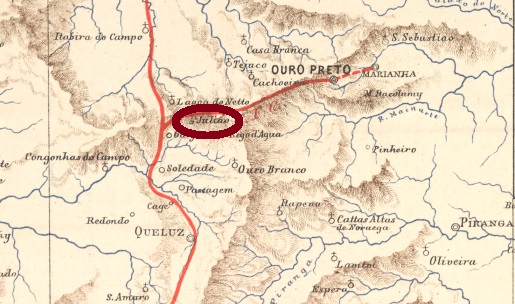
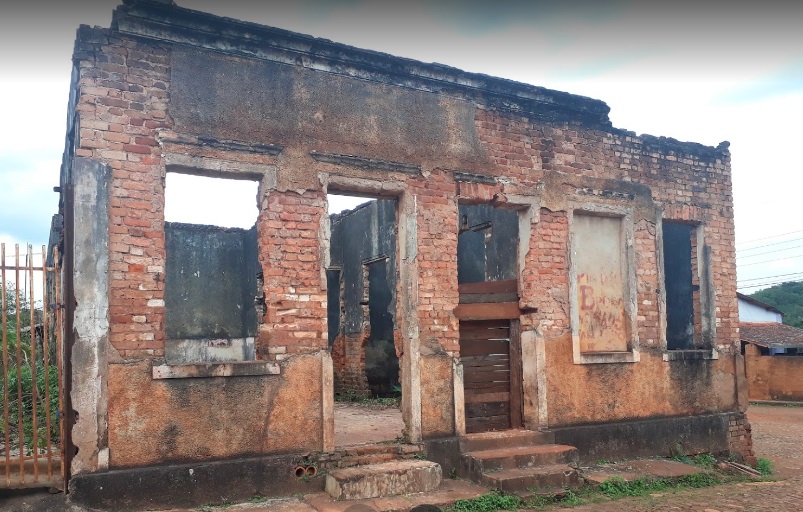
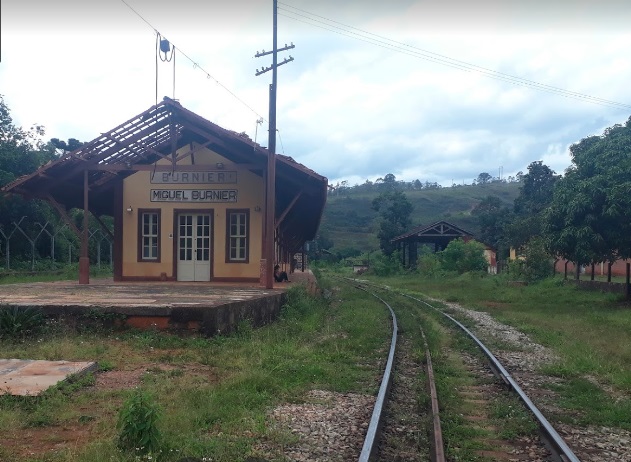
In July 1887, the Estrada de Ferro D. Pedro II railway company, Ponte Nova junction, inaugurated this station in the municipality of Ouro Preto, which was located about 45 km west of the provincial capital. The railway line passed to the E. F. Central do Brasil in 1889 and belonged to the Rede Ferroviária Federal S.A. from 1975 until operation end in 1996. Allegedly, the station building was renovated in 2012 to create a cultural centre (estacoesferroviarias.com.br). However, recent images cast doubt on whether this measure ever took place:
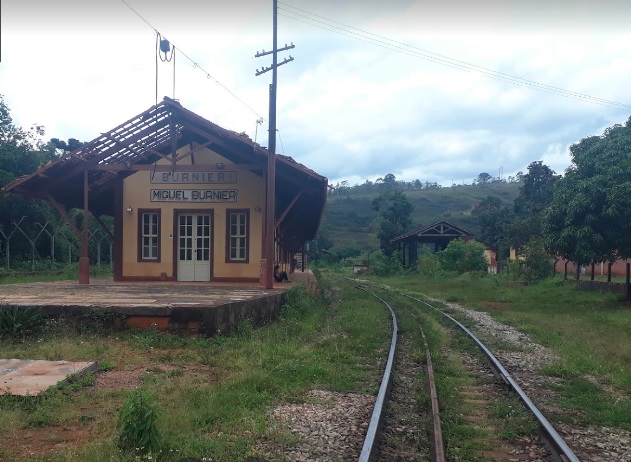
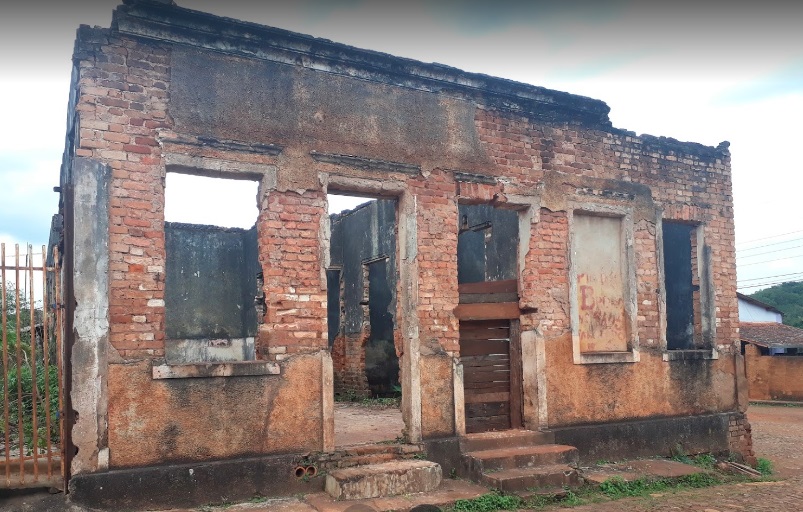
Around the station grew a settlement, which was elevated to a district in August 1911. Since the end of the 19th century, the village experienced an economic boom due to the construction of a modern iron foundry (Fundição Wigg) in September 1893. The station and the district were renamed Miguel Burnier around 1892 and 1948 repectively, after a former director of the D. Pedro II railway company. The iron foundry remained in operation until 1969, when it was bought and closed by the Votorantim Company. There followed an economic decline of the village, which around 2010 had just over 800 inhabitants:
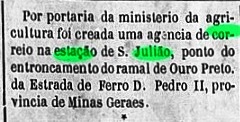
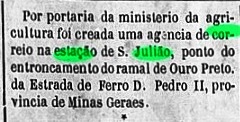
As Paula Sobrinho writes in Historia Postal de Minas Gerais (Belo Horizonte, 1997), the local post office was created in February 1888. This is confirmed by the Rio press:
The imperial cancel of the station is SMG-2500a (image from the Internet): a double circle with the inscriptions E. DE S. JULIÃO (with a hanging tilde between A and O) above and (MINAS) below. One copy found, dated 1889 inside.

São Julião (train station/Bahnhof), Minas Gerais (SMG-2500)
Der Bahnhof São Julião (Sankt Julian) wurde im Juli 1887 von der Estrada de Ferro D. Pedro II Eisenbahngesellschaft, Ponte Nova-Abzweigung, im Município von Ouro Preto eingeweiht und lag knapp 45 km westlich der Provinzhauptstadt. Die Bahnlinie ging 1889 zur E. F. Central do Brasil über und gehörte von 1975 bis Betriebsende 1996 der Rede Ferroviária Federal S.A. Angeblich wurde das Bahnhofgebäude 2012 renoviert, um fortan als Kulturzentrum zu fungieren (estacoesferroviarias.com.br). Neuere Bilder lassen allerdings Zweifel aufkommen, ob diese Maßnahme tatsächlich stattfand:
Rund um den Bahnhof wuchs eine Siedlung, die im August 1911 zum Distrikt erhoben wurde. Seit dem Ende des 19. Jahrhunderts erlebte der Ort einen wirtschaftlichen Aufschwung, bedingt durch den Bau einer modernen Eisengießerei (Fundição Wigg) im September 1893. Der Bahnhof und der Distrikt wurden um 1892 bzw. 1948 zu Miguel Burnier umbenannt, nach einem ehemaligen Direktor der D. Pedro II Bahngesellschaft. Die Eisengießerei blieb in Betrieb bis 1969, als sie von der Firma Votorantim gekauft und abgewickelt wurde. Es folgte ein wirtschaftlicher Verfall des Orts, der um 2010 knapp über 800 Einwohner zählte:
Wie Paula Sobrinho in História Postal de Minas Gerais (Belo Horizonte, 1997) schreibt, entstand das örtliche Postamt im Februar 1888. Das wird durch die Presse aus Rio bestätigt:
Der kaiserliche Stempel des Bahnhofs ist SMG-2500a (Abb. aus dem Internet): ein Doppelkreis mit den Inschriften E. DE S. JULIÃO (wobei die Tilde zwischen A und O schwebt) oben und (MINAS) unten. Ein Exemplar gefunden, datiert 1889 in der Mitte.

 Carimbologia