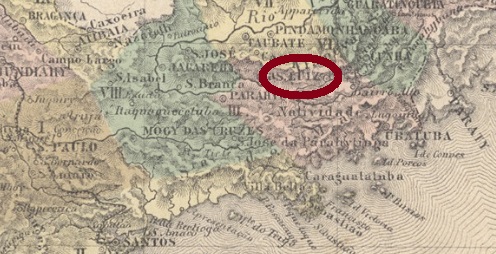
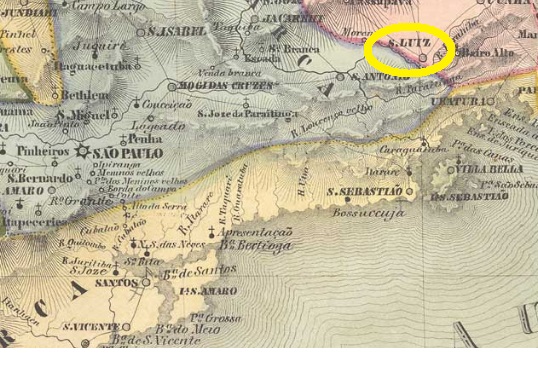
This very old Brazilian village was already in May 1769 a settlement called São Luiz e Santo Antonio do Parahytinga, which was located on the south bank of the river Parahytinga (now written Paraitinga), about 170 km east of the later province capital São Paulo. In January 1773 it rose to a villa and has been a town since April 1857. The Paraitinga is a tributary of the Paraiba, the word originates from the Tupi-Guarani language and supposedly means “bad, bright river”.
Two creation years were found for the local post office. Nova Monteiro (Administrações e Agencias Postaes do Brasil Imperio, in Brasil Filatelico/RJ, 1934-5; Reprint SPP 1994-1999) writes September 1835 for it, while the Imperial Mail Register (Tabella das Agencias do Correio do Imperio) of 1885 lists this agency from 1844.
The pride of the old locality is reflected in the diversity of cancels. Six local cancels (under two place names), seven mute cancels and a handwritten postmark were found, there could well be more. In the beginning there was SSP-1195a, which was found from 1835 to at least 1850 in black, red, and brown and was already shown in the RHM catalogue under P-SP-44:

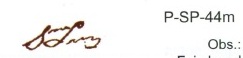
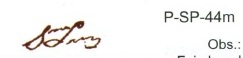
From the pre-philatelic period also comes this handwritten postmark, as seen in RHM under P-SP-44m:
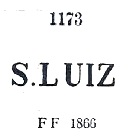
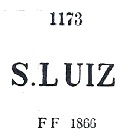
then followed SSP-1195b, which is also found in purple and looks amazingly like SSP-1195a. Since it was found from about 1866 to 1871, it could be a (broken?) variant of his predecessor, to make the new city no longer appear as a villa. Pictured in Paulo Ayres (Catalogo de Carimbos Brasil-Império, S. Paulo, 1937, 1942) under No. 1173:
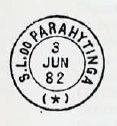
The first postmark with double circle is SSP-1195c (Samml. José A. Junges). The inscription above is S. LUIZ, and below there is a (C), for town (Cidade). Only one copy from 1878 was found. It was followed by the only cancel featuring the full toponym. The French type SSP-1685a was also presented by P. Ayres, this time on p. 118:
Near the end of the Empire, the abbreviated spelling returned in two double-circle stamps. At SSP-1195d (Coll. José A. Junges), who was seen between 1886 and 1889, is the inscription above SA’O LUIZ, below is a four-point square. At SSP-1195e (Coll. José A. Junges) one reads S. LUIZ above, below the ornament is a diamond formed by four small diamonds. Dates inside from 1889 on.
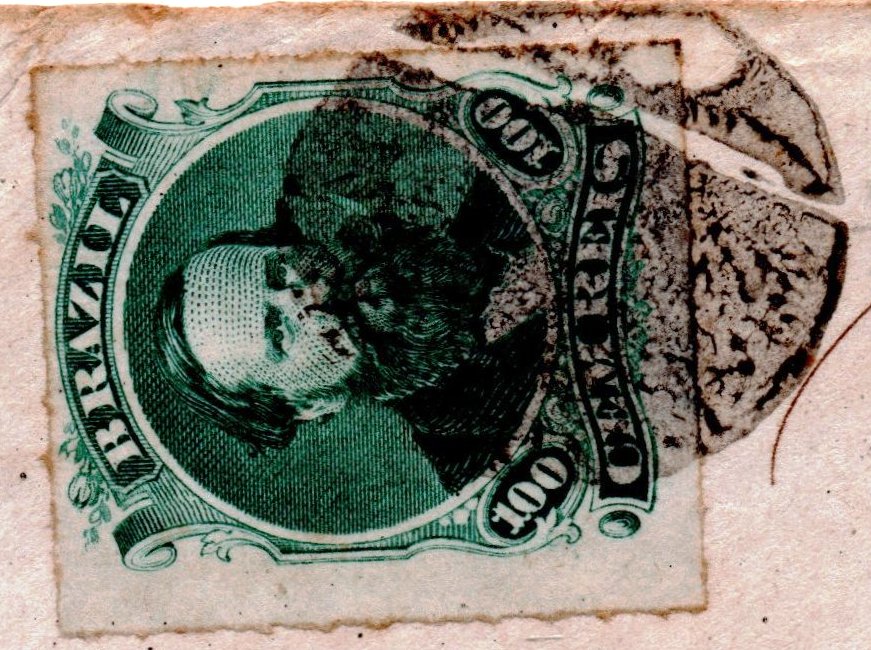
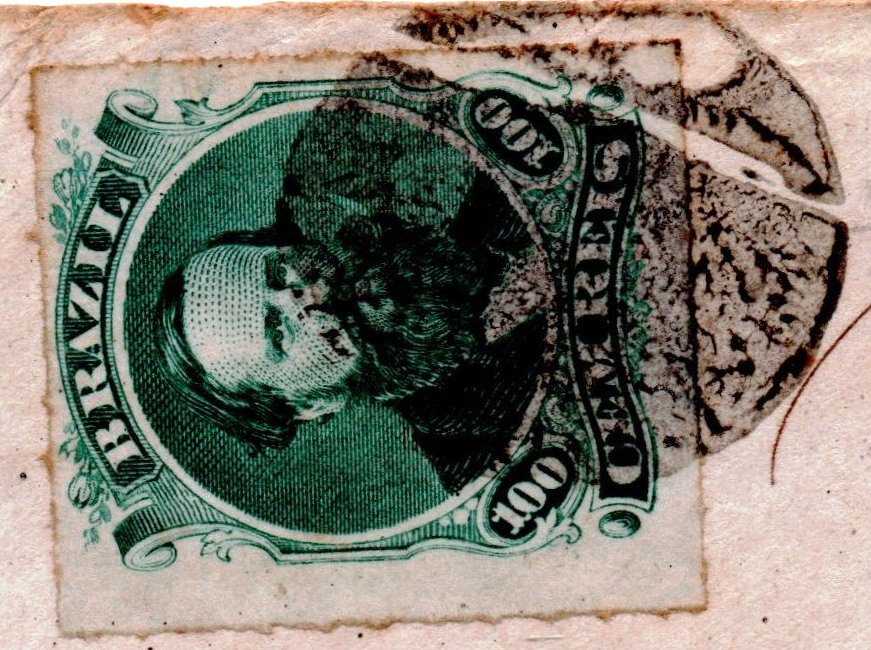
The oldest among the mute cancels is not recorded by Paulo Ayres or James A. Dingler/Klerman W. Lopes (Mute Cancellations of the Brazil Empire/ Carimbos Mudos do Brasil Império, Brazil Philatelic Association, Rio de Janeiro, 2000) and was found on an envelope from 1878:
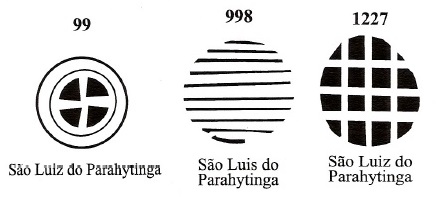
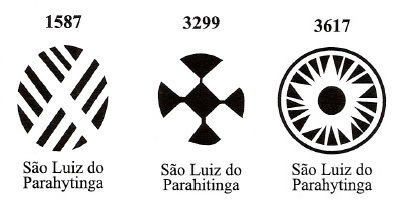
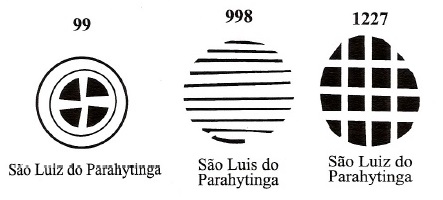
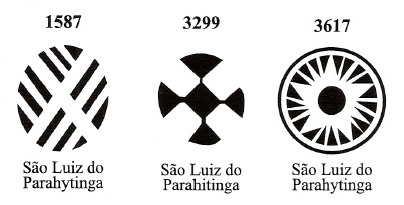
Other six mute postmarks were recorded by Dingler/Lopes or P. Ayres (opp. cit.):
Diese für brasilianische Verhältnisse sehr alte Ortschaft war bereits im Mai 1769 eine Siedlung mit dem Namen São Luiz e Santo Antonio do Parahytinga, die am Südufer des Flusses Parahytinga (heute Paraitinga geschrieben) lag, gut 170 km östlich der späteren Provinzhauptstadt São Paulo entfernt. Im Januar 1773 stieg sie zur Villa auf und ist seit April 1857 eine Stadt. Der Paraitinga ist ein Zufluss des Paraiba, das Wort aus der Tupi-Guarani-Sprache soll „schlechter, heller Fluss“ bedeuten.
Zwei Entstehungsdaten fürs örtliche Postamt wurden gefunden. Nova Monteiro (Administrações e Agencias Postaes do Brasil Imperio, in Brasil Filatelico/RJ, 1934-5; Reprint SPP 1994-1999) schreibt dafür den September 1835, während das Verzeichnis der kaiserlichen Postämter (Tabella das Agencias do Correio do Imperio) von 1885 diese Agentur ab 1844 auflistet.
Der Stolz der alten Stadt spiegelt sich in der Vielfalt der Stempel wider. Es wurden 6 Ortsstempel (unter 2 Ortsnamen), 7 stumme Stempel und eine handschriftliche Entwertung gefunden, es könnte durchaus noch weitere geben. Am Anfang war SSP-1195a, der ab 1835 bis mindestens 1850 in schwarz, rot und braun gefunden wurde und bereits im RHM-Katalog unter P-SP-44 abgebildet wurde:

Auch aus der Vorphila-Zeit stammt diese handschriftliche Entwertung, im RHM unter P-SP-44m zu sehen:
Es folgte SSP-1195b, der auch in violett vorkommt und verblüffend ähnlich wie SSP-1195a ist. Da er von ca. 1866 bis 1871 gefunden wurde, könnte er eine (abgebrochene?) Variante seines Vorgängers sein, um die neue Stadt nicht mehr als Villa erscheinen zu lassen. Abgebildet in Paulo Ayres (Catálogo de Carimbos Brasil-Império, S. Paulo, 1937, 1942) unter Nr. 1173:
Der erste Poststempel im Doppelkreis ist SSP-1195c (Samml. José A. Junges). Die Inschrift oben lautet S. LUIZ, und unten steht (C), für Stadt (Cidade). Nur ein Exemplar aus 1878 gefunden. Ihm folgte der bisher einzige Stempel mit dem vollständigen Ortsnamen. Der Französischer-Typus SSP-1685a wurde auch von P. Ayres abgebildet, diesmal auf S. 118:
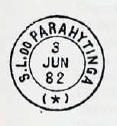
Am Ende des Kaiserreichs kehrte die gekürzte Schreibweise in zwei Doppelkreisstempeln zurück. Bei SSP-1195d (Samml. José A. Junges), der zwischen 1886 und 1889 zu sehen war, lautet die Inschrift oben SA’O LUIZ, unten ist ein durch vier Punkte gebildetes Viereck. Bei SSP-1195e (Samml. José A. Junges) liest man S. LUIZ oben, unten ist das Ornament diesmal eine Raute, die durch vier kleine Rauten gebildet ist. Daten in der Mitte ab 1889.
Die bisher älteste unter den stummen Entwertungen ist weder bei Paulo Ayres noch bei James A. Dingler/Klerman W. Lopes (Mute Cancellations of the Brazil Empire/ Carimbos Mudos do Brasil Império, Brazil Philatelic Association, Rio de Janeiro, 2000) erfasst und wurde auf einem Kuvert aus 1878 gefunden:
Weitere 6 stummen Poststempel sind bei Dingler/Lopes bzw. P. Ayres (opp. cit.) registriert:

 Carimbologia