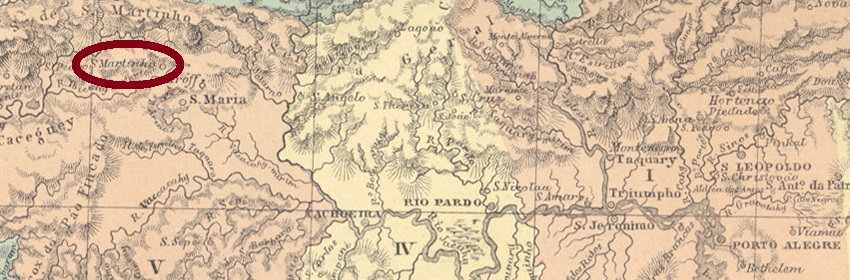
Another name: São Martinho da Serra
From the middle of the 19th century, this village was a freguesia of Cruz Alta, which was located close to the west bank of the Ibucuhy-Mirim River, about 320 km west of the provincial capital Porto Alegre. In May 1876, it was elevated to villa, but in 1901 the descent followed as a district of Santa Maria. It was not until March 1992 that political emancipation was regained, this time under the toponym of São Martinho da Serra.
According to Nova Monteiro, there has been a post office there since September 1866. This sounds rather improbable, because it was only ten years later that São Marinho became a villa. Furthermore, there was no news in the press, and the oldest available cancels have later dates. SRS-0230a (Coll. José A. Junges) is also available in purple and has a double circle with the inscription S. MARTINHO above. Dates in the middle from 1879 to 1884. SRS-0230b (Coll. José A. Junges) has the same inscription in larger letters above, but now there is also an ornament in cross below, which consists of four converging arrowheads. It also occurs in red and has internal dates from 1885 to 1887.
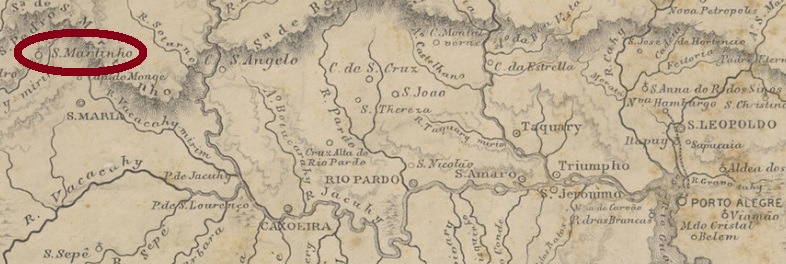
Anderer Name: São Martinho da Serra
Diese Ortschaft war ab Mitte des 19. Jahrhunderts eine Freguesia von Cruz Alta, die nah am Westufer des Flusses Ibucuhy-Mirim lag, ca. 320 km westlich der Provinzhauptstadt Porto Alegre entfernt. Im Mai 1876 wurde der Ort zu Villa erhoben, aber 1901 folgte der Abstieg als Distrikt von Santa Maria. Erst im März 1992 konnte die politische Emanzipation wieder erlangt werden, diesmal unter dem Ortsnamen São Martinho da Serra.
Laut Nova Monteiro gibt es dort ein Postamt seit September 1866. Das klingt eher unwahrscheinlich, denn erst zehn Jahre später wurde São Marinho eine Villa. Dann war keine diesbezügliche Nachricht in der Presse zu finden, und die ersten Stempel haben spätere Daten. SRS-0230a (Samml. José A. Junges) kommt auch in violett vor und ist ein Doppelkreis mit der Inschrift S. MARTINHO oben. Daten in der Mitte von 1879 bis 1884. SRS-0230b (Samml. José A. Junges) hat die gleiche Inschrift in größeren Buchstaben oben, aber nun gibt es auch ein Ornament in Kreuz unten, das aus vier konvergierenden Pfeilspitzen besteht. Es kommt auch in rot vor und hat interne Daten von 1885 bis 1887.

 Carimbologia