Other names: São Miguel Archanjo, São Miguel das Missões
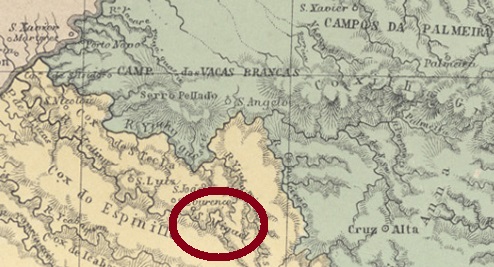
This village is famous because the Jesuits have built there one of the seven mission settlements (Sete Povos das Misses) for the Indians of the Guarani tribe since the 17th century. After long-time assaults by the Bandeirantes from São Paulo and after many wars between Spaniards and Portuguese, Jesuits and Indians were their main victims, and today only ruins remain of that civilization, as a tourist attraction.
Only towards the end of the Empire was an orderly settlement possible again. The district of Santo Angelo was built in May 1881, located about 480 km northwest of the provincial capital Porto Alegre. The place grew so slowly that it only emancipated itself more than a century later, in April 1988, when the municipality of São Miguel das Missões.
According to the Imperial Mail Register (Tabella das Agencias do Correio do Imperio, Rio de Janeiro, 1885), there has been a post office there since 1881. However, there are so many D.Pedro editions from 1866 with the local cancel SRS-0365a (Coll. José A. Junges) that one wonders whether this agency was not in operation earlier. The cancel is a double circle with the inscriptions S. MIGUEL above and S. PEDRO DO SUL below. There was free space in the inner circle to enter the date by hand, which rarely happened, as the available copies (used until at least 1889) show.
Andere Namen: São Miguel Archanjo, São Miguel das Missões
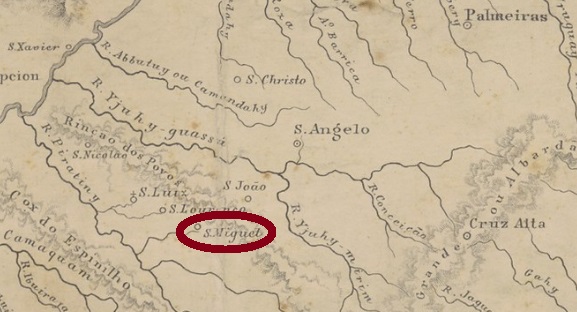
Diese Ortschaft ist berühmt, da die Jesuiten dort seit dem 17. Jahrhundert einen der sieben Missionssitze (Sete Povos das Missões) für die Indianer des Guarani-Stamms gebaut haben. Nach den Plünderungen der Bandeirantes aus São Paulo und nach den vielen Kriegen zwischen Spaniern und Portugiesen waren Jesuiten und Indianer die Hauptleidtragenden, und heute sind nur noch Ruinen als touristische Attraktion übriggeblieben.
Erst gegen Ende des Kaiserreichs war wieder eine geordnete Siedlung möglich. Der Distrikt von Santo Angelo entstand im Mai 1881 und lag ca. 480 km nordwestlich der Provinzhauptstadt Porto Alegre entfernt. Der Ort wuchs so langsam, dass er sich erst über ein Jahrhundert später emanzipierte, im April 1988, als Município von São Miguel das Missões.
Laut dem Verzeichnis der kaiserlichen Postämter (Tabella das Agencias do Correio do Imperio, Rio de Janeiro, 1885) gibt es dort ein Postamt seit 1881. Allerdings sind so viele D. Pedro-Ausgaben von 1866 mit dem Ortsstempel SRS-0365a (Samml. José A. Junges) vorhanden, dass man sich fragen muss, ob diese Agentur nicht schon früher in Betrieb war. Der Stempel ist ein Doppelkreis mit des Inschriften S. MIGUEL oben und S. PEDRO DO SUL unten. Im Innenkreis war freier Raum, um das Datum per Hand einzutragen, was wohl selten passiert ist, wie die bis mindestens 1889 vorhandenen Exemplare zeigen.

 Carimbologia