Other names: Sao João Evangelista de Biguassú, Guaporanga (1943)
See also Biguaçu (R. Koester: Carimbologia IV)
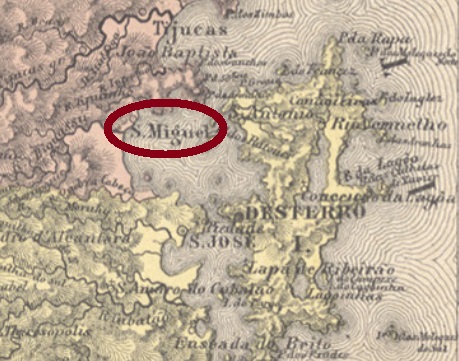
Like its namesake in the province of São Pedro do Rio Grande, this São Miguel of the neighbouring province of Santa Catarina has an eventful history. The settlement officially started in 1747, the village was located about 40 km northwest of the future capital Desterro (today Florianópolis) and became already in March 1833 a villa. Three descents to district followed: in July 1873 subordinated to Tijucas, in August 1886, to S. João Evangelista de Biguassu and most recently in April 1894, again to Biguassu (today written Biguaçu). In between, in April 1875 and 1888, the headquarters of a villa was in Sao Miguel. Since December 1943, the town has been called Guaporanga. The name has native American origin, describing a medicinal plant of the Myrtaceae family (Marlierea tomentosa, Cambess):

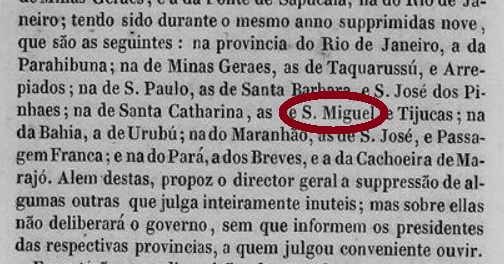
The postal history of this place is also turbulent and still has gaps. We do not yet know when this post office first opened, but it closed around 1846, as can be read in the Brazilian Yearbook (Annuario Politico, Historico e Estatistico do Brazil) for 1847:
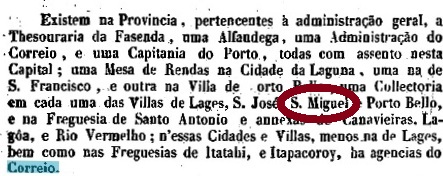
Although the next opening of the post office was not announced until 1875 in the report of the provincial president, the similar report of January 1850 indirectly mentioned the existence of a post office in São Miguel:
No postmark in the imperial era could be surely assigned to this village.
Andere Namen: São João Evangelista de Biguassú, Guaporanga (1943)
Siehe auch Biguaçu (R. Koester: Carimbologia IV)
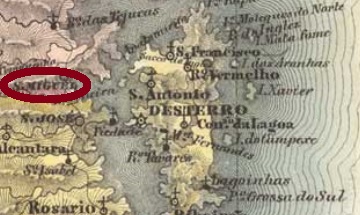
Wie sein Namensvetter in der Provinz São Pedro do Rio Grande, auch dieser São Miguel der Nachbarprovinz Santa Catarina hat eine wechselvolle Geschichte. Die Siedlung startete offiziell im Jahr 1747, der Ort lag knapp 40 km nordwestlich der künftigen Hauptstadt Desterro (heute Florianópolis) und wurde bereits im März 1833 eine Villa. Es folgten drei Abstiege als Distrikt: im Juli 1873 zu Tijucas, im August 1886 S. João Evangelista de Biguassu und zuletzt im April 1894, nochmals zu Biguassu (heute Biguaçu geschrieben). Zwischendurch – nämlich im April 1875 und in 1888 – war São Miguel Hauptsitz einer Villa. Seit Dezember 1943 heißt der Ort Guaporanga. Der Name hat indianischen Ursprung, so heißt eine Medizinpflanze der Familie der Myrtaceae (Marlierea tomentosa, Cambess):
Auch die Postgeschichte dieses Orts ist turbulent und weist noch Lücken auf. Wir wissen noch nicht, wann dieses Postamt erstmals eröffnet hat, aber es hat um 1846 geschlossen, wie aus dem Brasilien-Jahrbuch (Annuario Politico, Historico e Estatistico do Brazil) für 1847 hervorgeht:
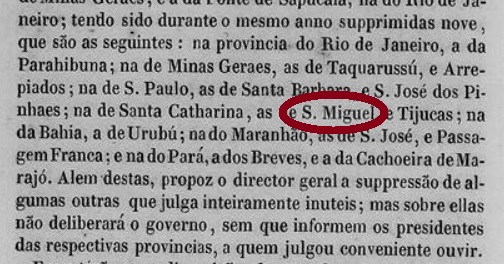
Obwohl die nächste Posteröffnung erst 1875 im Bericht des Provinzpräsidenten bekannt gegeben wurde, erwähnte der Bericht vom Januar 1850 indirekt das Vorhandensein eines Postamts in São Miguel:
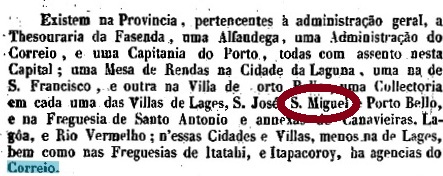
Kein Poststempel in der Kaiserzeit konnte bisher mit Sicherheit dieser Ortschaft zugeordnet werden.

 Carimbologia