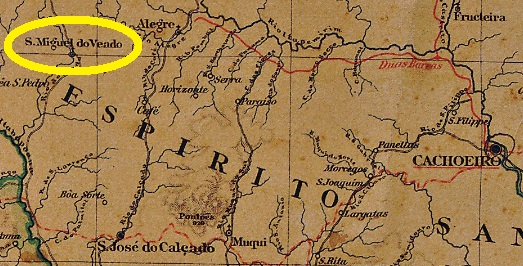
Other names: Veado, Siqueira Campos, Guaçuí (1943).
This locality was a freguesia of Cachoeira do Itapemerim from July 1866, located on the river Veado (roughly: deer/doe), over 220 km southwest of the provincial capital Vitória. In April 1884, it transferred as a district to the newly created municipality of Alegre and became the Município of Veado in December 1928. Since then, the municipality has been renamed twice: in August 1931 to Siqueira Campos and in December 1943 to the current Guaçuí. Lieutenant Antonio de Siqueira Campos (1898-1930) was a participant in the failed Copacabana revolt of 1922. The Tupi word Guaçuí means river of deer.
As Paulo Novaes (agenciaspostais.com.br) writes, there has been a post office there since November 1881. The imperial-era postmark is SES-0155a (Coll. José A. Junges). A double circle with the inscription S. MIGUEL DO VEADO on top and an ornament in cross below, formed by four small diamonds. Found with dates in the centre between 1887 and 1891.
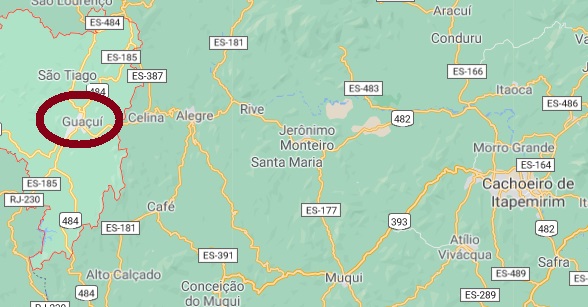
Andere Namen: Veado, Siqueira Campos, Guaçuí (1943)
Diese Ortschaft war ab Juli 1866 eine Freguesia von Cachoeira do Itapemerim, die am Fluss Veado (etwa: Hirsch/Reh) lag, gut 220 km südwestlich der Provinzhauptstadt Vitória entfernt. Im April 1884 wechselte sie als Distrikt zum neu gegründeten Município von Alegre über und wurde im Dezember 1928 der Município von Veado. Seitdem wurde die Gemeinde zweimal umbenannt: im August 1931 zu Siqueira Campos und im Dezember 1943 zum aktuellen Guaçuí. Der Leutnant Antonio de Siqueira Campos (1898-1930) war ein Teilnehmer der missglückten Copacabana-Revolte von 1922. Das tupi-Wort Guaçuí bedeutet Fluss der Rehe.
Wie Paulo Novaes (agenciaspostais.com.br) schreibt, gibt es dort ein Postamt seit November 1881. Der Poststempel der Kaiserzeit ist SES-0155a (Samml. José A. Junges). Ein Doppelkreis mit der Inschrift S. MIGUEL DO VEADO oben und einem Ornament in Kreuz unten, das aus vier kleinen Rauten besteht. Gefunden mit Daten in der Mitte zwischen 1887 und 1891.

 Carimbologia