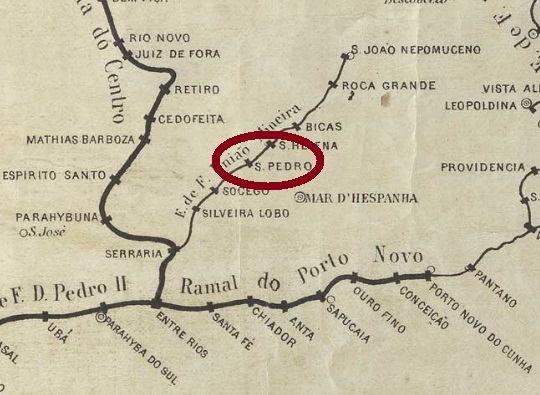
Another name: Pequery (Estação).
This station was inaugurated in July 1879 by the E.F. União Mineira railway company and was located on the Caratinga Line near Juiz de Fora, just under 280 km south of the provincial capital Ouro Preto. In 1884, the railway line was transferred to the Estrada de Ferro Leopoldina, and from 1975 until the end of operations in 1994, it belonged to Rede Ferroviária Federal. In the 1940s, the name changed to Pequeri, a word in the Tupi language that is said to mean River of the Little Fish. Now the rails have been torn out and the station building has become a small bistro.
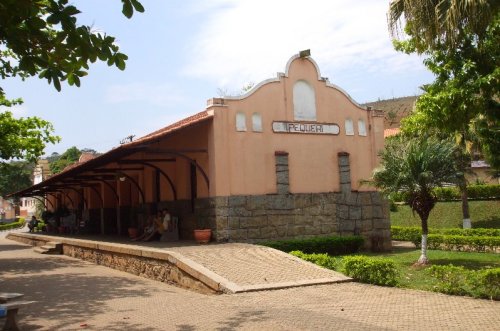
Paula Sobrinho writes in História Postal de Minas Gerais (Belo Horizonte, 1997) that there has been a station post office since July 1877. This is probably a typo, as this date is two years before the inauguration of the station. Two 19th century double-circle postmarks were found. SMG-2545a (coll. Karlheinz Wittig) has the inscription S. PEDRO (ESTAÇÃO) at the top, dated inside from 1883 to 1889. SMG-2545b (coll. José A. Junges) now has EST. DE S. PEDRO above and at the bottom it reads (MINAS). Dates in the middle: 1890-1899.
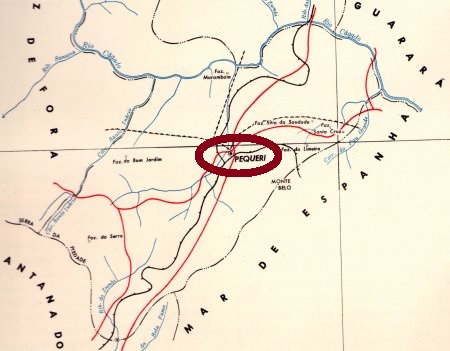
Anderer Name: Pequery (Estação)
Dieser Bahnhof wurde im Juli1879 durch die E.F. União Mineira Bahngesellschaft eingeweiht und lag auf der Caratinga-Linie bei Juiz de Fora, knapp 280 km südlich der Provinzhauptstadt Ouro Preto entfernt. 1884 ging die Bahnlinie zur Estrada de Ferro Leopoldina über, und von 1975 bis Betreibsende 1994 gehörte sie der Rede Ferroviária Federal. In den 40er Jahren wechselte der Name zu Pequeri, ein Wort der Tupi-Sprache, das Fluss der Fischlein bedeuten soll. Nun sind die Schienen ausgerissen, aus dem Bahnhofsgebäude wurde ein kleines Bistro.
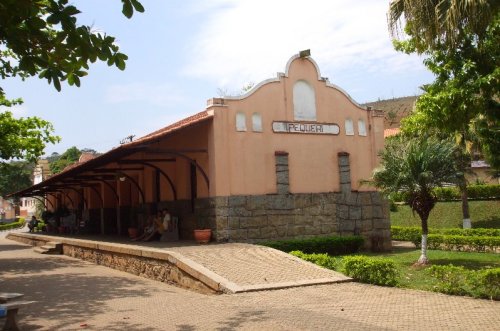
Paula Sobrinho schreibt in História Postal de Minas Gerais (Belo Horizonte, 1997), dass es dort seit Juli 1877 ein Postamt gibt. Das dürfte ein Tippfehler sein, denn dieses Datum liegt zwei Jahre vor der Bahnhofseinweihung. Zwei Poststempel im Doppelkreis aus dem 19. Jahrhundert wurden gefunden. SMG-2545a (Samml. Karlheinz Wittig) hat die Inschrift S. PEDRO (ESTAÇÃO) oben, datiert im Inneren von 1883 bis 1889. Bei SMG-2545b (Samml. José A. Junges) heißt es nun oben EST. DE S. PEDRO und unten liest man (MINAS). Daten in der Mitte: 1890-1899.

 Carimbologia