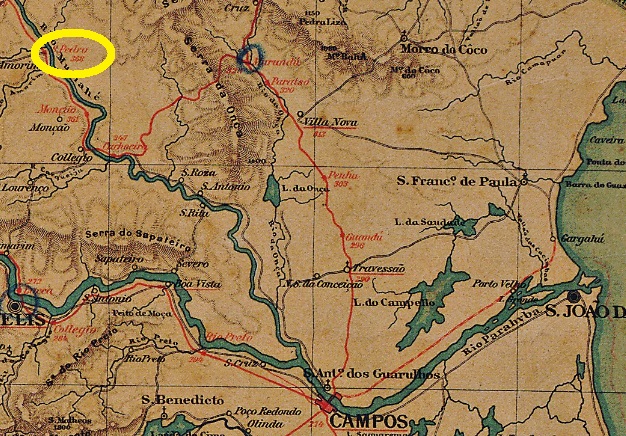
This station was inaugurated in June 1880 by the E. F. Carangola Railway Company in the municipality of Campos dos Goytacazes and was located on the north bank of the Muriaé River, about 320 km northeast of the capital Rio de Janeiro. The railway line changed hands three times: in 1890 to the Cia. Barão de Araruama and then to the Estrada de Ferro Leopoldina, in 1975 to the Rede Ferroviária Federal. The railway ceased to operate in 1977, the rails have since disappeared, and the station building was last used as a Baptist church hall (estacoesferroviarias.com.br).
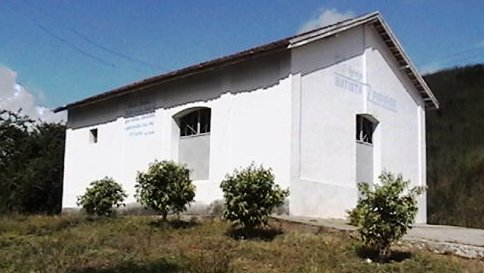
The station was renamed Paraiso in 1892; around it grew a settlement, now the district of Paraíso, in the Município of Italva. This municipality first became a município in 1983. Nevertheless, due to a formal error, this administrative autonomy was soon revoked and only restored in 1986.
According to the Imperial Mail Register (Tabella das Agencias do Correio do Imperio, 1885), there was a station post office since 1880. Two postmarks in double circle were found. SRJ-1893a (Coll. José A. Junges) has the inscription E. DE S. PEDRO; the only existing specimen bears a date from 1883 in the centre. SRJ-1893b (coll. Klerman W. Lopes) now has the inscription EST. DE S. PEDRO at the top and E.F. DO CARANGOLA at the bottom. Two copies dated 1889 at the centre.
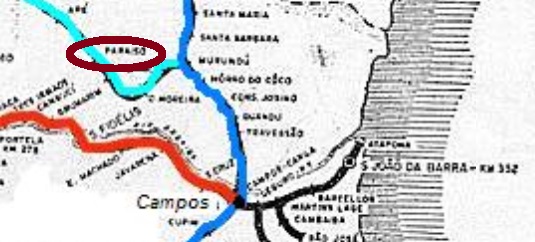
Dieser Bahnhof wurde im Juni 1880 durch die E. F. Carangola Bahngesellschaft im Município von Campos dos Goytacazes eingeweiht und lag am Nordufer des Flusses Muriaé, gut 320 km nordöstlich der Hauptstadt Rio de Janeiro entfernt. Die Bahnlinie wechselte den Besitzer dreimal: 1890 zu der Cia. Barão de Araruama und gleich danach zur Estrada de Ferro Leopoldina, und 1975 zur Rede Ferroviária Federal. Der Bahnbetrieb wurde 1977 eingestellt, die Schienen sind inzwischen weg, und das Bahnhofsgebäude diente zuletzt als Kirchraum der Baptisten (estacoesferroviarias.com.br).
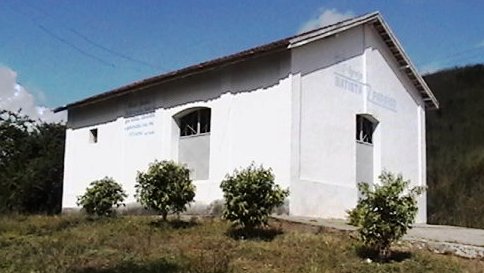
Der Bahnhof wurde 1892 zu Paraiso umbenannt; um ihn herum wuchs eine Siedlung, die heute der Distrikt von Paraíso ist, im Município von Italva. Diese Gemeinde wurde erstmals 1983 ein Município. Durch einen Formfehler wurde dennoch diese Verwaltungsautonomie bald aufgehoben und erst 1986 wiederhergestellt.
Laut Verzeichnis der kaiserlichen Postämter (Tabella das Agencias do Correio do Imperio, 1885) gab es ein Bahnhofspostamt seit 1880. Zwei Poststempel in Doppelkreis wurden gefunden. SRJ-1893a (Samml. José A. Junges) hat die Inschrift E. DE S. PEDRO; das einzige vorhandene Exemplar trägt ein Datum aus 1883 in der Mitte. SRJ-1893b (Samml. Klerman W. Lopes) hat nun oben die Inschrift EST. DE S. PEDRO und unten E.F. DO CARANGOLA. Zwei Exemplare, datiert 1889 in der Mitte.

 Carimbologia