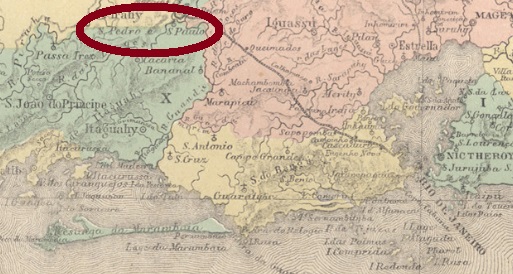
Other names: Macacos, Paracambi (1901).
This locality with the long name São Pedro e São Paulo do Ribeirão das Lages (Peter and Paul of the Stone Plate Creek) was, from May 1892, a district of Itaguahy, located on the north bank of the Guandu River, more than 80 km northwest of the capital Rio de Janeiro. After that, the place name changed twice: in December 1895 to Macacos (Monkeys) and six years later to Paracambi. The Tupi word means large forest by the wide river. Paracambi has been a separate município since August 1960.
As Paulo Novaes (agenciaspostais.com.br) writes, there has been a post office there since November 1875, and two imperial-era postmarks were found. SRJ-1480a also exists in violet, was in circulation until at least 1877 and was already presented by Paulo Ayres (Catálogo de Carimbos Brasil-Império, S. Paulo, 1937, 1942) under no. 1474.
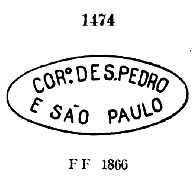
It was followed by the “French type” SRJ-1480b (Coll. Henrique B. Ferreira): a double circle with the inscription S. PEDRO E S. PAULO above and the star between brackets below. Dates in the centre, found within the period 1883-1888.
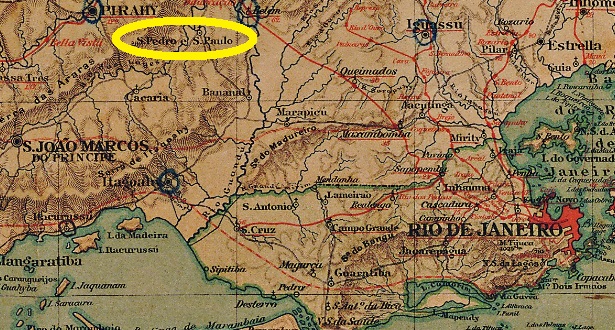
Andere Namen: Macacos, Paracambi (1901)
Diese Ortschaft mit dem langen Namen São Pedro e São Paulo do Ribeirão das Lages (Peter und Paul vom Steinplattenbach) war ab Mai 1892 ein Distrikt vom Itaguahy, der am Nordufer des Flusses Guandu lag, über 80 km nordwestlich der Hauptstadt Rio de Janeiro entfernt. Danach wechselte der Ortsname zweimal: im Dezember 1895 zu Macacos (Affen) und sechs Jahre später zu Paracambi. Das Tupi-Wort bedeutet großer Wald am breiten Fluss. Paracambi ist seit August 1960 ein eigener Município.
Wie Paulo Novaes (agenciaspostais.com.br) schreibt, gibt es dort ein Postamt seit November 1875. Zwei Poststempel der Kaiserzeit wurden gefunden. SRJ-1480gibt es auch in violett, war im Umlauf bis zumindest 1877 und wurde bereits durch Paulo Ayres (Catálogo de Carimbos Brasil-Império, S. Paulo, 1937, 1942) unter Nr. 1474 vorgestellt.
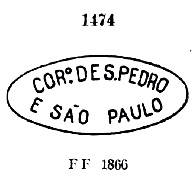
Ihm folgte der „französische Typ“ SRJ-1480b (Samml. Henrique B. Ferreira): ein Doppelkreis mit der Inschrift S. PEDRO E S. PAULO oben und dem Stern zwischen Klammern unten. Zwei Exemplare gefunden, datiert 1883-1888 in der Mitte.

 Carimbologia