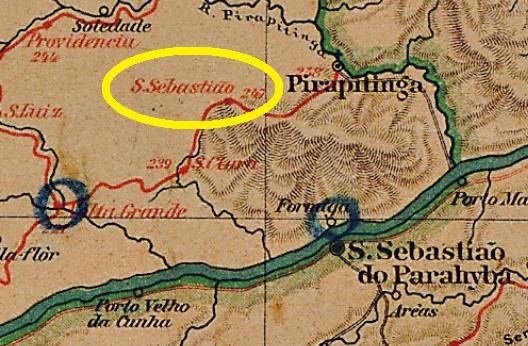
Other names: Estrela (1938), Estrela Dalva (1943)
This station post office is a special case whose story still has blanks to fill in. It had four different names in less than 15 years – with corresponding postmarks – and two other place names followed. Furthermore, it is not yet clear when exactly the station was built, but apparently the post office started operations beforehand.
The railway line between Volta Grande and Sant’Anna de Pirapetinga in the province of Minas Geraes was planned in the late 1860s by the Companhia União e Industria. Although the client was the Estrada de Ferro do Pirapetinga railway company, this has operated the line for a very short time, if at all, because the E. F. Leopoldina already acted as a line owner at the end of 1879.
The station was in the municipality of Sao José d’Além Parahyba, about 320 km southeast of the provincial capital Ouro Preto, and was intended to serve the municipalities on both banks of the Parahyba River, especially São Sebastião do Parahyba in the province of Rio de Janeiro. Since the postal system was then managed from Rio, the station post office was given the name of São Sebastião. Three inauguration dates for the station have been found: first in October 1874 (Paula Sobrinho: História Postal de Minas Gerais, Belo Horizonte, 1997), then in December 1879 (A Actualidade, 21.01.1880) and finally in 1880 (estacoesferroviarias.com.br).
But this station had probably been given another name, São Vicente – now by the province of Minas Gerais. As a result, not only were two different postmarks in circulation at the post office, but the post office was also listed twice in the 1885 Imperial Mail Register (Tabella das Agencias do Correio do Imperio).
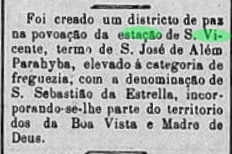
To defuse this confused situation in Solomon terms, in 1882 the provincial parliament in Ouro Preto decided by Provincial Law No. 2.988 to declare the village as a district and to call it henceforth São Sebastião da Estrella:
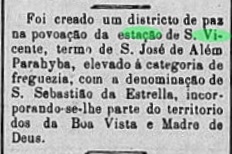
However, it took a while for this place name to appear in the stamps; before that, the name of São Sebastião do Pirapetinga was added, apparently without any legal basis. A relatively quiet time followed. It was not until December 1938 that the district was renamed Estrella, and exactly five years later the district was given the name Estrela Dalva, which has been a municipality since December 1953.
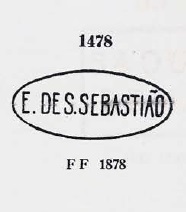
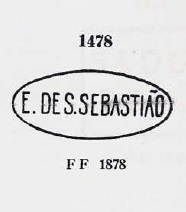
There are four creation dates for the station post office: 1872 (Tabella/1885), April 1877 (O Globo/RJ, 05.04.1877), December 1879 (O Apostolo, 31.12.1879) and July 1881 (Paula Sobrinho, op. cit.). The first postmark of this station is SMG-2575a, which was already shown by Paulo Ayres in Catalogo de Carimbos Brasil-Império (S. Paulo, 1937, 1942) under No. 1478:
It was followed by four cancels with double circles. SMG-2575b (Coll. José A. Junges) is also available in blue and has above the inscription E. DE S. SEBASTIÃO, with dates inside from 1881 to 1883ff. SMG-2647a (Coll. Karlheinz Wittig) is also found in blue and has the inscriptions S. SEBASTIÃO DO PIRAPETA. above and (ESTAÇÃO) below. It is dated inside from 1884ff to 1890. SMG-2668a (Coll. José A. Junges) has the inscription S. VICENTE (ESTAÇÃO) above, with dates from 1883ff to 1889 inside. Finally, SMG-2586a (image from the Internet) is likely to be Republican, since the internal dates go from 1891 to 1903. Here are the inscriptions S. SEBASTIÃO DA ESTRELLA above and (M.G.) below.
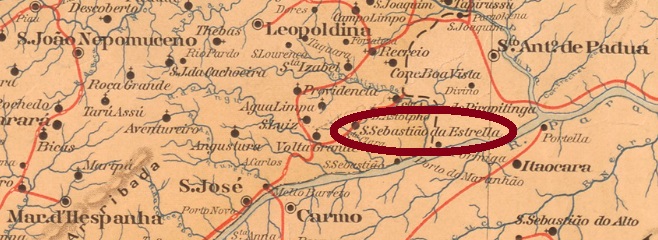
Andere Namen: Estrela (1938), Estrela Dalva (1943)
Dieses Bahnhofpostamt ist ein Sonderfall, dessen Geschichte noch lange nicht zu Ende erzählt wurde. Es hatte vier verschiedene Namen in weniger als 15 Jahren – mit entsprechenden Poststempeln – und weitere zwei Ortsnamen sind später dazu gekommen. Dann ist es noch nicht klar, wann genau der Bahnhof erbaut wurde, aber offenbar nahm das Postamt seinen Betrieb vorher auf.
Die Bahnlinie zwischen Volta Grande und Sant’Anna de Pirapetingain der Provinz Minas Geraes wurde ab Ende der 1860er Jahre von der Companhia União e Industria geplant und gebaut. Auftraggeber war zwar die Estrada de Ferro do Pirapetinga Bahngesellschaft, die aber – wenn überhaupt – sehr kurze Zeit die Linie betrieben hat, denn bereits Ende 1879 fungierte die E. F. Leopoldina als Linieninhaberin.
Der Bahnhof lag im Município von São José d’Além Parahyba, ca. 320 km südöstlich der Provinzhauptstadt Ouro Preto entfernt, und sollte die Gemeinden an beiden Ufern des Flusses Parahyba bedienen, besonders São Sebastião do Parahyba in der Provinz Rio de Janeiro. Da das Postwesen zunächst von Rio aus verwaltet wurde, bekam das Bahnhofspostamt zunächst den Namen São Sebastião. Drei Einweihungsdaten für den Bahnhof sind überliefert: erstmals im Oktober 1874 (Paula Sobrinho: História Postal de Minas Gerais, Belo Horizonte, 1997), dann im Dezember 1879 (A Actualidade, 21.01.1880), und zuletzt 1880 (estacoesferroviarias.com.br).
Nun aber hatte dieser Bahnhof einen anderen Namen – São Vicente – wohl von der Provinz Minas Gerais verpasst bekommen. Dies hatte zur Folge, dass nicht nur bald zwei unterschiedliche Poststempel an der Post im Umlauf waren, sondern auch das Postamt zweimal im Verzeichnis der kaiserlichen Postämter (Tabella das Agencias do Correio do Imperio, Rio de Janeiro, 1885) aufgelistet ist.
Um diese konfuse Lage salomonisch zu entzerren, entschied sich 1882 das Provinzparlament in Ouro Preto durch das Provinzialgesetz Nr. 2.988 dafür, die Ortschaft als Distrikt zu erklären und fortan São Sebastião da Estrella zu nennen:
Es dauerte jedoch eine Weile, bis dieser Ortsname in den Stempeln erschien; dazwischen kam noch – scheinbar ganz ohne gesetzliche Grundlage – der Name São Sebastião do Pirapetinga. Es folgte eine relativ ruhige Zeit. Erst im Dezember 1938 kam die nächste Umbenennung als Distrikt von Estrella, und genau fünf Jahre später bekam der Distrikt den heute noch gültigen Namen Estrela Dalva, der seit Dezember 1953 ein Municipio ist.
Fürs Bahnhofspostamt gibt es vier Gründungsdaten: 1872 (Tabella/1885), April 1877 (O Globo/RJ, 05.04.1877), Dezember 1879 (O Apostolo, 31.12.1879) und auch den Juli 1881 (Paula Sobrinho, op.cit.). Der erste Poststempel dieses Bahnhofs ist SMG-2575a, der bereits durch Paulo Ayres in Catálogo de Carimbos Brasil-Império (S. Paulo, 1937, 1942) mit Nr. 1478 gezeigt wurde:
Ihm folgten vier Stempel mit Doppelkreisen. SMG-2575b (Samml. José A. Junges) kommt auch in blau vor und hat oben die Inschrift E. DE S. SEBASTIÃO, mit Daten im Inneren von 1881 bis 1883ff. SMG-2647a (Samml. Karlheinz Wittig) kommt ebenfalls in blau vor und hat die Inschriften S. SEBASTIÃO DO PIRAPETA. oben und (ESTAÇÃO) unten. Daten 1884ff bis 1890 innen. SMG-2668a (Samml. José A. Junges) hat die Inschrift S. VICENTE (ESTAÇÃO) oben, mit Daten von 1883ff bis 1889 im Inneren. Und schließlich SMG-2586a (Abb. aus dem Internet) dürfte bereits republikanisch sein, da die inneren Daten von 1891 bis 1903 gehen. Hier lauten die Inschriften S. SEBASTIÃO DA ESTRELLA oben und (M.G.) unten.

 Carimbologia