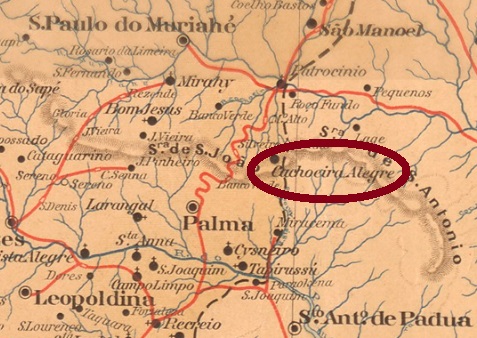
Another name: Cachoeira Alegre (1911)
This locality was a district of S. Paulo do Muriahé from September 1870, close to the border with Rio de Janeiro, a good 240 km southeast of the provincial capital of Ouro Preto. In August 1911, the village changed to the newly created Municipio of Palma, now under the shortened name of Cachoeira Alegre, and since December 1962 it has been a district of Barão de Monte Alto.
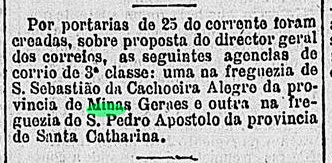
As Paula Sobrinho writes in História Postal de Minas Gerais (Belo Horizonte, 1997), there has been a post office there since April 1881. This is confirmed by the Rio press:
Two postmarks as double circles were found for the 19th century. On SMG-2580a (Collected by José A. Junges) the inscription above is S. SEBASo. DA CACHOEIRA ALEGRE, below you can see an ornament in cross formed by four small diamonds. Dates in the centre from about 1883 to 1889. SMG-2580b (Collected by Márcio Protzner) could already be Republican, as the only copy so far has a date of 1898 inside. The inscription at the top now reads S. SEBAST. DA CACHA. ALEGRE, at the bottom it reads (MINAS).
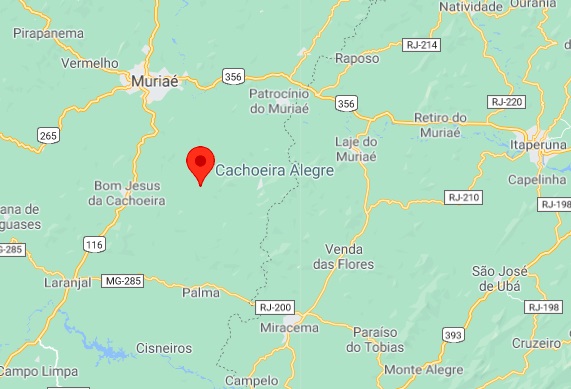
Anderer Name: Cachoeira Alegre (1911)
Diese Ortschaft war ab September 1870 ein Distrikt von S. Paulo do Muriahé, der nah an der Grenze zu Rio de Janeiro lag, gut 240 km südöstlich der Provinzhauptstadt Ouro Preto entfernt. Im August 1911 wechselte der Ort zum neu gegründeten Municipio von Palma, nun unter dem gekürzten Namen Cachoeira Alegre, und seit Dezember 1962 ist er ein Distrikt von Barão de Monte Alto.
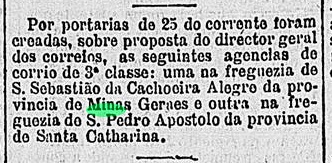
Wie Paula Sobrinho in História Postal de Minas Gerais (Belo Horizonte, 1997) schreibt, gibt es dort ein Postamt seit April 1881 Das wird durch die Rio-Presse bestätigt:
Zwei Poststempel im Doppelkreis wurden für den 19. Jahrhundert gefunden. Bei SMG-2580a (Samml. José A. Junges) lautet die obige Inschrift S. SEBASo. DA CACHOEIRA ALEGRE, unten sieht man ein Ornament in Kreuz, das aus vier kleinen Rauten gebildet wird. Daten in der Mitte von ca. 1883 bis 1889. SMG-2580b (Samml. Márcio Protzner) könnte bereits republikanisch sein, da das bisher einzige Exemplar innen ein Datum von 1898 aufweist. Die Inschrift oben lautet nun S. SEBAST. DA CACHA. ALEGRE, unten steht (MINAS).

 Carimbologia