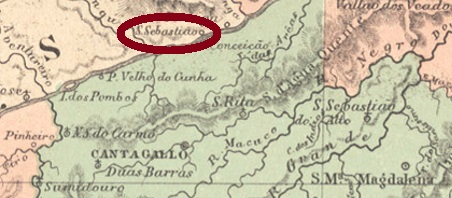
Another name: Euclides da Cunha (1938-1943)
This locality was a district of Cantagallo from December 1874, located on the south bank of the Parahyba do Sul River, over 220 km northeast of the capital Rio de Janeiro. It rose to villa status around 1890, but soon reverted to district. Between 1938 and 1943, the village was called Euclides da Cunha, in memory of the famous engineer and writer (1866-1909) who was born in the area. After that, the old name returned for the district, and so it remains today.
The Imperial Mail Register (Tabella das Agencias do Correio do Imperio, Rio de Janeiro, 1885) reports a post office there from 1871. Three postmarks of the imperial period were found. The oldest one, SRJ-1490a, was probably in use from the beginning and was presented by Paulo Ayres in Catálogo de Carimbos Brasil-Império (S. Paulo, 1937, 1942) under No. 1480:
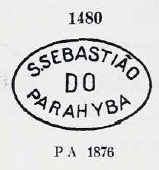
Two cancels in double circle followed. SRJ-1490b (agenciaspostais.com.br) was seen only once in reddish brown and has the inscription S.S. DO PARAHYBA at the top, with an inner date of 1883. Its successor SRJ-1490c (coll. Karlheinz Wittig) has the inscription S. SEBASTIĀO DO PARAHYBA at the top and an ornament in X at the bottom. Dates in the middle between 1888 and 1891.
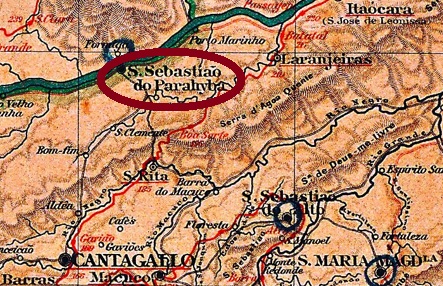
Anderer Name: Euclides da Cunha (1938-1943)
Diese Ortschaft war ab Dezember 1874 ein Distrikt von Cantagallo, der am Südufer des Flusses Parahyba do Sul lag, gut 220 km nordöstlich der Hauptstadt Rio de Janeiro entfernt. Um ca. 1890 stieg er zur Villa auf, kehrte aber bald zum Distrikt-Status zurück. Zwischen 1938 und 1943 hieß der Ort Euclides da Cunha, in Erinnerung an den berühmten Ingenieur und Schriftsteller (1866-1909), der in der Gegend geboren wurde. Danach kehrte der alte Name des Distrikts zurück, und so ist es bis heute geblieben.
Im Verzeichnis der kaiserlichen Postämter (Tabella das Agencias do Correio do Imperio, Rio de Janeiro, 1885) liest man, dass es dort ab 1871 ein Postamt gab. Drei Poststempel der Kaiserzeit waren zu finden. Der älteste davon, SRJ-1490a, war wohl von Anfang an in Gebrauch und wurde bereits durch Paulo Ayres in Catálogo de Carimbos Brasil-Império (S. Paulo, 1937, 1942) unter Nr. 1480 vorgestellt:
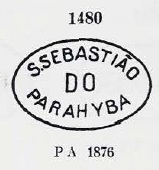
Es folgten zwei Stempel in Doppelkreis. SRJ-1490b (agenciaspostais.com.br) war bisher nur einmal in rotbraun zu sehen und hatte oben die Inschrift S.S. DO PARAHYBA, mit einem inneren Datum aus 1883. Sein Nachfolger SRJ-1490c (Samml. Karlheinz Wittig) hat oben die Inschrift S. SEBASTIĀO DO PARAHYBA und unten ein Ornament in X. Daten in der Mitte zwischen 1888 und 1891.

 Carimbologia