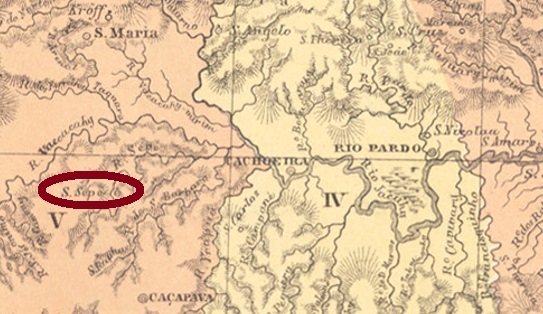
São Sepé was a district near Caçapava from December 1850, located on the west bank of the river of the same name, over 260 km west of the provincial capital Porto Alegre. In April 1864, the place rose to Villa, which also became the municipal headquarters. Since there is no Catholic saint named Sepé, it is assumed that the place name is of indigenous origin. It is possible that it has to do with the legendary Guarani leader Sepé Tiaraju (ca. 1720-1756), who fell in the resistance struggle against Spanish and Portuguese invaders. In 2009, Sepé Tiaraju was named one of Brazil’s 12 National Heroes:
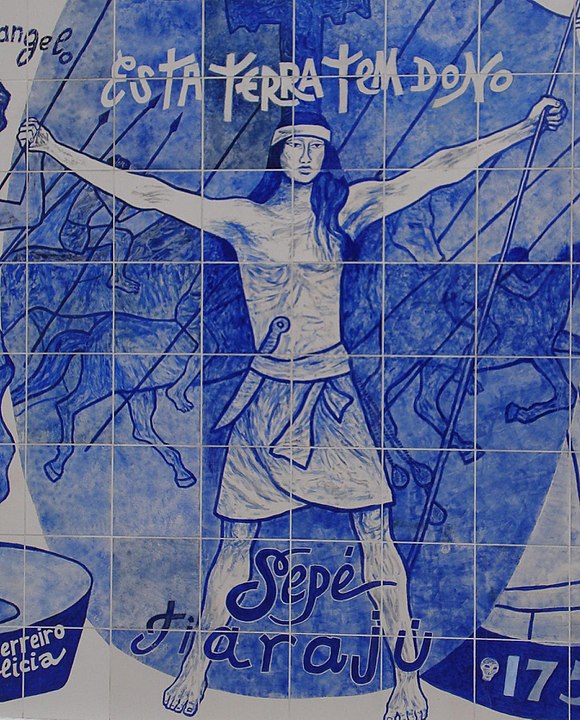
(Photo: Eugenio Hansen)
As Nova Monteiro writes in Administrações e Agencias Postaes do Brasil Imperio (Brasil Filatelico/RJ, 1934-5; reprint SPP 1994-1999), there has been a post office there since July 1866. Two 19th century double-circle postmarks have been found, but apparently not the oldest one, unfortunately. SRS-0375b (Coll. José A. Junges) has the inscription S. SEPÉ at the top and internal dates from 1889 to 1890. SRS-0375c (Coll. José A. Junges) will probably be Republican. Here the inscription above is also S. SEPÉ, below one reads (S. PEDRO DO SUL). Dates in the middle from 1896 to 1902.
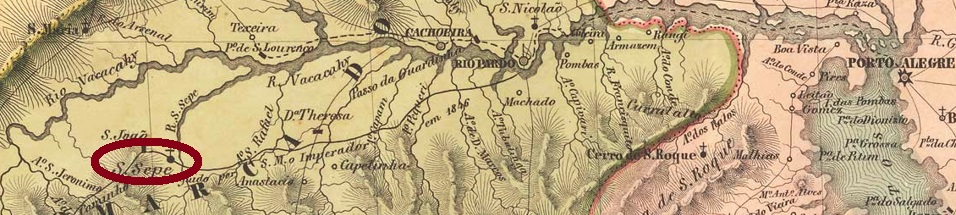
São Sepé war ab Dezember 1850 ein Distrikt bei Caçapava, der am Westufer des gleichnamigen Flusses lag, gut 260 km westlich der Provinzhauptstadt Porto Alegre entfernt. Im April 1864 stieg der Ort zu Villa auf, die auch der Gemeindesitz wurde. Da es kein katholischer Heiliger namens Sepé gibt, wird angenommen, dass die Ortsbezeichnung indigenen Ursprungs ist. Möglicherweise hat sie mit dem legendären Guarani-Führer Sepé Tiaraju (ca. 1720-1756) zu tun, der im Widerstandskampf gegen spanische und portugiesische Invasoren fiel. 2009 ist Sepé Tiaraju als einer der 12 Nationalen Helden Brasiliens ernannt worden:
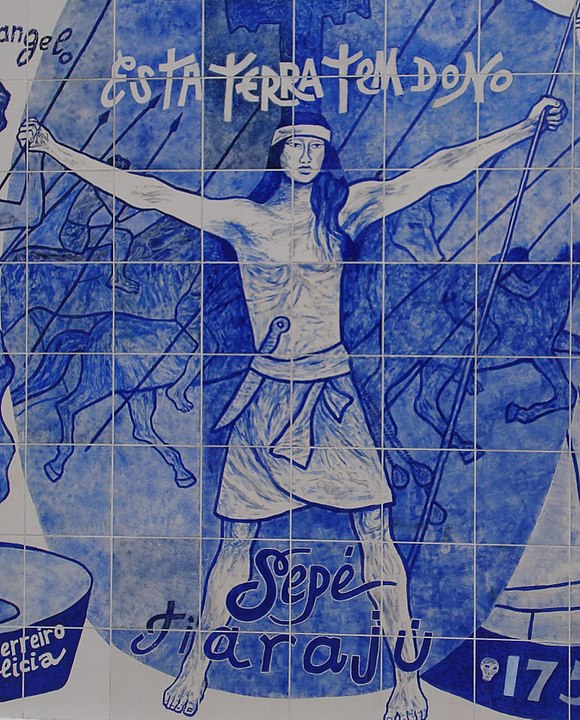
(Foto: Eugenio Hansen)
Wie Nova Monteiro in Administrações e Agencias Postaes do Brasil Imperio (Brasil Filatelico/RJ, 1934-5; Reprint SPP 1994-1999) schreibt, gibt es dort ein Postamt seit Juli 1866. Zwei Doppelkreis-Stempel des 19. Jahrhunderts wurden gefunden, aber offenbar nicht der älteste davon, leider. SRS-0375b (Samml. José A. Junges) hat oben die Inschrift S. SEPÉ und innere Daten von 1889 bis 1890. SRS-0375c (Samml. José A. Junges) wird wohl republikanisch sein. Hier lautet die obige Inschrift ebenfalls S. SEPÉ, unten liest man (S. PEDRO DO SUL). Daten in der Mitte von 1896 bis 1902.

 Carimbologia