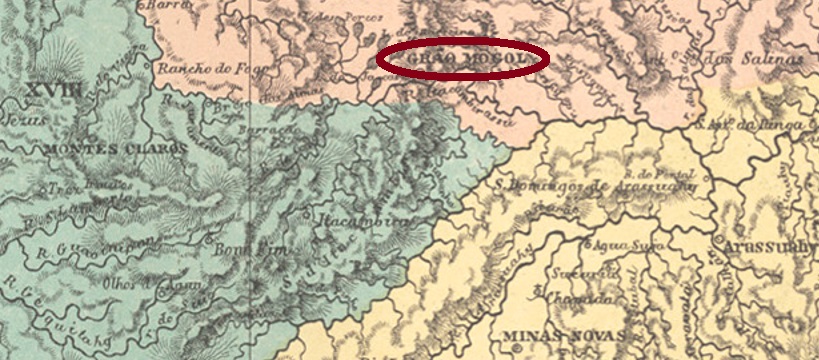
Other names: Serra de Santo Antonio, Serra do Grão-Mogor, Grão Mogol (1840)
See also Grão-Mogol (R. Koester: Carimbologia XX)
This village was already the settlement Serra de Santo Antonio do Itacambirassu in 1781, and was situated on the Ribeirão do Inferno (Hell Creek) near Serro, more than 650 km north of the later provincial capital Ouro Preto. In April 1840, it became the district of Grão Mogol. The name is actually the Portuguese version of Grand Mogol. However, it seems to have less to do with the rulers of northern India from the 16th to the 19th century, and more with the legendary diamond that has been considered lost since 1739. Knowing that diamonds were searched for in the area for centuries, one can understand the dream of such a discovery. Anyway, the local authorities apparently do not like to give information about this subject. In March 1849, Grão Mogol became a villa, and in May 1858, a town.
Two creation dates for the local post office were found, almost 50 years apart. Nova Monteiro in Administrações e Agencias Postaes do Brasil Imperio (in Brasil Filatelico/RJ, 1934-5; reprint SPP 1994-1999) writes March 1798, while both Paula Sobrinho (História Postal de Minas Gerais, Belo Horizonte, 1997) and Reinhold Koester (Carimbologia XX) give January 1846. A third date could be added, because in 1833 there was no post office listed in Serra in the Serro county (O Universal, 13 November 1833). And just two years later, we find the postmark SMG-4015a on a letter to Minas Novas:

This stamp also appears in sepia and was already presented by Paulo Ayres under no. 1500 in Catálogo de Carimbos Brasil-Império (S. Paulo, 1937, 1942). However, small differences to the illustration from the RHM catalogue are noticeable.
There is also a mute cancellation in connection with SMG-4015a, which was applied on a numeral issue of 1854:

Since these mute cancellations were not officially ordered before 1865 – and provided that the object above is genuine – this means that SMG-4015 was in use for at least 30 years, and then also 25 years after the place was already called Grão-Mogol. Reinhold Koester (Carimbologia XX) found the first cancel with inscription GRÃO-MOGOR (sic) dated only from 1879 on.
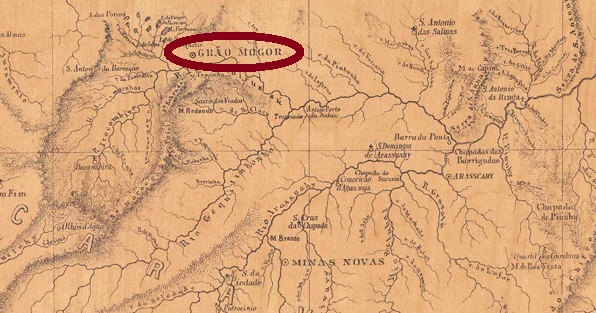
Andere Namen: Serra de Santo Antonio, Serra do Grão-Mogor, Grão Mogol (1840)
Siehe auch Grão-Mogol (R. Koester: Carimbologia XX)
Diese Ortschaft war bereits 1781 die Siedlung Serra de Santo Antonio do Itacambirassu, und lag am Ribeirão do Inferno (Höllenbach) bei Serro, über 650 km nördlich der späteren Provinzhauptstadt Ouro Preto entfernt. Im April 1840 wurde daraus der Distrikt von Grão Mogol. Der Name ist tatsächlich die portugiesische Version von Großmogul. Allerdings scheint hier weniger die Rede von den Herrschern in Nordindien vom 16. bis 19. Jahrhundert zu sein, sondern wird eher mit dem legendären Diamanten zu tun haben, der seit 1739 als verschollen gilt. Wenn man weiß, dass in der Gegend jahrhundertlang nach Diamanten gesucht wurde, kann man den Traum von einer solchen Entdeckung nachvollziehen. Wie es dem auch sei, die Behörden vor Ort geben offenbar nicht gerne darüber Auskunft. Im März 1849 wurde Grão Mogol eine Villa, und im Mai 1858 eine Stadt.
Zwei Gründungsdaten fürs örtliche Postamt wurden gefunden, die fast 50 Jahre auseinander liegen. Nova Monteiro schreibt dafür in Administrações e Agencias Postaes do Brasil Imperio (in Brasil Filatelico/RJ, 1934-5; Reprint SPP 1994-1999) den März 1798, während sowohl Paula Sobrinho (História Postal de Minas Gerais, Belo Horizonte, 1997) als auch Reinhold Koester (Carimbologia XX) den Januar 1846 angeben. Es könnte noch ein drittes Datum dazu kommen, denn 1833 war kein Postamt in Serra in der Gemarkung Serro aufgelistet (O Universal, 13. November 1833). Und gleich zwei Jahre später findet man den Poststempel SMG-4015a auf einem Brief nach Minas Novas:

Dieser Stempel kommt auch in sepia vor und wurde bereits durch Paulo Ayres unter Nr. 1500 in Catálogo de Carimbos Brasil-Império (S. Paulo, 1937, 1942) vorgestellt. Allerdings sind kleine Unterschiede zur Abbildung vom RHM-Katalog feststellbar.
Auch in Verbindung zu SMG-4015a ist eine stumme Entwertung vorhanden, die auf eine Ziffer-Ausgabe von 1854 verpasst wurde:
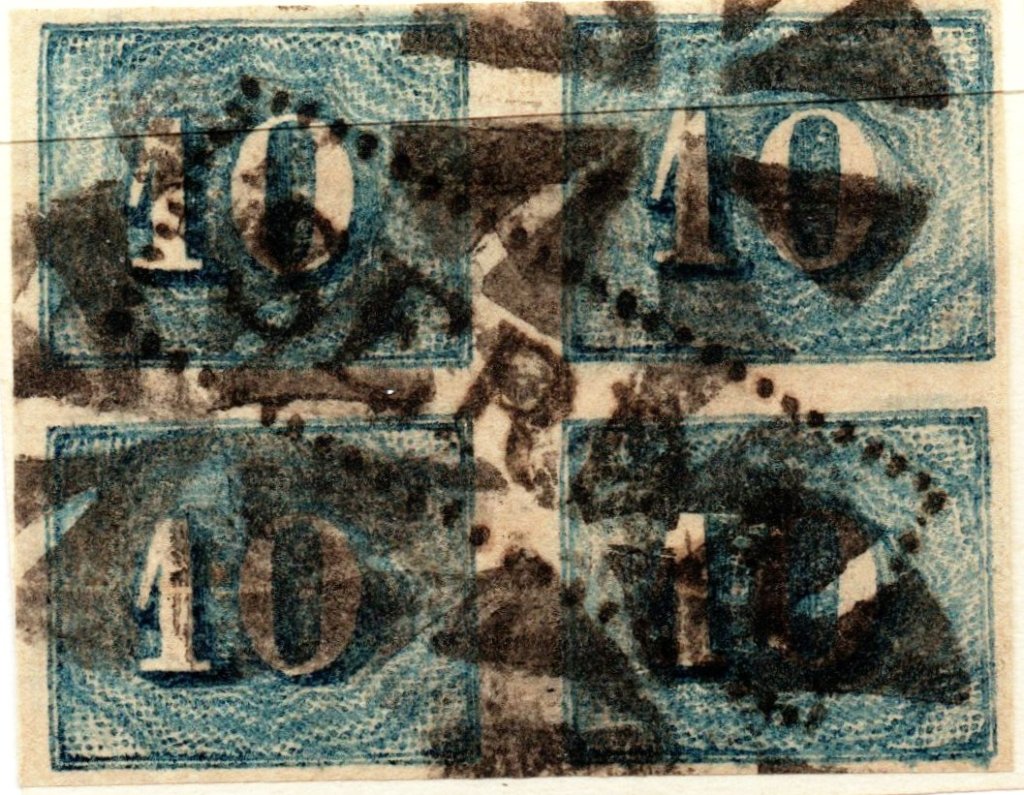
Da diese stummen Entwertungen erst ab 1865 offiziell angeordnet waren – und wenn das Objekt oben echt ist – bedeutet dies, dass SMG-4015 mindestens 30 Jahre lang verwendet wurde, und dann auch 25 Jahre nachdem der Ort bereits Grão-Mogol hieß. Reinhold Koester (Carimbologia XX) fand den ersten Stempel mit Inschrift GRÃO-MOGOR (sic) erst ab 1879 datiert.

 Carimbologia