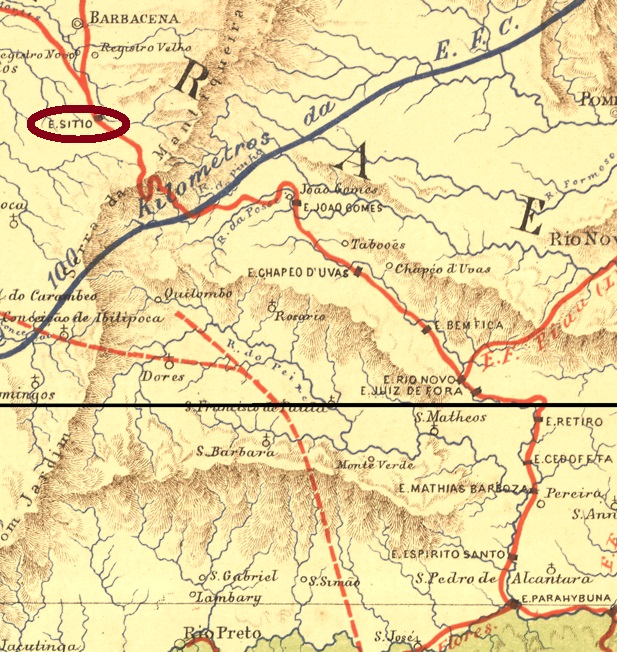
Another name: Antonio Carlos (Est.)
The Sítio train station was inaugurated in March 1878 (according to Paula Sobrinho) or in October of that year (according to Ralph M. Giesbrecht) by the E. F. Dom Pedro II railway company and was located on the main line (Linha do Centro) in the Município of Barbacena, 140 km south of the provincial capital Ouro Preto. With the Republic from 1889 on, the railway line was renamed E.F. Central do Brasil, and from 1975 until its closure in 1996 it belonged to Rede Ferroviária Federal S.A. (estacoesferroviarias.com.br). With the arisal of this area, the station was renamed Antonio Carlos in December 1948, and has been an independent município ever since.
Paula Sobrinho writes in História Postal de Minas Gerais (Belo Horizonte, 1997) that the station post office was created in March 1878. The only postmark of the imperial period so far is SMG-3635a (Coll. Karlheinz Wittig): a double circle with the inscription SITIO on top and an ornament in lozenge below, formed by four small lozenges. The dates in the middle are from the period 1888-1891.
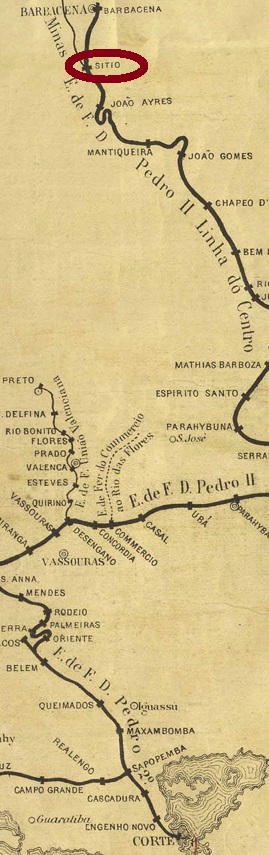
Anderer Name: Antonio Carlos (Est.)
Der Bahnhof Sítio wurde im März 1878 (laut Paula Sobrinho) oder im Oktober d. Js. (laut Ralph M. Giesbrecht) durch die E. F. Dom Pedro II Bahngesellschaft eingeweiht und lag in der Hauptlinie (Linha do Centro) im Município von Barbacena, 140 km südlich der Provinzhauptstadt Ouro Preto entfernt. Mit der Republik ab 1889 wurde die Bahnlinie E.F. Central do Brasil umbenannt, von 1975 bis zur Stilllegung 1996 gehörte sie der Rede Ferroviária Federal S.A. (estacoesferroviarias.com.br). Mit dem Aufstieg dieser Gegend wurde der Bahnhof im Dezember 1948 Antonio Carlos umbenannt, der auch seitdem ein eigenständiger Município ist.
Paula Sobrinho schreibt in História Postal de Minas Gerais (Belo Horizonte, 1997), dass das Bahnhofspostamt im März 1878 entstanden ist. Der bisher einzige Poststempel der Kaiserzeit ist SMG-3635a (Samml. Karlheinz Wittig): ein Doppelkreis mit dem Inschrift SITIO oben und einem Ornament in Raute unten, das aus vier kleinen Rauten gebildet wird. Die Daten in der Mitte entstammen dem Zeitraum 1888-1891.

 Carimbologia