Another name: Paraopeba (1911).
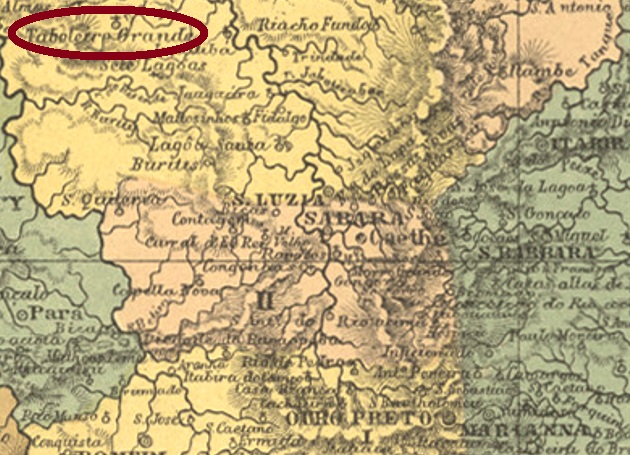
This other Taboleiro in the province of Minas Gerais was a district of Sete Lagoas from March 1840, located 190 km northwest of the provincial capital Ouro Preto. And it remained so until November 1911, when it became the Município of Paraopeba.
At least two periods of operation for the local post office have been identified for the 19th century. The first of these was probably at the beginning of the 1940s, when the postmark TMG-3165a was used. This was applied to pre-philatelic objects and was listed in the RHM catalogue under P-MG-62:

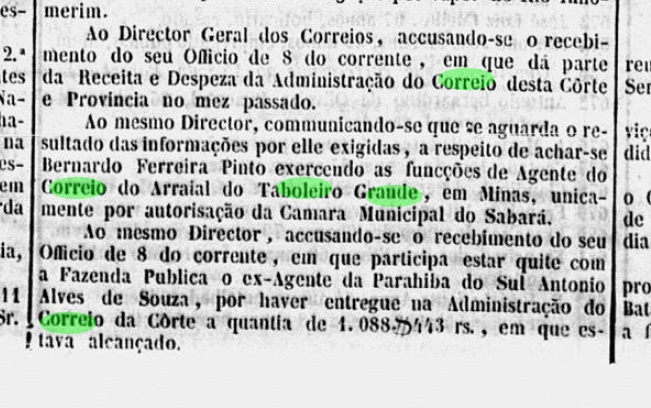
The agency was closed sometime after February 1847. At that time the post was still occupied, as shown in the Rio press:
The second opening of the post office took place in June 1868, as can be read in Nova Monteiro’s Administrações e Agencias Postaes do Brasil Imperio (Brasil Filatelico/RJ, 1934-5; Reprint SPP 1994-1999). From this second period comes SMG-3195c (Coll. José A. Junges): a double circle with the inscriptions TABOLEIRO above and (G) below, which also occurs in red, crimson and violet. The dates in the middle go from 1884 to 1898.
Anderer Name: Paraopeba (1911)
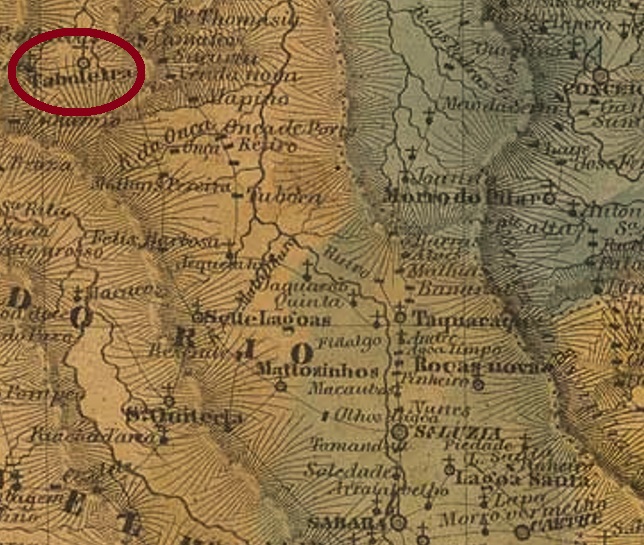
Dieser andere Taboleiro in der Provinz Minas Gerais war ab März 1840 ein Distrikt von Sete Lagoas, der 190 km nordwestlich der Provinzhauptstadt Ouro Preto lag. Und so blieb es bis November 1911, als daraus der Município von Paraopeba wurde.
Zumindest zwei Betriebsperioden fürs örtliche Postamt wurden für den 19. Jahrhundert ausfindig gemacht. Die erste davon dürfte am Anfang der 40er Jahre gewesen sein, als der Poststempel TMG-3165a verwendet wurde. Dieser war auf Prephila-Objekten angewendet und wurde im RHM-Katalog unter P-MG-62 aufgelistet:

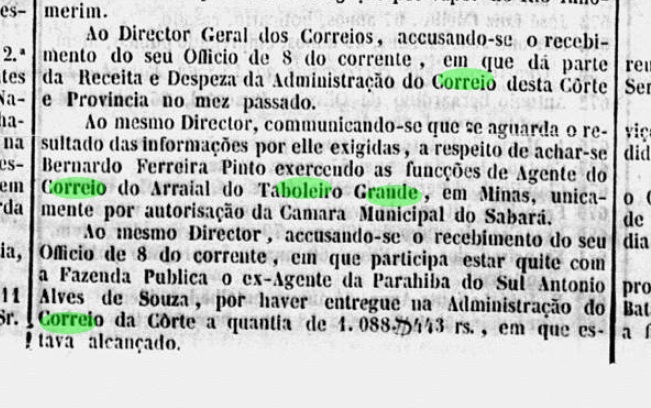
Die Agentur wurde irgendwann nach Februar 1847 geschlossen. Zu diesem Zeitpunkt war die Stelle noch besetzt, wie aus der Presse aus Rio hervorgeht:
Die zweite Eröffnung des Postamts fand im Juni 1868 statt, wie in Nova Monteiros Administrações e Agencias Postaes do Brasil Imperio (Brasil Filatelico/RJ, 1934-5; Reprint SPP 1994-1999) zu lesen ist. Aus dieser zweiten Periode stammt SMG-3195c (Samml. José A. Junges): Ein Doppelkreis mit den Inschriften TABOLEIRO oben und (G) unten, der auch in Rot, Karmin und Violett vorkommt. Die Daten in der Mitte gehen von 1884 bis 1898.

 Carimbologia