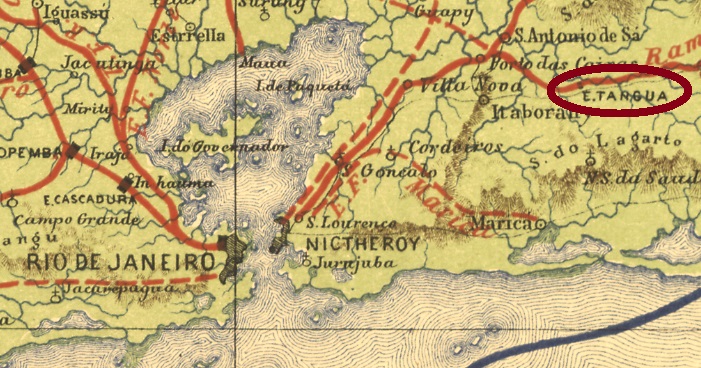
Updated on January 11, 2022
Tanguá station was inaugurated in March 1878 by the C.F.C. Niteroiense railway company and was located at Itaborahy, just under 70 km east of the capital Rio de Janeiro. In 1887 the railway line went to the E.F. Leopoldina and from 1975 until its closure in 1996 it belonged to Rede Ferroviária Federal S.A. (estacoesferroviarias.com.br). The settlement around the station continued to grow and became the district of Itaborahy in January 1924. Tanguá has been an independent município since December 1995.
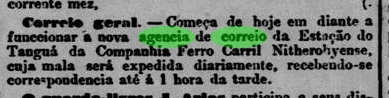
The station post office started its operations in February 1878, according to the Rio press:
Two station postmarks were found for the 19th century. First came TRJ-1905a, as illustrated in Paulo Ayres’ Catálogo de Carimbos Brasil-Império, (S. Paulo, 1937, 1942) under no. 1510:

It was followed by TRJ-1905b (Coll. Fuad Ferreira Fo.): a French type with the inscription TANGUÁ above and the star between brackets below, dated 1883-1886 in the centre. Next came TRJ- 1905c (agenciaspostais.com.br): a double circle with the inscription TANGUÁ above and an ornament in X below. The dates in the middle go from 1893 to 1897.
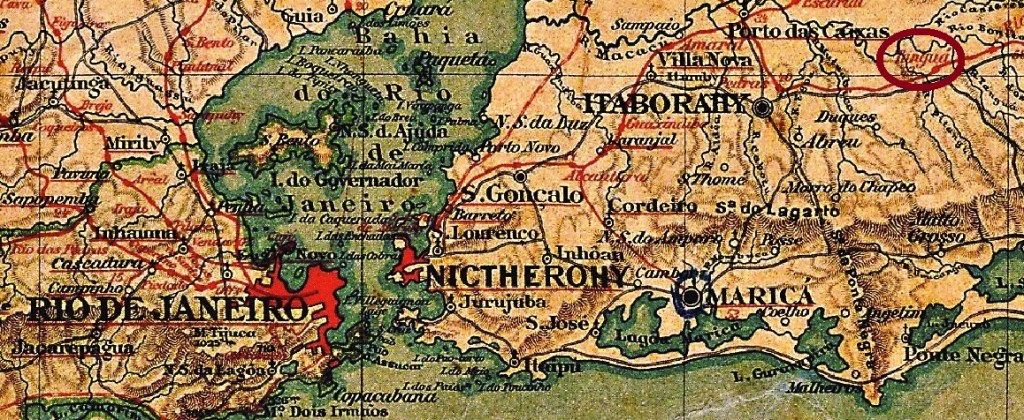
Aktualisiert am 11. Januar 2022
Der Bahnhof Tanguá wurde im März 1878 durch die C.F.C. Niteroiense-Bahngesellschaft eingeweiht und lag bei Itaborahy, knapp 70 km östlich der Hauptstadt Rio de Janeiro entfernt. 1887 ging die Bahnlinie zur E.F. Leopoldina und von 1975 bis zur Stilllegung 1996 gehörte sie der Rede Ferroviária Federal S.A. (estacoesferroviarias.com.br). Die Siedlung um den Bahnhof wuchs weiter und wurde im Januar 1924 zum Distrikt von Itaborahy. Seit Dezember 1995 ist Tanguá ein eigenständiger Município.
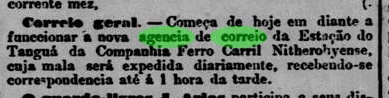
Das Bahnhofspostamt startete seinen Betrieb im Februar 1878, wie die Presse aus Rio mitteilte:
Zwei Bahnhofspoststempel wurden für den 19. Jahrhundert gefunden. Zuerst kam TRJ-1905a, wie im Paulo Ayres‘ Catálogo de Carimbos Brasil-Império, (S. Paulo, 1937, 1942) unter Nr. 1510 abgebildet wurde:

Ihm folgte TRJ-1905b (Samml. Fuad Ferreira Fo.): ein Französischer Typus mit der Inschrift TANGUÁ oben und dem Stern zwischen Klammern unten, datiert 1883-1886 in der Mitte. Danach kam TRJ- 1905c (agenciaspostais.com.br): ein Doppelkreis mit der Inschrift TANGUÁ oben und einem Ornament in X unten. Die Daten in der Mitte gehen von 1893 bis 1897.

 Carimbologia