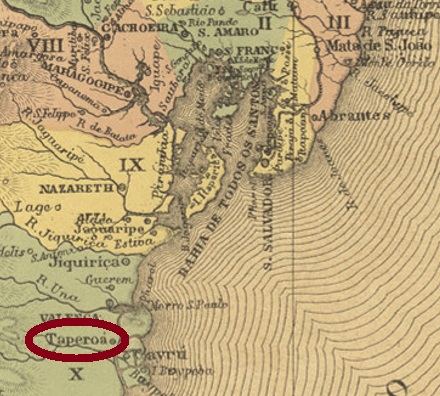
Another name: Nova Boipeba
This village was originally an Indian settlement called São Miguel de Taperoguá, located between Valença and Cayru, 140 km southwest of the provincial capital Salvador da Bahia. At the beginning of the 19th century, it rose to become a freguesia called Nova Boipeba, but by May 1847 it had become the Vila of Taperoá. Since April 1906, Taperoá has been a town.
As Nova Monteiro writes in Administrações e Agencias Postaes do Brasil Imperio (Brasil Filatelico/RJ, 1934-5; Reprint SPP 1994-1999), there was a post office there since March 1863. Two postmarks have been found, but unfortunately not the very first one. TBA-0730b (Coll. José A. Junges) is a simple double circle with the inscription TAPEROÁ on top. The dates in the centre go from about 1878 to 1893. TBA-0730c (Coll. José A. Junges) should already be Republican. The inscription (BAHIA) now appears at the bottom of the double circle. There is a date from 1899 in the centre.
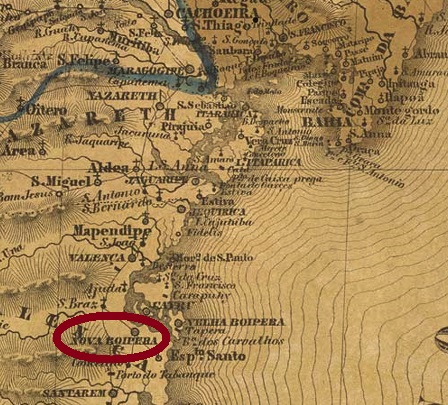
Anderer Name: Nova Boipeba
Diese Ortschaft war ursprünglich ein Indianerdorf namens São Miguel de Taperoguá und lag zwischen Valença und Cayru, 140 km südwestlich der Provinzhauptstadt Salvador da Bahia entfernt. Am Anfang des 19. Jahrhunderts stieg sie zu einer Freguesia namens Nova Boipeba auf, aber schon im Mai 1847 wurde sie zur Vila von Taperoá. Seit April 1906 ist Taperoá eine Stadt.
Wie Nova Monteiro in Administrações e Agencias Postaes do Brasil Imperio (Brasil Filatelico/RJ, 1934-5; Reprint SPP 1994-1999) schreibt, gab es dort ein Postamt seit März 1863. Zwei Poststempel wurden zwar gefunden, leider noch nicht der allererste. TBA-0730b (Samml. José A. Junges) ist ein schlichter Doppelkreis mit der Inschrift TAPEROÁ oben. Die Daten in der Mitte gehen von ca. 1878 bis 1893. TBA-0730c (Samml. José A. Junges) dürfte bereits republikanisch sein. Im Doppelkreis erscheint nun unten die Inschrift (BAHIA) dazu. Datum in der Mitte aus 1899.

 Carimbologia