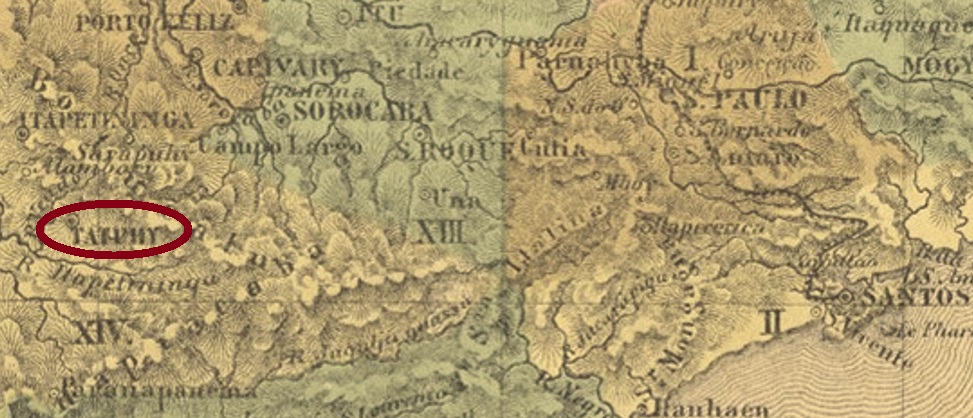
Tatuhy (also Tatuhi, now spelled Tatuí) was a freguesia of the Vila of Itapetininga from March 1822, located on the north bank of the Tatuí River (a tributary of the Sorocaba), 140 km west of the later provincial capital of São Paulo. It was elevated to the status of a vila in February 1844 and became a town in July 1861. The place name comes from the Tupi-guarani language and means river of armadillos.
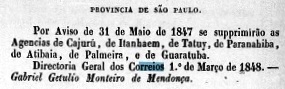
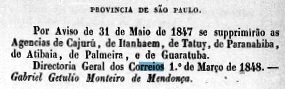
The local post office opened at least twice, although it has not yet been possible to date the first opening precisely. It is likely to have taken place around 1844. However, the agency closed in May 1847, according to an imperial ministerial report:
The second opening, however, took place immediately in April of the following year, as Nova Monteiro writes in Administrações e Agencias Postaes do Brasil Imperio (in Brasil Filatelico/RJ, 1934-5; reprint SPP 1994-1999). The first local cancel TSP-1415a also occurs in light brown and was shown in the RHM catalogue:

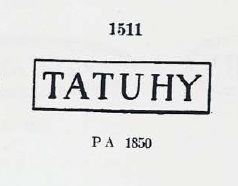
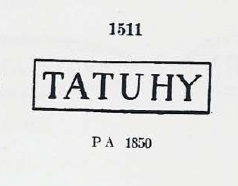
The next two postmarks have already been presented by Paulo Ayres in Catálogo de Carimbos Brasil-Império (S. Paulo, 1937, 1942). TSP-1415b corresponds to P. Ayres No. 1511 and was in use from about 1850 to 1867:
TSP-1415c is No. 1179 by Paulo Ayres, in use from about 1866:

There followed four town stamps in double circle with the above inscription TATUHY. TSP-1415d (Coll. Mário Orsi Jr.) is a French type with the small star between brackets at the bottom, which also occurs in red. The dates inside have been found so far for the period 1776-1883. TSP-1415e (Coll. José A. Junges) is a plain double circle without decoration at the bottom, dated 1878-1880 in the centre. TSP-1415f (Coll. José A. Junges) has dates of 1884 and 1885 in the centre and an ornament at the bottom formed by four branches in lozenge. And TSP-1415g (Coll. José A. Junges) also appears in turquoise and blue and shows inner dates between 1886 and 1896. Here the lower ornament at the bottom is a cross-shaped circle with a smaller white circle in its centre.
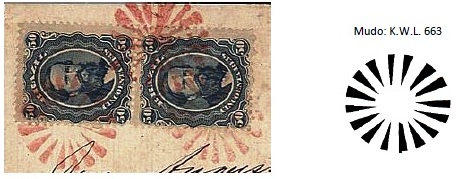
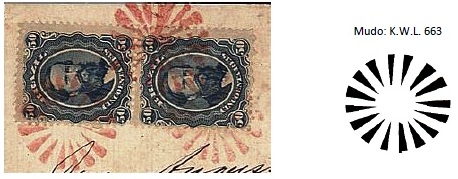
Philatelist Mario Celso Orsi Jr. was able to identify two mute cancels for Tatuhy listed in Mute Cancellations of the Brazil Empire / Carimbos Mudos do Brasil Império (Brazil Philatelic Association, Rio de Janeiro, 2000) by J.A. Dingler and K.W. Lopes. The cancel BPA 663 was found on a letter from 1876:
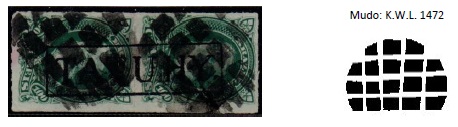
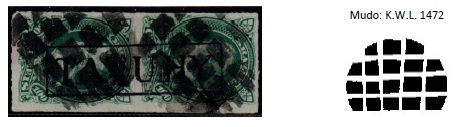
And cancel BPA 1472 was seen on a D. Pedro issue from 1877:
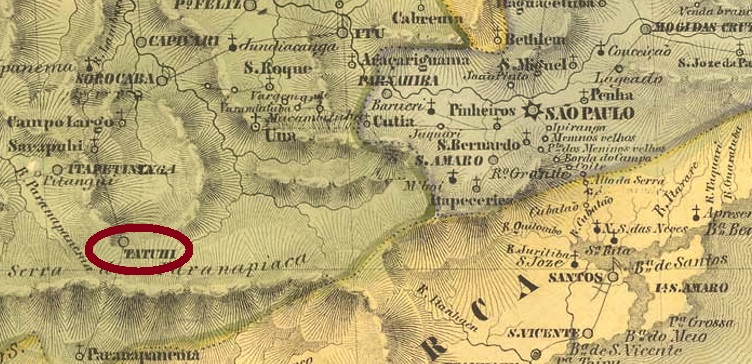
Tatuhy (auch Tatuhi, heute Tatuí geschrieben) war ab März 1822 eine Freguesia der Vila von Itapetininga, die am Nordufer des Flusses Tatuí (ein Nebenfluss des Sorocabas) lag, 140 km westlich der späteren Provinzhauptstadt São Paulo entfernt. Im Februar 1844 wurde der Ort zur Vila erhoben und ist seit Juli 1861 eine Stadt. Der Ortsname kommt aus der Tupi-guarani-Sprache und bedeutet Fluss der Gürteltiere.
Das örtliche Postamt eröffnete mindestens zweimal, wobei die erste Entstehung bisher nicht genau datiert werden konnte. Sie dürfte ca. 1844 stattgefunden haben. Die Agentur schloss aber im Mai 1847, wie aus einem kaiserlichen Ministerialbericht hervorgeht:
Die zweite Eröffnung erfolgte aber gleich im April des folgenden Jahres, wie Nova Monteiro in Administrações e Agencias Postaes do Brasil Imperio (in Brasil Filatelico/RJ, 1934-5; Reprint SPP 1994-1999) schreibt. Der erste Ortsstempel TSP-1415a kommt auch in hellbraun vor und wurde im RHM-Katalog abgebildet:

Die nächsten zwei Poststempel sind bereits durch Paulo Ayres in Catálogo de Carimbos Brasil-Império (S. Paulo, 1937, 1942) vorgestellt worden. TSP-1415b entspricht P. Ayres Nr. 1511 und war im Gebrauch von ca. 1850 bis 1867:
TSP-1415c ist Nr. 1179 von Paulo Ayres, verwendet ab ca. 1866:

Es folgten vier Ortsstempel in Doppelkreis mit der obigen Inschrift TATUHY. TSP-1415d (Samml. Mário Orsi Jr.) ist ein französischer Typus mit dem kleinen Stern zwischen Klammern unten, der auch in Rot vorkommt. Die Daten im Inneren wurden bisher für den Zeitraum 1776-1883 gefunden. TSP-1415e (Samml. José A. Junges) ist ein schlichter Doppelkreis ohne Verzierung unten, datiert 1878-1880 in der Mitte. TSP-1415f (Samml. José A. Junges) hat Daten von 1884 und 1885 in der Mitte und ein Ornament unten, das aus vier Zweigen in Raute gebildet wird. Und TSP-1415g (Samml. José A. Junges) kommt auch in türkis und blau vor und zeigt innere Daten zwischen 1886 und 1896. Hier ist die untere Verzierung unten ein kreuzförmiger Kreis mit einem kleineren weißen Kreis in der Mitte.
Der Philatelist Mario Celso Orsi Jr. konnte zwei stumme Stempel für Tatuhy identifizieren, die in Mute Cancellations of the Brazil Empire / Carimbos Mudos do Brasil Império (Brazil Philatelic Association, Rio de Janeiro, 2000) von J.A. Dingler und K.W. Lopes aufgelistet waren. Der Stempel BPA 663 wurde auf einem Brief aus 1876 gefunden:
Und der Stempel BPA 1472 war auf einer D. Pedro Marke aus dem Jahr 1877 zu sehen:

 Carimbologia