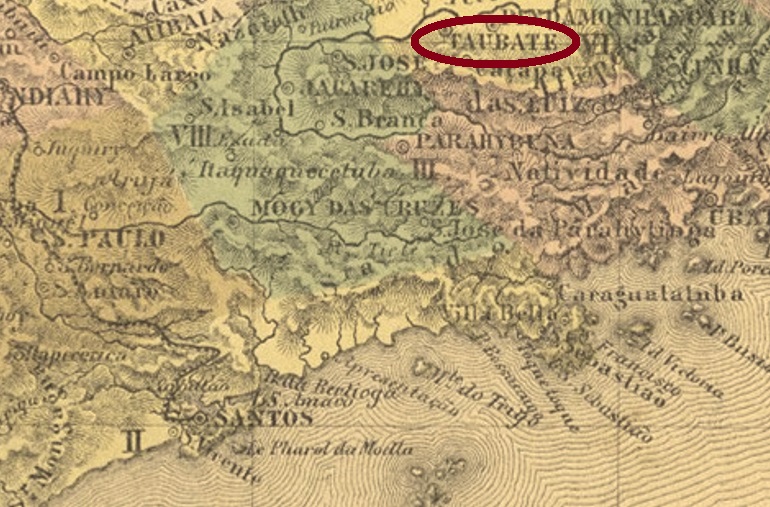
This old village was the freguesia of São Francisco das Chagas de Taubaté, appointed by royal decree (Provisão Real) in December 1645, located on the south bank of the river Parahyba do Sul, 130 km northeast of the future provincial capital of São Paulo. Allegedly, the ascent to the vila also took place in December 1645, which would be rather unusual. Taubaté has been a town since February 1842. The Indian name means village on the hill.
As Nova Monteiro writes in Administrações e Agencias Postaes do Brasil Imperio (in Brasil Filatelico/RJ, 1934-5; Reprint SPP 1994-1999), there was a post office there since May 1828. The pre-philatelic postmark from there is TSP-1420a, it was in use until about 1841 and was already presented in the RHM catalogue under P-SP-57. However, there are small discrepancies between the catalogue illustration and the actual postmark specimens:

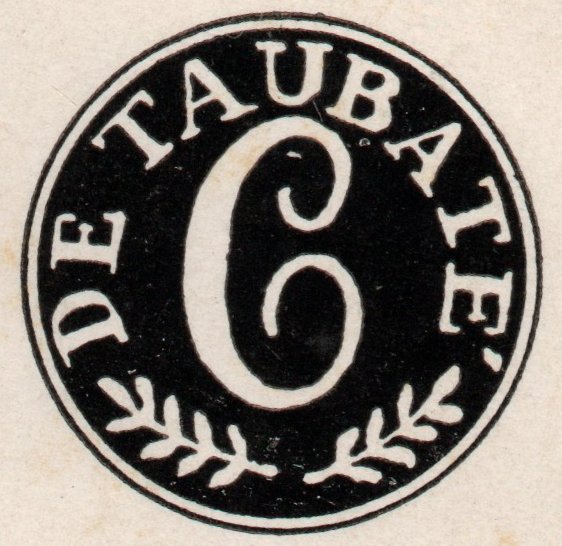
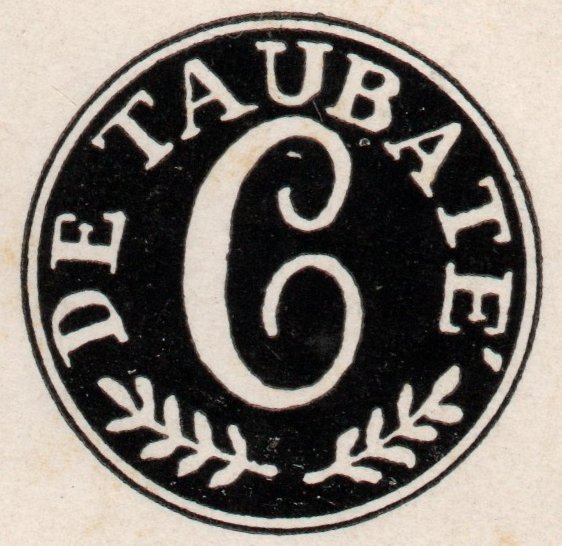
Then came the seal-like TSP-1420b, presented by Paulo Ayres in Catálogo de Carimbos Brasil-Império (S. Paulo, 1937, 1942) under no. 30/1942 and used between 1842 and at least 1844:
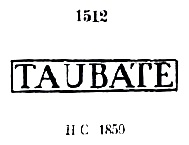
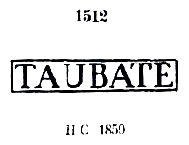
The following five place stamps were also seen in Paulo Ayres (op. cit.). TSP-1420c is P.A. 1512, it also exists in red, and was in use from about 1850 to at least 1876.
For TSP-1420d there are also small differences between the P. Ayres illustration no.1551 and the examples found:
The French-type TSP-1420e is found on P. Ayres on p. 118 and also exists in red:

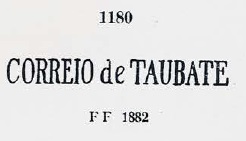
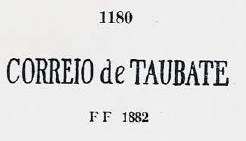
Around the same period, TSP-1420f was used, also in lilac, no. 1180 on P. Ayres:
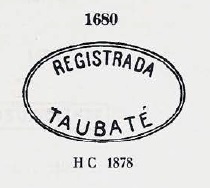
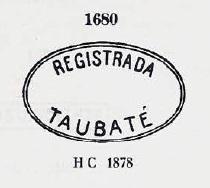
TSP-1420g (P.Ayres 1680) was used for registered mail:
Then TSP-1420h (Coll. José A. Junges) was in use between 1880 and 1895: a plain double circle with the inscription TAUBATÉ on top.
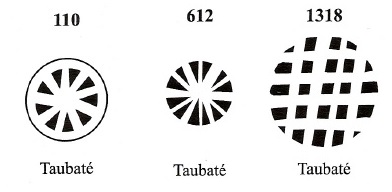
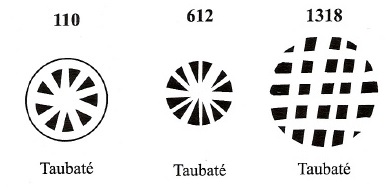
Three mute cancellations from Taubaté are shown in Mute Cancellations of the Brazil Empire/ Carimbos Mudos do Brasil Império (Brazil Philatelic Association, Rio de Janeiro, 2000) by J.A. Dingler and K.W. Lopes under nos. 110, 612 and 1318:
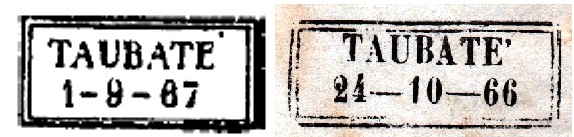
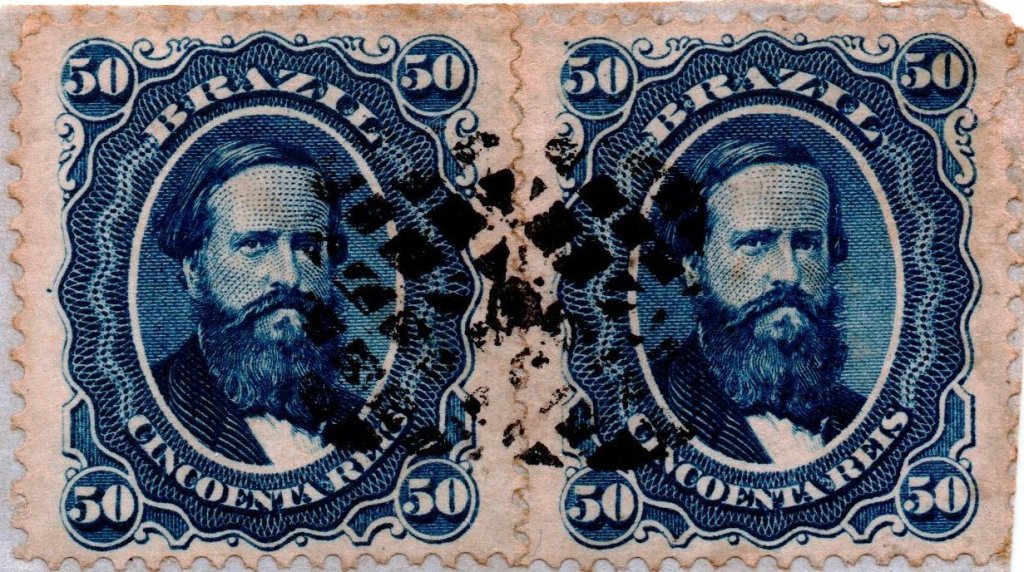
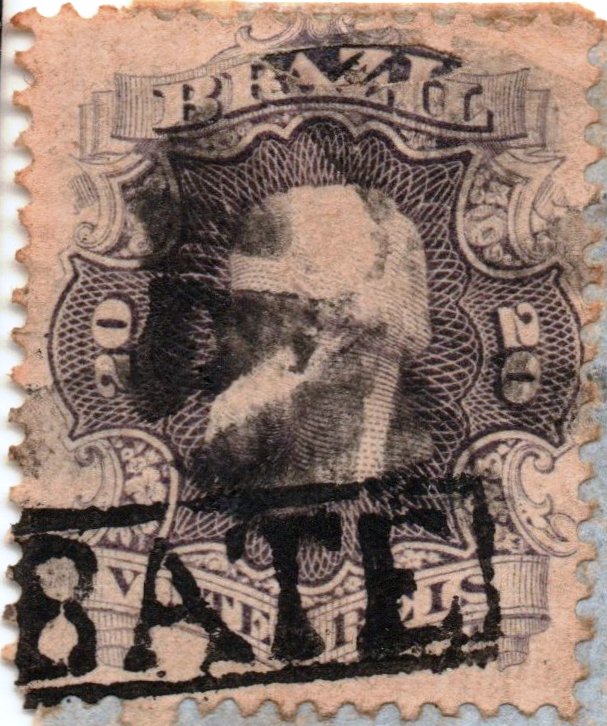
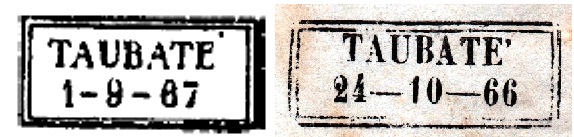
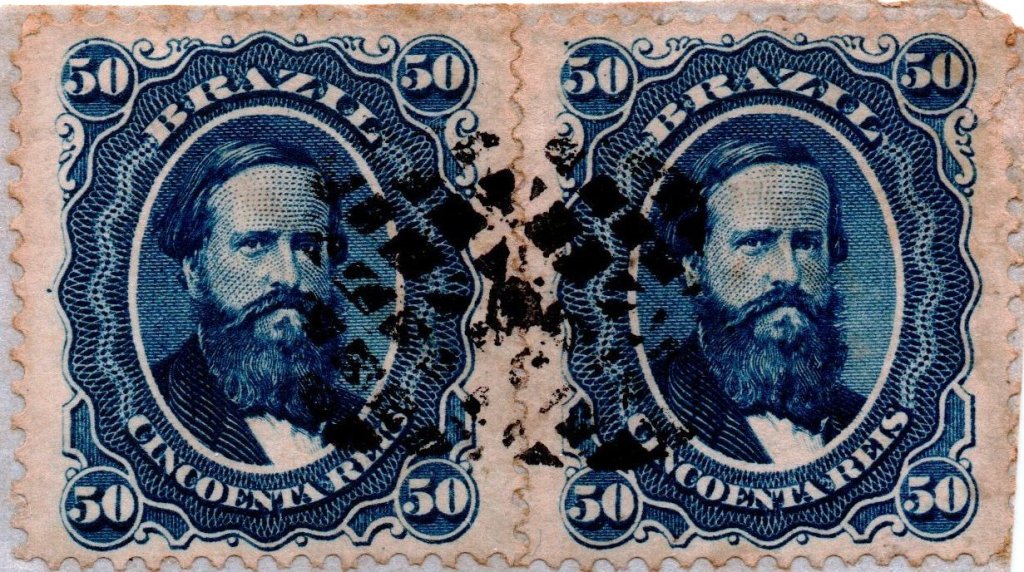
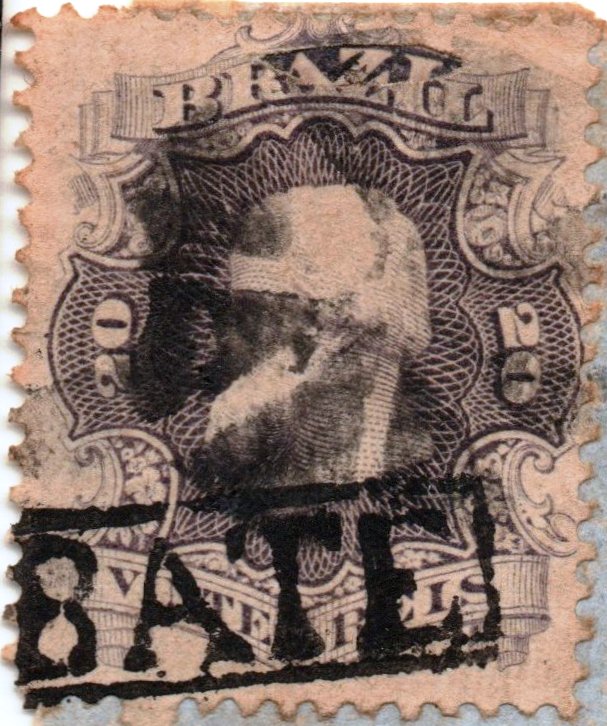
Two other mute cancels come from the José A. Junges collection, both on D. Pedro issues from 1866:
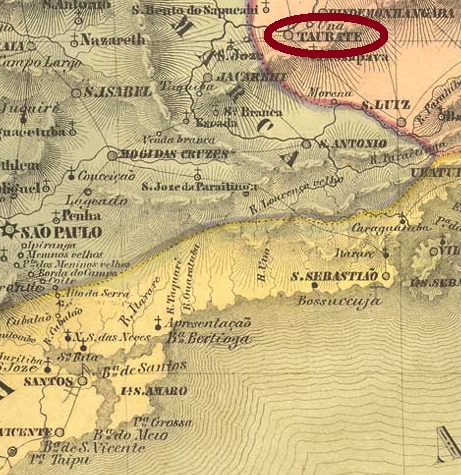
Diese alte Ortschaft war im Dezember 1645 die durch königliche Verfügung (Provisão Real) ernannte Freguesia von São Francisco das Chagas de Taubaté, die am Südufer des Flusses Parahyba do Sul lag, 130 km nordöstlich der künftigen Provinzhauptstadt São Paulo entfernt. Angeblich soll auch im Dezember 1645 der Aufstieg zur Vila stattgefunden haben, was eher ungewöhnlich wäre. Seit Februar 1842 ist Taubaté eine Stadt. Der indianische Name bedeutet Dorf auf der Anhöhe.
Wie Nova Monteiro in Administrações e Agencias Postaes do Brasil Imperio (in Brasil Filatelico/RJ, 1934-5; Reprint SPP 1994-1999) schreibt, gab es dort ein Postamt seit Mai 1828. Der Prephila-Poststempel von dort ist TSP-1420a, er war bis ca. 1841 in Gebrauch und wurde bereits im RHM-Katalog unter P-SP-57 vorgestellt. Allerdings gibt es kleine Abweichungen zwischen der Katalog-Abbildung und den tatsächlichen Stempelexemplaren:

Danach kam der siegelähnliche TSP-1420b, der durch Paulo Ayres in Catálogo de Carimbos Brasil-Império (S. Paulo, 1937, 1942) unter Nr. 30/1942 vorgestellt wurde und zwischen 1842 und mindestens 1844 verwendet wurde:
Die folgenden fünf Ortsstempel waren auch in Paulo Ayres (op. cit.) zu sehen. TSP-1420c ist P.A. 1512. Ihn gibt es auch in Rot, und er war zwischen ca. 1850 bis mindestens 1876 in Gebrauch.
Bei TSP-1420d gibt es ebenfalls kleine Unterschiede zwischen der P. Ayres Abbildung Nr.1551 und den gefundenen Beispielen:
Der französischer Typus TSP-1420e steht auf P. Ayres auf S. 118 und kommt auch in Rot vor:

Etwa im gleichen Zeitraum wurde TSP-1420f – auch in lila – verwendet, die Nr. 1180 bei P. Ayres:
TSP-1420g (P.Ayres 1680) war für Einschreibsendungen bestimmt:
Dann war noch TSP-1420h (Samml. José A. Junges) zwischen 1880 und 1895 in Gebrauch: ein schlichter Doppelkreis mit der Inschrift TAUBATÉ oben.
Drei stumme Entwertungen aus Taubaté sind in Mute Cancellations of the Brazil Empire / Carimbos Mudos do Brasil Império, (Brazil Philatelic Association, Rio de Janeiro, 2000) von J.A. Dingler und K.W. Lopes unter den Nr. 110, 612 und 1318 aufgelistet:
Zwei weitere stumme Stempel kommen aus der Sammlung José A. Junges, beide auf D. Pedro-Briefmarken aus 1866:

 Carimbologia