Text update of May 24, 2022
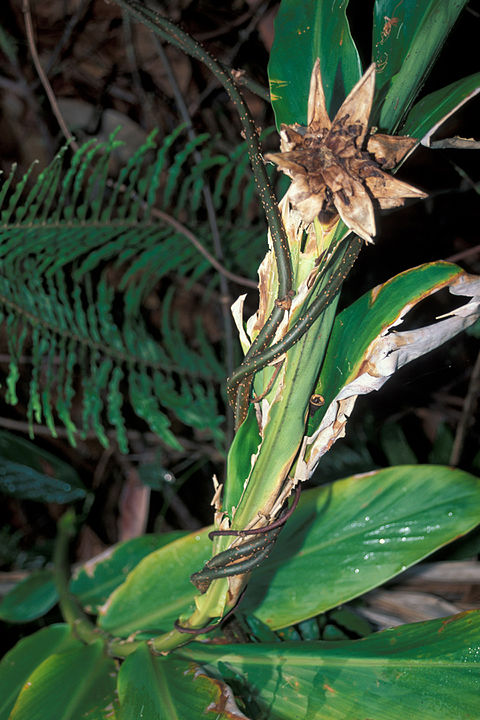
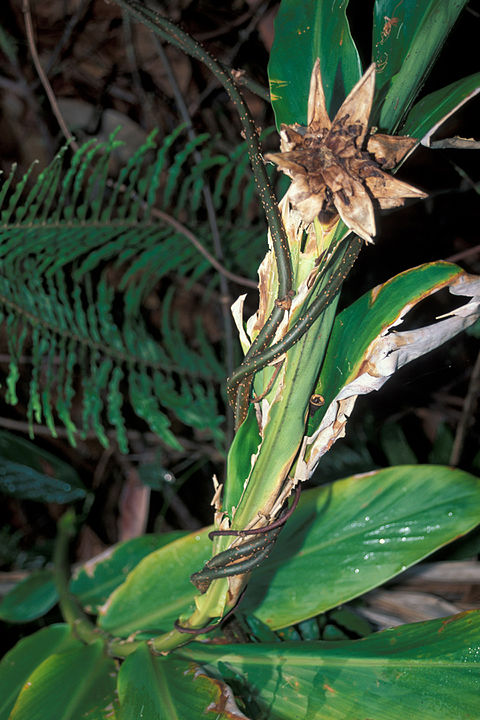
Timbó is the generic Indian name for many liana varieties in Brazil, which were used as anaesthetics for fishing due to their toxic ingredients:
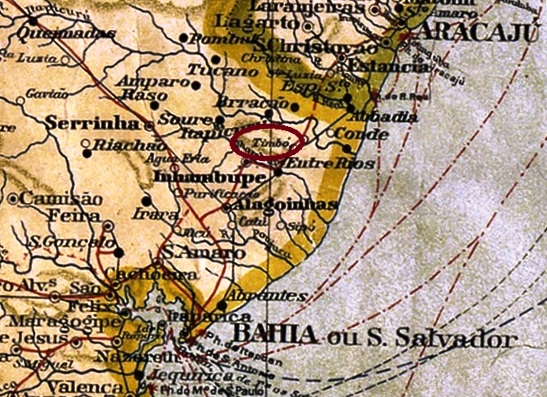
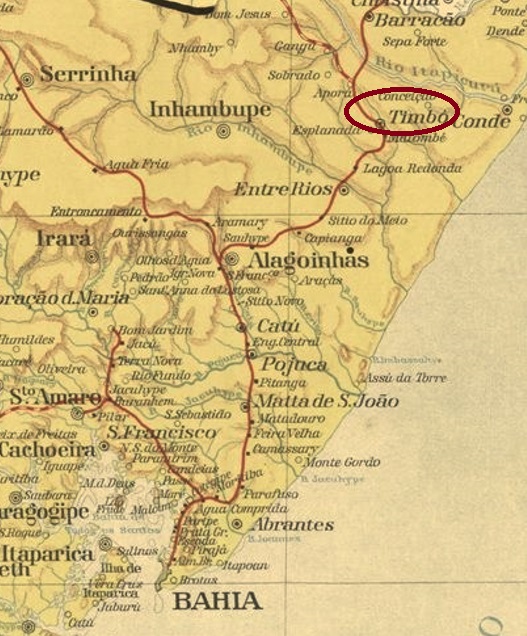
The Arraial of Timbó was a small settlement that emerged around 1850 and was located in the Município of Vila do Conde, over 160 km north of the provincial capital Salvador da Bahia. After the construction of the E.F. da Bahia ao São Francisco railway company towards the end of the Empire, the village grew rapidly, as it was initially located at the end of the rail line. However, with the decline of the railway, it soon shrank again and is now a suburb in the Município of Esplanada.
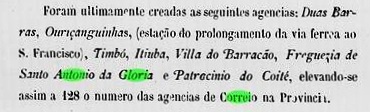
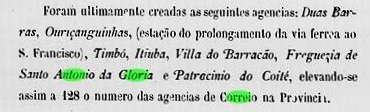
The local post office was established around the turn of the year 1876-77, according to the provincial president’s report for 1877:
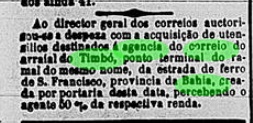
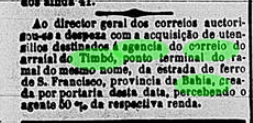
The railway station, inaugurated at the end of March 1887, probably caused a move of the postal agency from the centre of the village to the rails, as can be deduced from a Rio press release:
Three early postmarks were found, all with dates from the Republic. TBA-0735a (Coll. Luis C. Fritzen) is a plain double circle with the inscription TIMBÓ at the top. One copy was seen, dated 1890 in the centre. TBA-0736a (Coll.. FM) is a rectangular box stamp for ambulant mail, with the inscription AMB. TIMBÓ, found on stamps of the Southern Cross issue (1890ff). TBA-0735b (image from the Internet) is a double circle with the inscriptions TIMBÓ above and (BAHIA) below. The only specimen so far bears a date from 1902 in the centre.
Textaktualisierung vom 24.05.2022
Timbó ist der allgemeine indianische Name für viele Lianensorten in Brasilien, die durch ihre giftigen Inhaltsstoffe als Betäubungsmittel für Fische verwendet wurden:
Der Arraial von Timbó war eine kleine Siedlung, die um 1850 entstanden ist und im Município von Vila do Conde lag, über 160 km nördlich von der Provinzhauptstadt Salvador da Bahia entfernt. Nach dem Bau der E.F. da Bahia ao São Francisco Eisenbahngesellschaft gegen Ende des Kaiserreichs wuchs der Ort schnell, da er zunächst am Ende der Bahnstrecke lag. Mit dem Niedergang des Bahnbetriebs schrumpfte er aber auch bald wieder und ist heute ein Vorort im Município von Esplanada.
Das örtliche Postamt wurde um die Jahreswende 1876-77 ins Leben gerufen, wie der Bericht des Provinzpräsidenten für 1877 mitteilt:
Der am Ende März 1887 eingeweihte Bahnhof verursachte wohl einen Umzug der Postagentur aus der Ortsmitte zu den Schienen, wie man aus der Rio-Presse entnehmen kann:
Drei frühe Poststempel wurden gefunden, alle mit Daten aus der Republik. TBA-0735a (Samml. Luis C. Fritzen) ist ein schlichter Doppelkreis mit der Inschrift TIMBÓ oben. Ein Exemplar gesehen, datiert 1890 in der Mitte. TBA-0736a (Samml. FM) ist ein rechteckiger Kastenstempel für den ambulanten Postbetrieb, mit der Inschrift AMB. TIMBÓ, gefunden auf Marken der Ausgabe Kreuz des Südens (1890ff). TBA-0735b (Abb. aus dem Internet) ist ein Doppelkreis mit den Inschriften TIMBÓ oben und (BAHIA) unten. Das bisher einzige Exemplar trägt ein Datum aus 1902 in der Mitte.

 Carimbologia