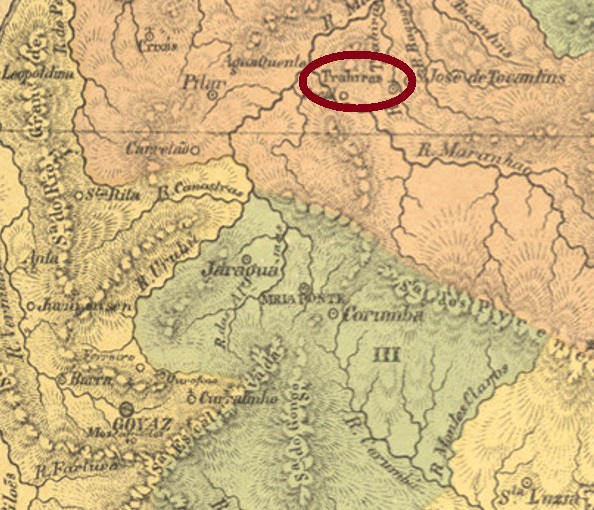
Another name: Tupiraçaba (1943)
Traíra is the common folk term for the South American tiger tetra (Hoplias malabaricus, Bloch 1794), which is popularly fished and eaten throughout the continent:

Trahiras was also the name of the village founded by gold miners, which was elevated to a villa as early as around 1740 and was located on the west bank of the Traíras River, 340 km northeast of the provincial capital Goyaz (today Goiás Velho). When precious metal could no longer be found, the village shrank from 18,000 to about 1000 inhabitants. It became a district of São José de Tocantins in April 1833 and changed to the newly founded Município of Niquelândia in December 1943 under the toponym Tupiraçaba. Tupiraçaba had only about 120 inhabitants around 2007.
Two periods of operation have been identified for the local post office. The first was from March 1829, as Nova Monteiro writes in Administrações e Agencias Postaes do Brasil Imperio (Brasil Filatelico/RJ, 1934-5; Reprint SPP 1994-1999). This first period ended in January 1851, as reported by Aureo G. Santos in Agências de Correio Criadas e Suprimidas 1851, 1855, 1856 e 1857 (in Brasil Filatélico 181, Rio de Janeiro, 1977):

Of the second period of operation, we only know that it went from about 1855 to before 1875. Unfortunately, no imperial postmark from this locality has been seen so far.
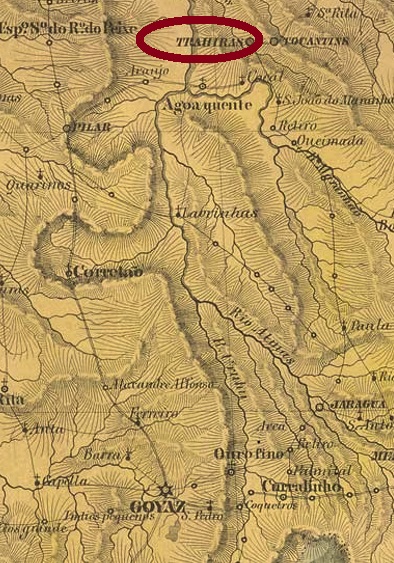
Anderer Name: Tupiraçaba (1943)
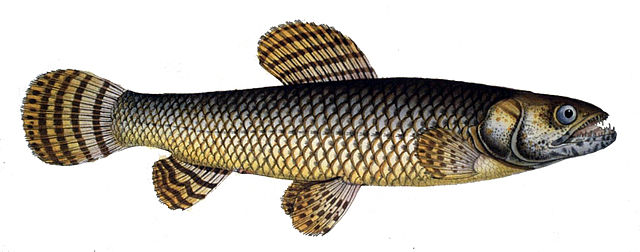
Traíra ist der allgemeine Volksbegriff für den südamerikanischer Tigersalmler (Hoplias malabaricus, Bloch 1794), der gern im ganzen Kontinent geangelt und gegessen wird:
Trahiras hieß auch die von Goldgräbern gegründete Ortschaft, die bereits um ca. 1740 zur Villa erhoben wurde und am Westufer des Flusses Traíras lag, 340 km nordöstlich der Provinzhauptstadt Goyaz (heute Goiás Velho) entfernt. Als dann kein Edelmetall mehr zu finden war, schrumpfte der Ort von 18.000 zu ca. 1000 Einwohnern. Er wurde im April 1833 ein Distrikt von São José de Tocantins und wechselte im Dezember 1943 unter dem Ortsnamen Tupiraçaba zum neu gegründeten Município von Niquelândia. Tupiraçaba zählte um 2007 lediglich ca. 120 Einwohner.
Es wurden zwei Betriebsperioden fürs örtliche Postamt ermittelt. Erstmals ab März 1829, wie Nova Monteiro in Administrações e Agencias Postaes do Brasil Imperio (Brasil Filatelico/RJ, 1934-5; Reprint SPP 1994-1999) schreibt. Diese erste Periode endete im Januar 1851, wie Aureo G. Santos in Agências de Correio Criadas e Suprimidas 1851, 1855, 1856 e 1857, (in Brasil Filatélico 181, Rio de Janeiro, 1977) berichtet:

Von der zweiten Betriebsperiode wissen wir nur, dass sie von ca. 1855 bis vor 1875 ging. Bisher wurde leider kein kaiserlicher Poststempel aus dieser Ortschaft gesehen.

 Carimbologia