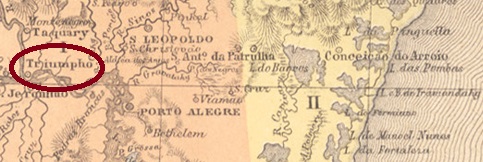
The southernmost Triumpho in imperial Brazil was already a freguesia from October 1754, located barely 80 km west of the later provincial capital Porto Alegre. In October 1831, it became a villa in its own município.
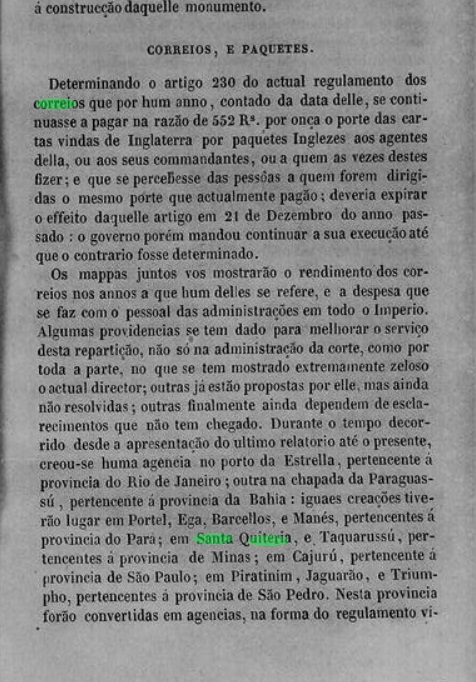
Two foundation dates for the local post office were found. First in October 1831, as Nova Monteiro writes in Administrações e Agencias Postaes do Brasil Imperio (in Brasil Filatelico/RJ, 1934-5; reprint SPP 1994-1999). Then in 1846, immediately after the Farroupilha uprising had ended, as can be read in the 1846 Annual Report:
Two postmarks in the double circle from the Empire have been registered, unfortunately not the oldest. TRS-0465b (Coll. José A. Junges) has the inscription TRIUMPHO at the top and an (I) at the bottom. The dates in the middle are from the period 1877-1888. Its successor TRS-0465c (Coll. José A. Junges) has the same inscription at the top, but at the bottom there is now an ornament in lozenge, formed by four small lozenges. Inner dates go from 1880 to 1889.
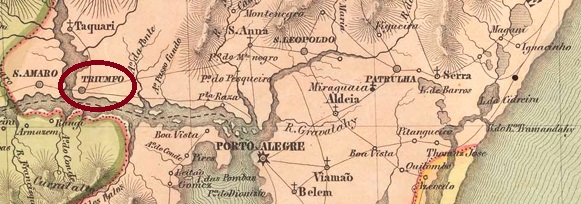
Der südlichste Triumpho im kaiserlichen Brasilien war bereits ab Oktober 1754 eine Freguesia, die knapp 80 km westlich der späteren Provinzhauptstadt Porto Alegre lag. Im Oktober 1831 erfolgte dann der Aufstieg zur Villa im eigenen Município.
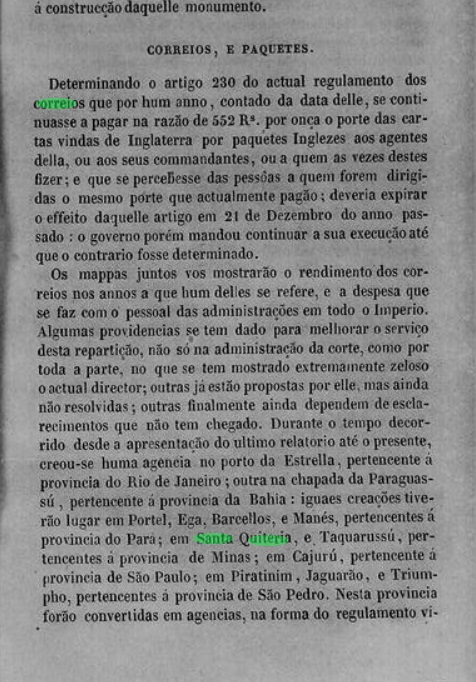
Zwei Gründungsdaten fürs örtliche Postamt wurden gefunden. Erstmals im Oktober 1831, wie Nova Monteiro im Administrações e Agencias Postaes do Brasil Imperio (in Brasil Filatelico/RJ, 1934-5; Reprint SPP 1994-1999) schreibt. Dann 1846, unmittelbar nach Beendigung des Farroupilha-Aufstands, wie im Jahresbericht 1846 zu lesen ist:
Zwei Poststempel im Doppelkreis aus dem Kaiserreich sind erfasst worden, leider nicht der älteste. TRS-0465b (Samml. José A. Junges) hat oben die Inschrift TRIUMPHO und unten steht eine (I). Die Daten in der Mitte entstammen dem Zeitraum 1877-1888. Sein Nachfolger TRS-0465c (Samml. José A. Junges) hat oben die gleiche Inschrift, unten ist nun ein Ornament in Raute zu sehen, das aus vier kleinen Rauten gebildet wird. Innere Daten von 1880 bis 1889.

 Carimbologia