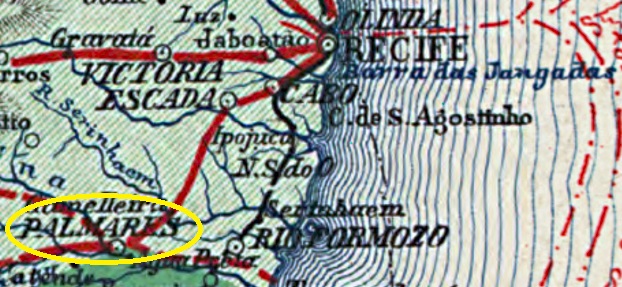
See also Palmares/PE in R. Koester: Carimbologia XXIX
Trombetas (“trumpets”) was the name of an Indian tribe that was still in this region around 1800, 120 km southwest of Recife. An Engenho (large sugar cane plantation) was named after these Indians, which was established a few decades later close to the settlement of Montes. Around this engenho, another settlement grew amazingly fast, due to the construction of the Una railway station in 1862 by the E.F. Recife ao São Francisco railway company and also due to blacks who had arrived, probably from the Palmares quilombo region in neighbouring Alagoas.
In May 1868, the village became a district called Palmares, which was then in the município of Água Preta. Five years later, the ascent to Villa was celebrated, and it only took another 6 years for Palmares to become a city. By the end of 1890, the town is said to have had over 25 thousand inhabitants.
The local post office came into being in September 1866, as Nova Monteiro writes in Administrações e Agencias Postaes do Brasil Imperio (in Brasil Filatelico/RJ, 1934-5; reprint SPP 1994-1999). The year is confirmed by the Directory of Imperial Post Offices (Tabella das Agencias do Correio do Imperio, Rio de Janeiro, 1885) under Palmares. However, in 1866 the town – and probably also this agency – was still called Trombetas. This name can be read in the regional press until at least 1869. The Una station – which had an own post office since 1864 – was renamed Palmares between 1875 and 1879, also because another Una locality had been created near Rio Formoso (UPE-0730, post office since 1877).
No Trombetas postmark has been found so far. For town postmarks with PALMARES see Koester, Carimbologia XXIX.
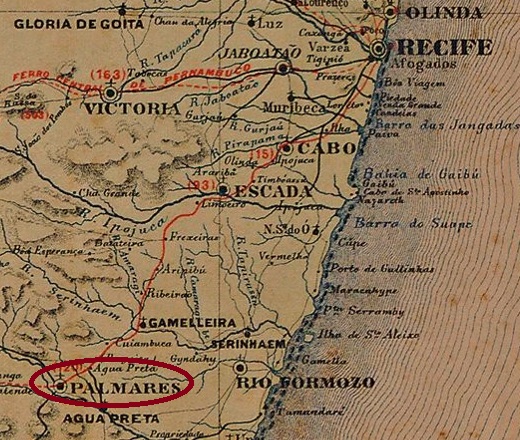
Siehe auch Palmares/PE in R. Koester: Carimbologia XXIX
Trombetas („Trompeten“) hieß tatsächlich ein Indianerstamm, der um 1800 noch in dieser Region weilte, 120 km südwestlich von Recife. Nach diesen Indianern wurde auch der Engenho (Zuckerrohr-Großplantage) benannt, der wenige Jahrzehnte später dort nah an der Siedlung Montes entstand. Um diesen Engenho wuchs dann eine weitere Siedlung erstaunlich schnell, bedingt durch den Bau des Bahnhofs Una 1862 durch die E.F. Recife ao São Francisco Bahngesellschaft und auch durch angereiste Schwarze, die wohl aus der Palmares-Quilomboregion im benachbarten Alagoas kamen.
Im Mai 1868 wurde aus dem Dorf ein Distrikt namens Palmares, der nun im Município von Água Preta lag. Fünf Jahre später wurde der Aufstieg zu Villa gefeiert, und weitere 6 Jahre hat es nur gebraucht, bis Palmares eine Stadt wurde. Ende 1890 soll die Stadt bereits über 25 Tausend Einwohner gezählt haben.
Das örtliche Postamt entstand im September 1866, wie Nova Monteiro in Administrações e Agencias Postaes do Brasil Imperio (in Brasil Filatelico/RJ, 1934-5; Reprint SPP 1994-1999) schreibt. Das Jahr wird durch das Verzeichnis der kaiserlichen Postämter (Tabella das Agencias do Correio do Imperio, Rio de Janeiro, 1885) unter Palmares bestätigt. Allerdings hieß 1866 der Ort – und wohl auch diese Agentur – noch Trombetas. Diesen Namen liest man in der Regionalpresse bis mindestens 1869. Der Bahnhof Una hatte ein eigenes Postamt ab 1864 und wurde zwischen 1875 und 1879 zu Palmares umbenannt, auch weil eine weitere Ortschaft Una bei Rio Formoso entstanden war (UPE-0730, Postamt seit 1877). Bisher wurde kein Trombetas-Poststempel gefunden. Für Ortsstempel mit PALMARES siehe Koester, Carimbologia XXIX.

 Carimbologia