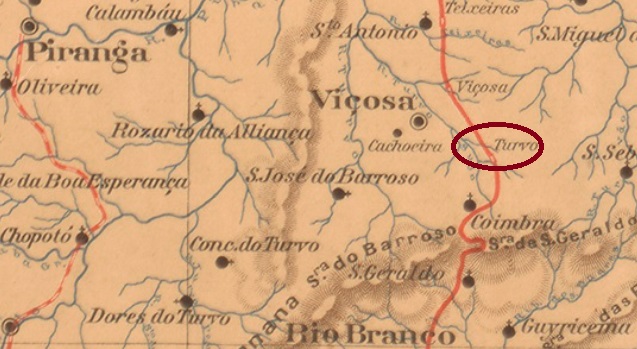
Another name: Est. Cajury (1910)
Turvo station was inaugurated in October 1885 by the E.F. Leopoldina (Caratinga Line) in the Município of Viçosa (formerly Santa Rita do Turvo) and was located on the east bank of the Turvo, 140 km southeast of the provincial capital of Ouro Preto. The railway line became part of the Rede Ferroviária Federal in 1975 until it was closed in 1996. The station building is very well preserved today, and the entire station square is listed as a cultural asset. This is a remarkable exception among Brazilian municipalities (estacoesferroviarias.com.br).
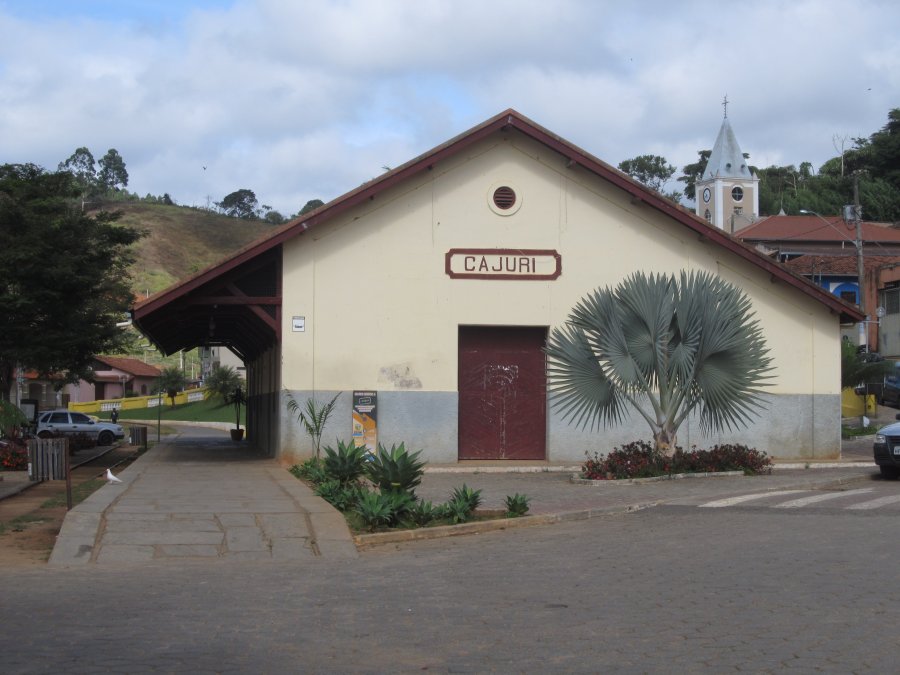
Around the station, the settlement continued to grow and became a district called Cajury in December 1938. Since December 1962, Cajuri (as it is now spelled) has been an independent municipality.
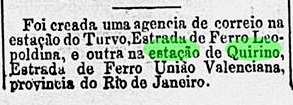
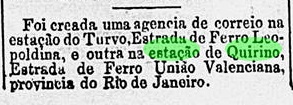
The station post office was created in April 1886, as reported by the Rio press:
The station postmark of the imperial period is TMG-3587a (Coll. José A. Junges): a double circle with the inscriptions ESTM DO TURVO above and (MINAS) below, which also exists in blue. Dates in the centre go from 1886 to 1890.
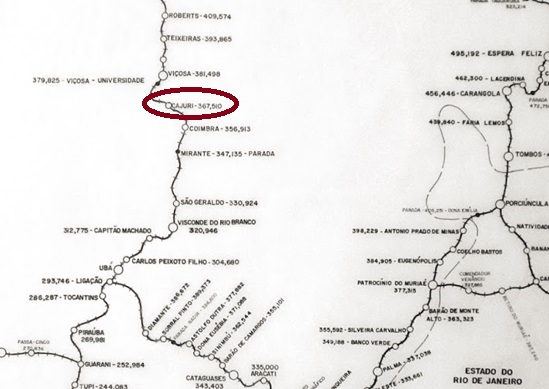
Anderer Name: Est. Cajury (1910)
Der Bahnhof Turvo wurde im Oktober 1885 durch die E.F. Leopoldina (Caratinga-Linie) im Município von Viçosa (ehemals Santa Rita do Turvo) eingeweiht und lag am Ostufer des Turvo, 140 km südöstlich der Provinzhauptstadt Ouro Preto entfernt. Die Bahnlinie ging 1975 zur Rede Ferroviária Federal bis zur Stilllegung 1996. Das Bahnhofsgebäude ist heute sehr gut erhalten, der gesamte Bahnhofsplatz steht als Kulturgut unter Denkmalschutz. Eine vorbildliche Ausnahme unter den Gemeinden Brasiliens (estacoesferroviarias.com.br).

Um den Bahnhof wuchs die Siedlung weiter und wurde im Dezember 1938 zu einem Distrikt namens Cajury. Seit Dezember 1962 ist Cajuri (wie es nun geschrieben wird) eine eigenständige Gemeinde.
Das Bahnhofspostamt existierte ab April 1886, wie die Presse aus Rio berichtete:
Der Bahnhofspoststempel der Kaiserzeit ist TMG-3587a (Samml. José A. Junges): ein Doppelkreis mit den Inschriften ESTM DO TURVO oben und (MINAS) unten, den es auch in blau gibt. Daten in der Mitte von 1886 bis 1890.

 Carimbologia