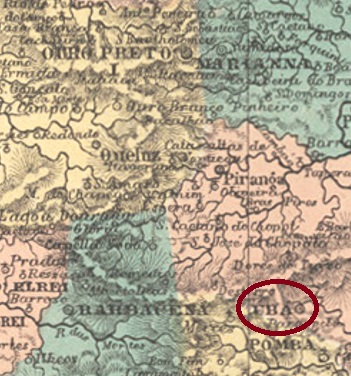
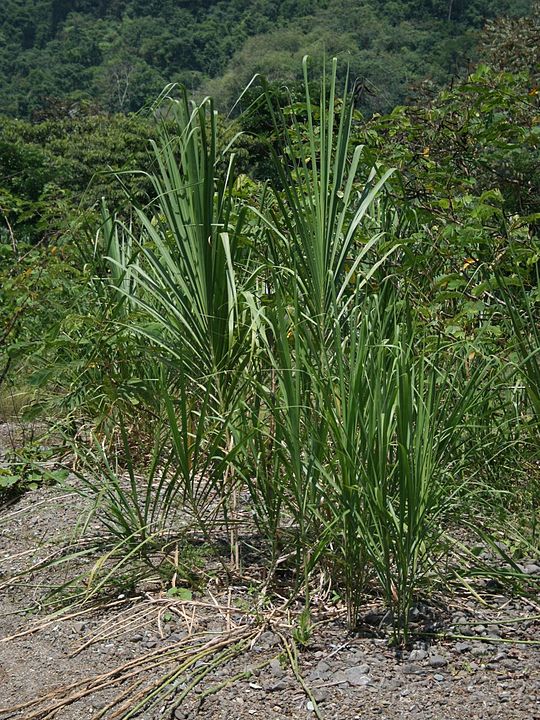
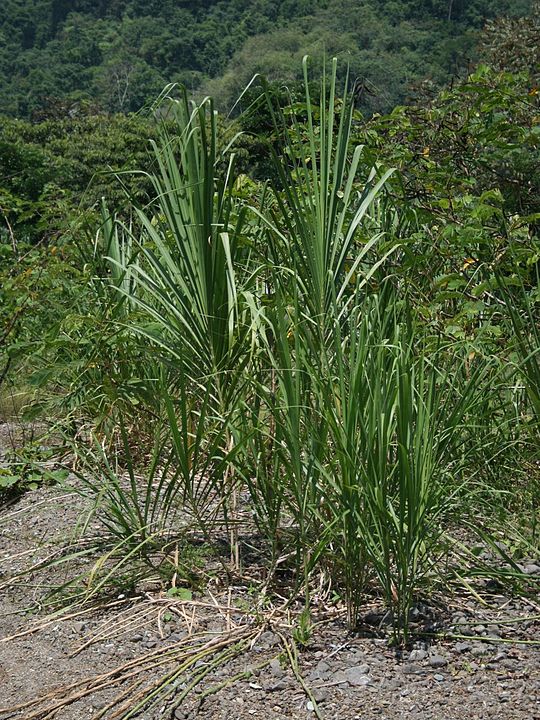
In April 1841, the Arraial (settlement) of São Januário do Ubá was officially founded in the Município of São João Baptista do Presídio. The settlement was located on the north bank of the Ubá Grande River, 160 km southeast of the provincial capital of Ouro Preto. In June 1853 it became a vila, and in July 1857 its name was shortened to Ubá. Between 1868 and March 1871, Ubá was a district of Visconde do Rio Branco. Then it became a vila again, and in July 1875 it was given the status of a town. The name Ubá has Indian origins and means both a canoe made from a single tree trunk and a plant of the family Arundinoidae:
Two dates of origin for the local post office have been found. First in December 1852, as Nova Monteiro writes in Administrações e Agencias Postaes do Brasil Imperio (Brasil Filatelico/RJ, 1934-5; Reprint SPP 1994-1999). Then in April 1854, as Paula Sobrinho claims in História Postal de Minas Gerais (Belo Horizonte, 1997).
The first postmark is UMG-3235a. It also occurs in blue and red and was presented by Paulo Ayres in the Catálogo de Carimbos Brasil-Império (S. Paulo, 1937, 1942) under No. 1517:

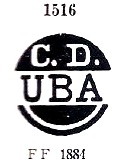
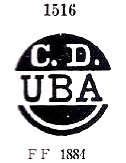
Strangely, it reads that Ubá is a town (CIDE, for cidade), although this did not become true until 1875. It was followed by UMG-3235b, used between ca.1866 and ca.1884, and also made famous by Paulo Ayres (now under no. 1516):
After that came three postmarks as double circles. UMG-3235c (Coll. Fuad Ferreira Fo.) is probably very rare, the only known example of it is dated 1870. Here one reads C. DE UBÁ at the top and MINAS between two crosses at the bottom, while the date is placed in a horizontal stripe. UMG-3235d (Coll. José A. Junges) simply reads UBA at the top and a (C) at the bottom. The dates in the middle go from 1881 to 1883. Finally, UMG-3235e (Coll. José A. Junges) has UBÁ at the top and (MINAS) below, with internal dates from 1887 to 1897.
In addition, three mute cancellations and a handwritten one are known. The former date from the period ca. 1866-1882:
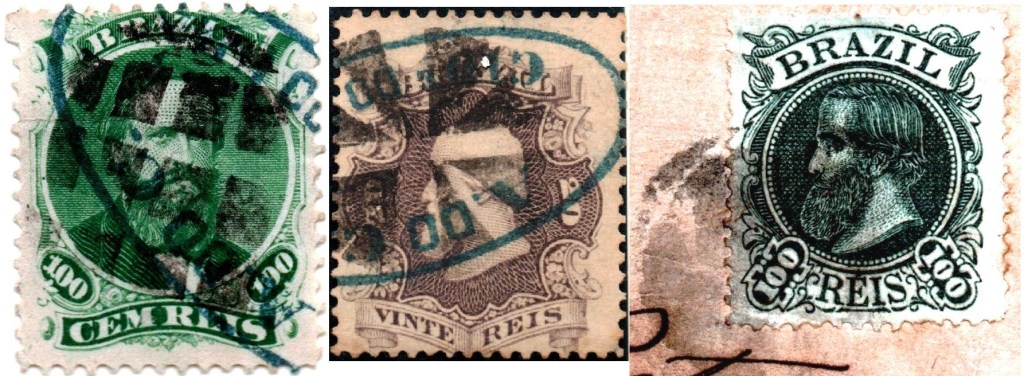
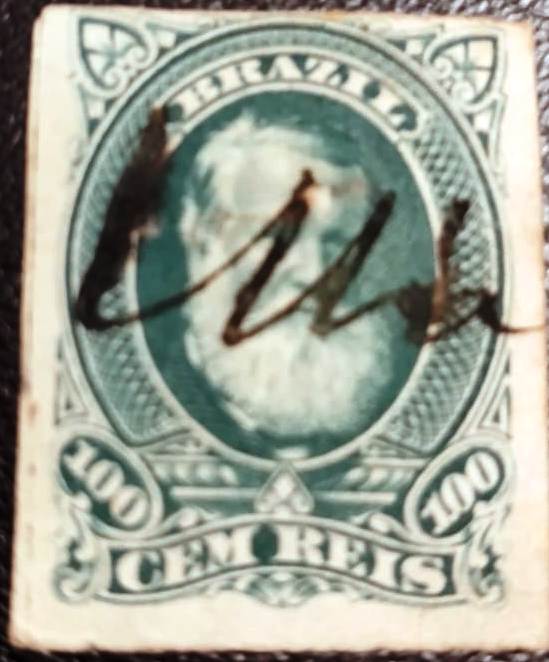
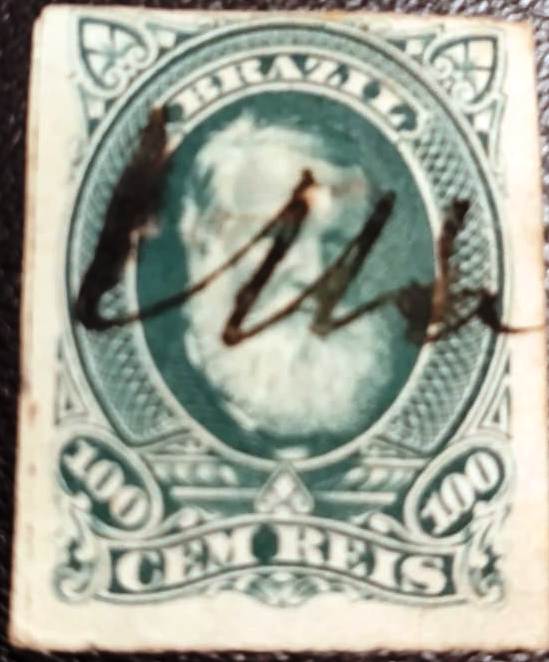
The manuscript cancellation was found on a D. Pedro issue from 1877:
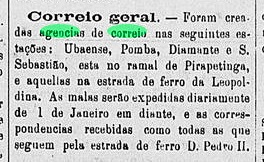
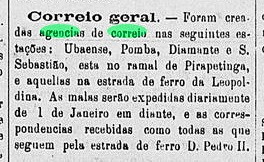
In October 1879, a station of the E.F. Leopoldina railway company, Caratinga Line, was inaugurated in Ubá. This station received its own post office in December 1879, as reported by the Rio press:
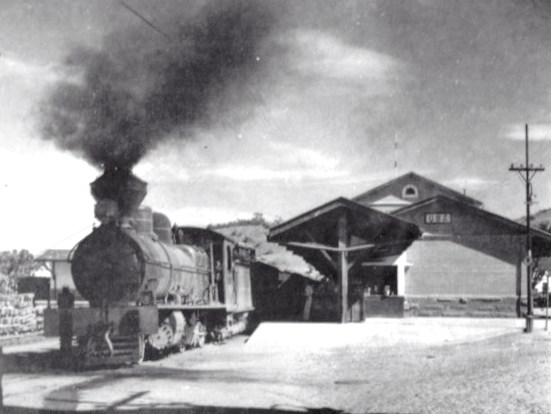
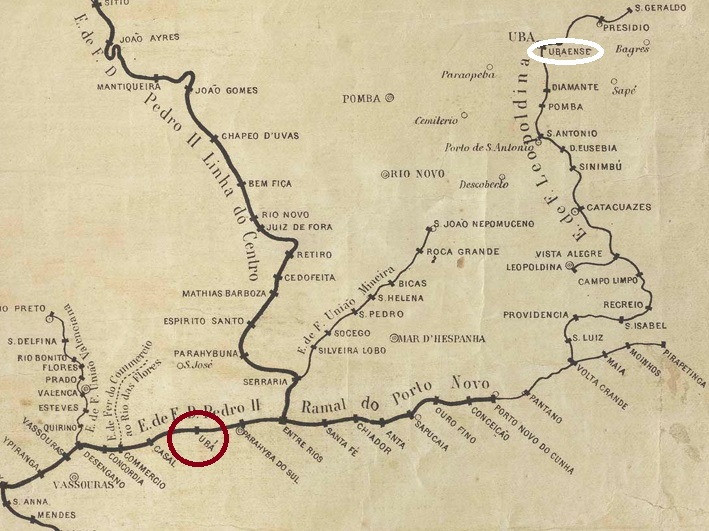
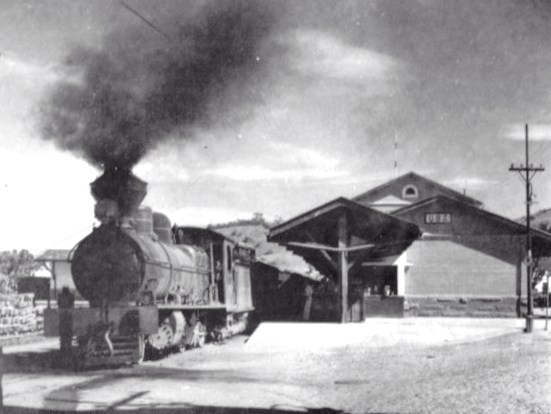
The station was initially called Estação Ubaense, probably to avoid confusion with the Ubá station from Rio province (URJ-1915). However, since no postmark has been seen under Ubaense so far, it may be assumed that the local post office changed to the station at about that time. In 1886, the Ubá station from Rio was renamed Paty, and the name Ubaense for the Minas station disappeared for good. The railway line belonged to Rede Ferroviária Federal S.A. from 1975 until its closure in 1996 (estacoesferroviarias.com.br).
Im April 1841 wurde der Arraial (Siedlung) von São Januário do Ubá im Município von São João Baptista do Presídio offiziell gegründet. Die Ortschaft lag am Nordufer des Flusses Ubá Grande, 160 km südöstlich der Provinzhauptsadt Ouro Preto entfernt. Im Juni 1853 erfolgte der Austieg zur Vila, die im Juli 1857 den Namen zu Ubá verkürzte. Zwischen 1868 und März 1871 war Ubá ein Distrikt von Visconde do Rio Branco. Dann wurde der Ort abermals eine Vila, die im Juli 1875 den Status einer Stadt erhielt. Der Name Ubá hat indianischen Ursprung und bedeutet sowohl ein Kanu, das aus einem einzigen Baumstamm angefertigt wird, als auch eine Pflanze der Familie Arundinoidae:
Zwei Entstehungsdaten fürs örtliche Postamt wurden ermittelt. Erstmals im Dezember 1852, wie Nova Monteiro in Administrações e Agencias Postaes do Brasil Imperio (Brasil Filatelico/RJ, 1934-5; Reprint SPP 1994-1999) schreibt. Dann im April 1854, wie Paula Sobrinho in História Postal de Minas Gerais (Belo Horizonte, 1997) behauptet.
Der erste Poststempel ist UMG-3235a. Er kommt auch in blau und rot vor und wurde von Paulo Ayres im Catálogo de Carimbos Brasil-Império, (S. Paulo, 1937, 1942) unter Nr. 1517 vorgestellt:
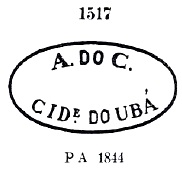
Seltsamerweise liest man darin, dass Ubá eine Stadt (CIDE, für Cidade, Stadt) ist, obwohl dies erst 1875 wahr wurde. Ihm folgte UMG-3235b, der zwischen ca.1866 und ca.1884 im Umlauf war und ebenfalls durch Paulo Ayres (diesmal unter Nr. 1516) bekannt wurde:
Danach kamen drei Poststempel als Doppelkreise. UMG-3235c (Samml. Fuad Ferreira Fo.) dürfte sehr selten sein, das einzige bekannte Exemplar ist aus 1870. Hier liest man C. DE UBÁ oben und MINAS zwischen zwei Kreuzen unten, während das Datum in einem waagerechten Streifen platziert wird. Bei UMG-3235d (Samml. José A. Junges) steht oben lediglich UBA, und unten sieht man ein (C). Die Daten in der Mitte gehen von 1881 bis 1883. Schließlich hat UMG-3235e (Samml. José A. Junges) UBÁ oben und (MINAS) untern, mit inneren Daten von 1887 bis 1897.
Darüber hinaus sind drei stumme und eine handschriftliche Entwertung bekannt. Erstere entstammen dem Zeitraum ca. 1866-1882:
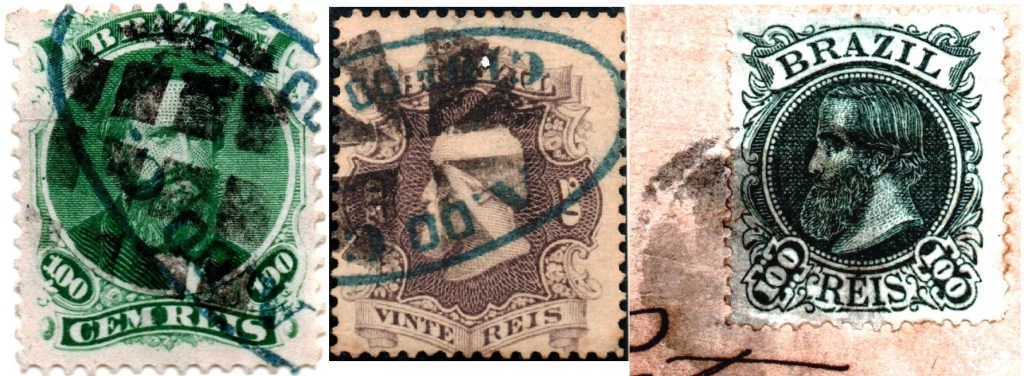
Die handgeschriebene Entwertung wurde auf einer D.-Pedro-Ausgabe aus 1877 gefunden:
Im Oktober 1879 wurde in Ubá ein Bahnhof der E.F. Leopoldina Bahngesellschaft, Caratinga-Linie, eingeweiht. Dieser Bahnhof erhielt im Dezember 1879 ein eigenes Postamt, wie aus der Rio-Presse hervorgeht:
Der Bahnhof wurde zunächst Estação Ubaense genannt, wohl um Verwechslungen mit dem Ubá-Bahnhof aus der Provinz Rio (URJ-1915) zu vermeiden. Da aber bisher kein Poststempel unter Ubaense zu sehen war, darf man annehmen, dass das Ortspostamt etwa zu diesem Zeitpunkt zum Bahnhof wechselte. 1886 wurde dann der Bahnhof Ubá aus Rio nach Paty umbenannt, und der Name Ubaense für den Minas-Bahnhof verschwand endgültig. Die Bahnhlinie gehörte von 1975 bis zur Stilllegung 1996 der Rede Ferroviária Federal S.A. (estacoesferroviarias.com.br).

 Carimbologia