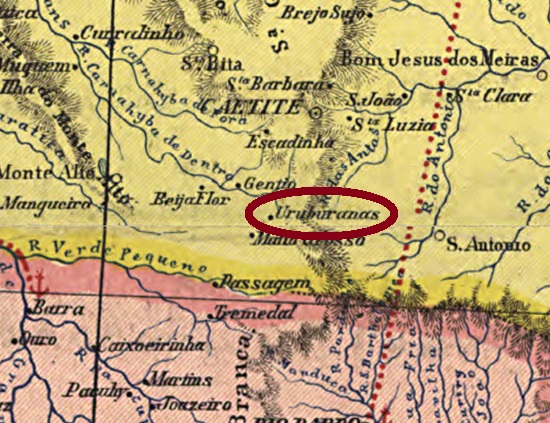
Other names: Villa Bella das Umburanas, Guirapá (1943)
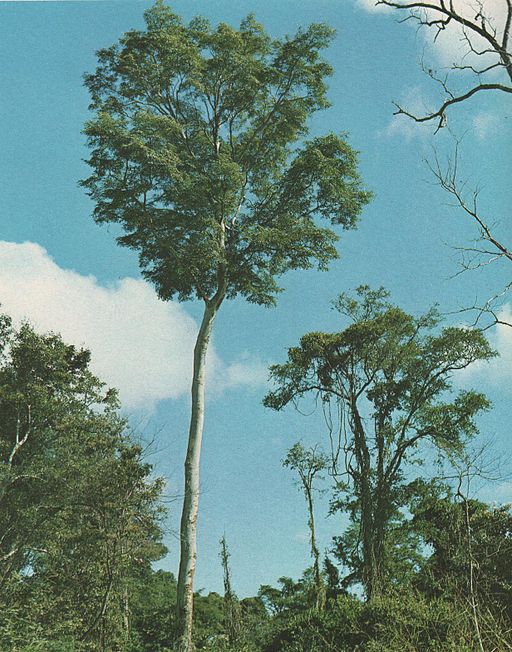
In the imperial province of Bahia there were at least five localities called Umburanas, and when we know how difficult it is to get hold of 19th century postal objects from this area, the assignment of postmarks becomes a difficult task. Umburana, also called amburana or imburana, is the common name for a genus of plants in the Fabaceae family whose bark and seeds have valuable medicinal properties. The wood is also used to make cachaça barrels:
The freguesia of São Sebastião do Amparo das Umburanas was created in July 1877 near Caetités, 700 km southwest of the provincial capital Salvador da Bahia. The village rose to become Villa Bella das Umburanas in July 1889, at a time when the economic decline could not be stopped anymore: in August 1918, Umburanas was demoted to the district of Urandy. In December 1943, the place name changed to the current Guirapá, which has been a district of the Município of Pindaí since February 1962. In the Indian language Tupi-guarani, Guirapá means crooked tree.
Two dates of origin have been found for the local post office. Firstly in 1863, as noted in the Directory of Imperial Post Offices (Tabella das Agencias do Correio do Imperio, Rio de Janeiro, 1885). And finally in August 1883, according to a press release from Rio de Janeiro:

The only imperial postmark so far is certainly not the oldest: UBA-0745b (Coll. José A. Junges) is a plain double circle with the inscription UMBURANAS at the top. The dates in the middle are from the period 1887-1891.
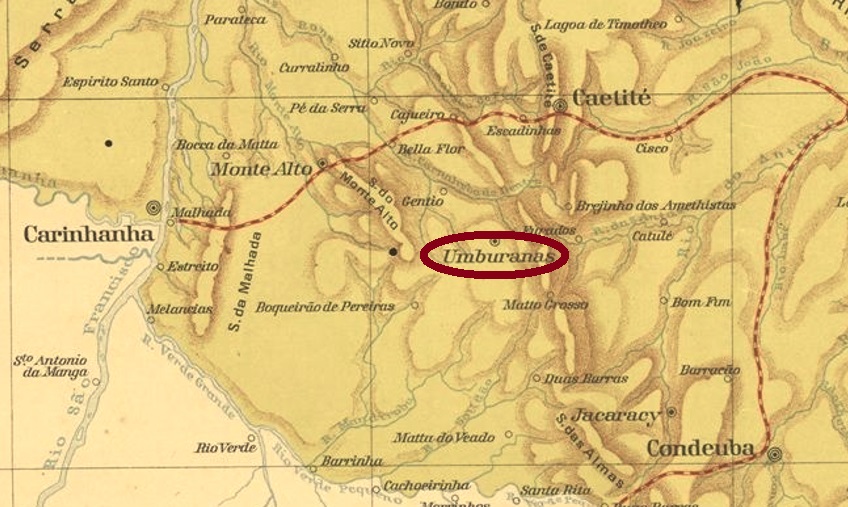
Andere Namen: Villa Bella das Umburanas, Guirapá (1943)
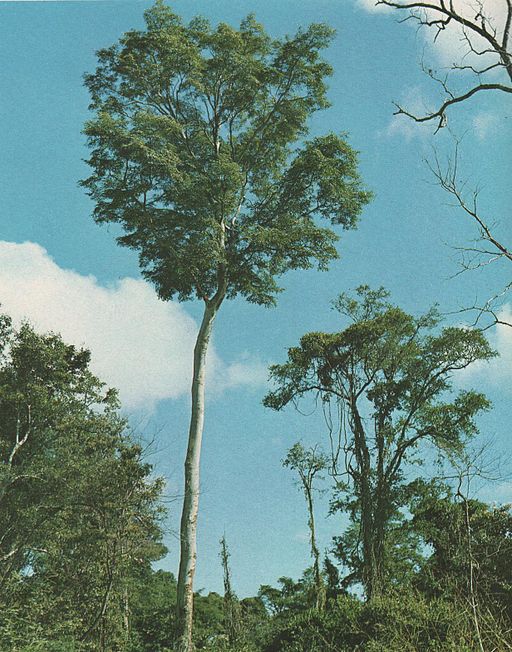
In der kaiserlichen Provinz Bahia gab es mindestens fünf Ortschaften, die Umburanas hießen, und wenn wir wissen, wie schwer man an postalischen Belegen des 19. Jahrhunderts aus dieser Gegend kommt, wird die Zuordnung der Poststempel zu einer schwer lösbaren Aufgabe. Umburana, auch Amburana oder Imburana genannt, ist die allgemeine Bezeichnung für eine Pflanzengattung der Familie Fabaceae, deren Baumrinde und Samen wertvolle medizinische Eigenschaften aufweisen. Das Holz wird auch zur Herstellung von Cachaça-Fässern verwendet:
Die Freguesia von São Sebastião do Amparo das Umburanas entstand im Juli 1877 bei Caetités und lag 700 km südwestlich der Provinzhauptstadt Salvador da Bahia. Der Ort stieg zwar im Juli 1889 zur Villa Bella das Umburanas, als der wirtschaftliche Rückgang der Region nicht mehr aufzuhalten war: im August 1918 war Umburanas zum Distrikt von Urandy degradiert. Im Dezember 1943 wechselte der Ortsname zum aktuellen Guirapá, der seit Februar 1962 ein Distrikt des Município von Pindaí ist. In der Indianersprache Tupi-guarani bedeutet Guirapá krummer Baum.
Zwei Entstehungszeitpunkte wurden fürs örtliche Postamt ermittelt. Erstmals 1863, wie im Verzeichnis der kaiserlichen Postämter (Tabella das Agencias do Correio do Imperio, Rio de Janeiro, 1885) vermerkt. Und schließlich im August 1883, nach einer Pressemitteilung aus Rio de Janeiro:

Der bisher einzige kaiserliche Poststempel ist bestimmt nicht der älteste: UBA-0745b (Samml. José A. Junges) ist ein schlichter Doppelkreis mit der Inschrift UMBURANAS oben. Die Daten in der Mitte entstammen dem Zeitraum 1887-1891.

 Carimbologia