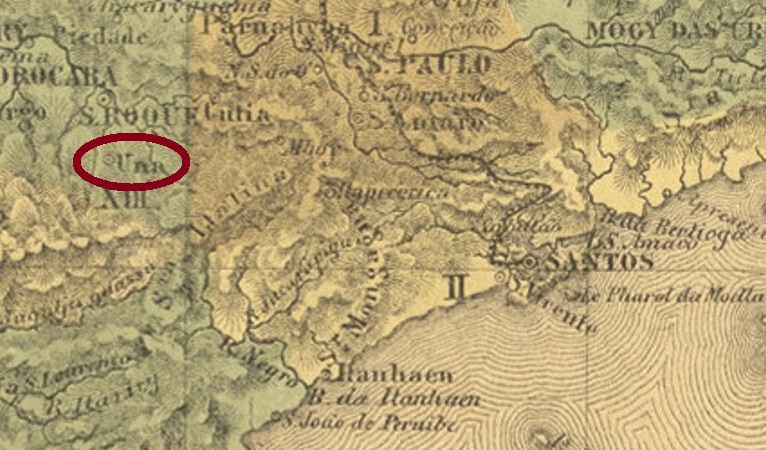
This locality was the freguesia of N. Sa. das Dores do Una from August 1811 and was located near São Roque, 70 km west of the provincial capital of São Paulo. Between February 1846 and May 1850, the district belonged to Sorocaba before returning to São Roque. In March 1857, the ascent to the Villa took place, and since November 1944, this Município has been called Ibiúna. The word from the Tupi-Guarani language means dark earth.
The local post office was created in August 1857, according to Nova Monteiro in Administrações e Agencias Postaes do Brasil Imperio (Brasil Filatelico/RJ, 1934-5; Reprint SPP 1994-1999). This is confirmed by Aureo G. Santos in Agências de Correio Criadas e Suprimidas 1851, 1855, 1856 e 1857 (Brasil Filatélico 181, Rio de Janeiro, 1977):

Three place stamps were used in the imperial period, which show great similarity among themselves. First USP-1450a (Coll. José A. Junges), which was in circulation between 1857 and 1863: a square with rounded corners showing UNA inside. It was followed by USP-1451b (Coll. José A. Junges), which can only be distinguished from its predecessor by the dot after the A. It is also found in red. It also appears in red and was found between about 1866 and after 1883.
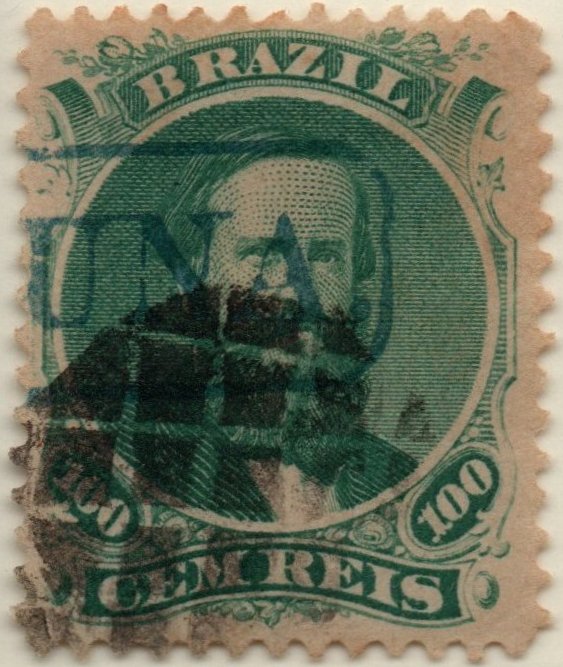
The third town cancel USP-1450c also exists in blue and was already made known by Paulo Ayres under no. 1521. Here the comparison with USP-1450a:

A mute cancellation from Una in São Paulo was found in the collection José A. Junges:
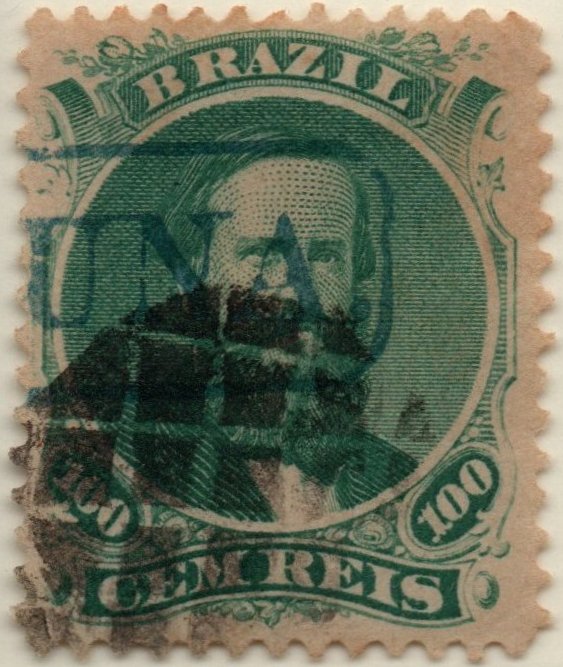
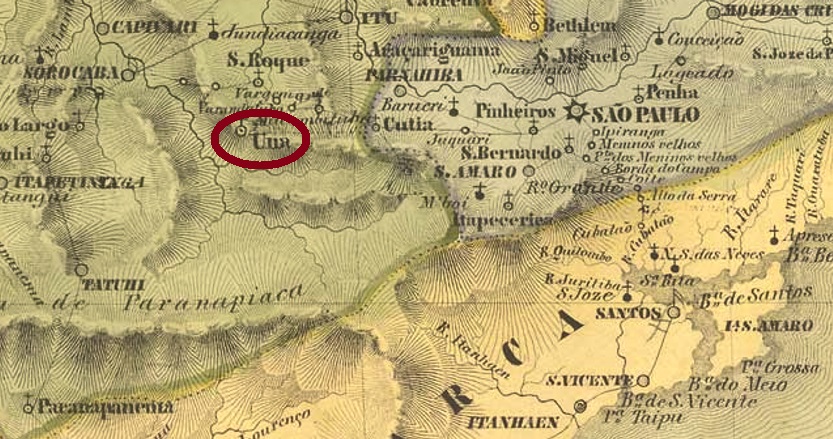
Diese Ortschaft war ab August 1811 die Freguesia von N. Sa. das Dores do Una und lag bei São Roque, 70 km westlich der Provinzhauptstadt São Paulo entfernt. Zwischen Februar 1846 und Mai 1850 gehörte der Distrikt zu Sorocaba, bevor er zu São Roque zurückkehrte. Im Marz 1857 fand der Aufstieg zur Villa statt, und seit November 1944 heißt dieser Município Ibiúna. Das Wort aus der Tupi-Guarani-Sprache bedeutet dunkle Erde.
Das örtliche Postamt wurde im August 1857 ins Leben gerufen, wie Nova Monteiro in Administrações e Agencias Postaes do Brasil Imperio (Brasil Filatelico/RJ, 1934-5; Reprint SPP 1994-1999) schreibt. Dies wird bestätigt durch Aureo G. Santos in Agências de Correio Criadas e Suprimidas 1851, 1855, 1856 e 1857 (Brasil Filatélico 181, Rio de Janeiro, 1977):

Drei Ortsstempel wurden in der Kaiserzeit verwendet, die untereinander große Ähnlichkeit aufweisen. Erstmals USP-1450a (Samml. José A. Junges), der zwischen 1857 und 1863 im Umlauf war: ein Viereck mit abgerundeten Ecken, der darinnen UNA zeigt. Ihm folgte USP-1451b (Samml. José A. Junges), der von seinem Vorgänger nur durch den Punkt nach dem A zu unterscheiden ist. Er kommt auch in rot vor und war zwischen ca. 1866 bis nach 1883 zu finden.
Den dritten Ortsstempel USP-1450c gibt es auch in blau und wurde bereits durch Paulo Ayres unter Nr. 1521 bekannt gemacht. Hier der Vergleich mit USP-1450a:

Eine stumme Entwertung aus Una in São Paulo wurde in der Samml. José A. Junges entdeckt:

 Carimbologia