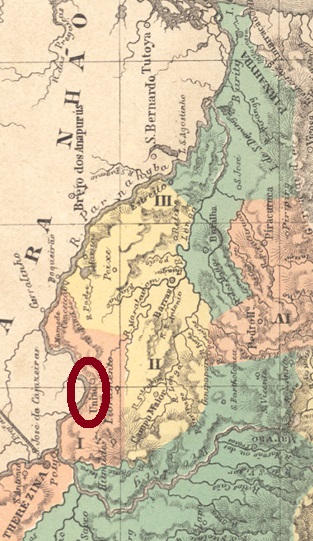
The Freguesia of N. Sa. dos Remedios da União came into being in August 1853 and was located on the east bank of the river Parnaiba, 90 km north of the then newly crowned provincial capital Teresina. Only a month later, it was promoted to a vila, and since December 1889, União has been a town.
Two years of origin for the local post office were found. First in March 1856, as Nova Monteiro writes in Administrações e Agencias Postaes do Brasil Imperio (Brasil Filatelico/RJ, 1934-5; Reprint SPP 1994-1999). Then 1880, as listed in the Directory of Imperial Post Offices (Tabella das Agencias do Correio do Imperio, Rio de Janeiro, 1885). There are also two 19th century local postmarks, the first of which has not yet been definitively confirmed.
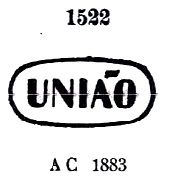
UPI-0170a was already presented by Paulo Ayres in the Catálogo de Carimbos Brasil-Império (S. Paulo, 1937, 1942) under No. 1522, and Cicero A. Almeida assigned it to the province of Piauí in his Carimbos Postais – século XIX (Rio de Janeiro, 1989) under no. MPT 353:
Also from Almeida’s work there comes UPI 0170b, which is then clearly from Piauí:

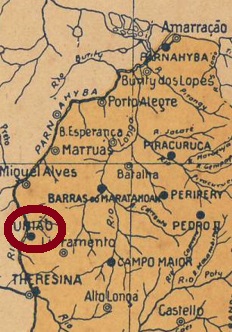
Die Freguesia von N. Sa. dos Remedios da União entstand im August 1853 und lag am Ostufer des Flusse Parnaiba, 90 km nördlich der damals frisch gekürten Provinzhauptstadt Teresina entfernt. Bereits ein Monat später erfolgte der Aufstieg zur Vila, und seit Dezember 1889 ist União eine Stadt.
Zwei Entstehungsjahre fürs örtliche Postamt wurden gefunden. Erstmals im März 1856, wie Nova Monteiro in Administrações e Agencias Postaes do Brasil Imperio (Brasil Filatelico/RJ, 1934-5; Reprint SPP 1994-1999) schreibt. Dann 1880, wie im Verzeichnis der kaiserlichen Postämter (Tabella das Agencias do Correio do Imperio, Rio de Janeiro, 1885) aufgelistet. Ebenfalls zwei Ortsstempel für den 19. Jahrhundert liegen vor, wobei der erste davon noch nicht endgültig bestätigt ist.
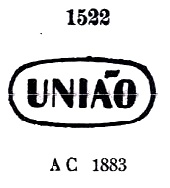
UPI-0170a wurde bereits durch Paulo Ayres im Catálogo de Carimbos Brasil-Império (S. Paulo, 1937, 1942) unter der Nr. 1522 vorgestellt, und Cicero A. Almeida hat ihn der Provinz Piauí in seinem Carimbos Postais – século XIX (Rio de Janeiro, 1989) unter Nr. MPT 353 zugeordnet:
Auch aus Almeidas Werk kommt UPI 0170b, der dann eindeutig aus Piauí zu erkennen ist:


 Carimbologia